


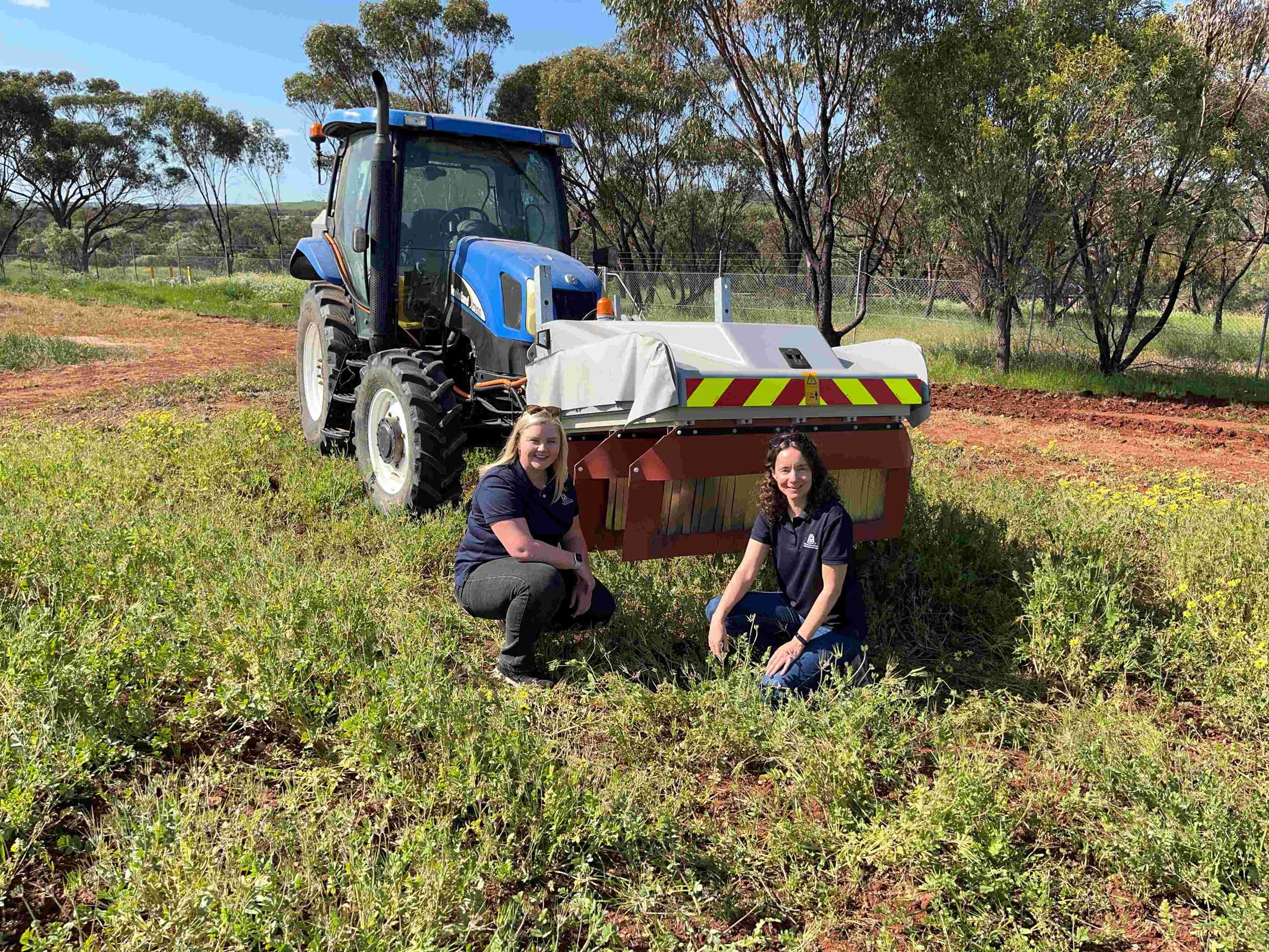
The latest Department of Primary Industries and Regional Development’s (DPIRD) trials of the Zasso XPower electric weed control machine were profiled at the Australian Society of Agronomy conference in Albany today.
The machine uses mechanical power to produce a non-selective high voltage current, which is applied to plants via a series of electrodes mounted behind or in front of the tractor.
The electricity passes through the foliage and roots, causing the cell walls to be destroyed – killing the plant or suppressing growth.
DPIRD collaborated with Case New Holland to test the technology's suitability to Australian agronomy, with support from the Grains Research and Development Corporation, Wine Australia and the Cotton Research and Development Corporation.
In-kind support was also provided by consultants AHA Viticulture and the Western Australian Local Government Association.
DPIRD research scientist Miranda Slaven said field trials at the Muresk Institute, near Northam, showed electric weed control was effective and did not adversely affect the soil’s biological population.
“This research examined the effectiveness of electric weed control on annual ryegrass, L. rigidum, while assessing the effect on soil biology using Rhizoctonia root rot, Rhizoctonia solani, as the indicator species,” she said.
“The treatments included one, two and three sequential applications and an untreated control at the lowest possible speed of 1.4 kilometres per hour to provide the highest possible ‘dose’ of electricity to the grey sandy loam soil.
“The results found there was no negative impact of the applications on the Rhizoctonia fungus, even at slow application speeds to the same site repeated several times.
“The trials also demonstrated electric weed control was effective at managing the population of mature, dense annual ryegrass at low speeds, with plants dying within two to three weeks of application.
“This means electric weed control could offer an alternative option to herbicides – without causing damage to soil biota – despite the comparably slower application speed.”
The department also assessed the suitability of the Zasso XPower machine to control glyphosate resistant annual ryegrass along fence lines, crop topping and inter-row treatment, while also evaluating the fire risk.
Principal research scientist Catherine Borger said the trials showed that while the technology was best suited to small scale weed control, in areas that are difficult to access with conventional machinery, there was scope for more broad scale applications.
“The technology was more effective in controlling broadleaf weeds than grass weeds, although control of mature grasses, like kikuyu, was comparable with that achieved using herbicide,” Dr Borger said.
“Electric weed control of glyphosate resistant annual ryegrass was comparable with herbicide treatments, suggesting the technology has immediate potential for fence line weed control where herbicide use is limited due to native vegetation or water.
“Inter row trials in lupin crops at Wongan Hills and Northam found electric weed control did not affect growth, biomass and yields of the crop.
“This suggests this technology has future potential in broad scale grains applications for inter-row weed control, without damaging the surrounding crops.”
The research also demonstrated that while the winter and spring trials resulted in no fires, electric weed control should not be used in summer or autumn over dry plant residue, which could elevate the sparking risk.
Trial results also reinforced the department’s soil health findings, with results showing no evidence of damage to the soil biota, including bacteria, archaea and fungal soil microbiome communities or free-living nematodes.
More conference information is available from the Agronomy Australia website.
 Print this page
