


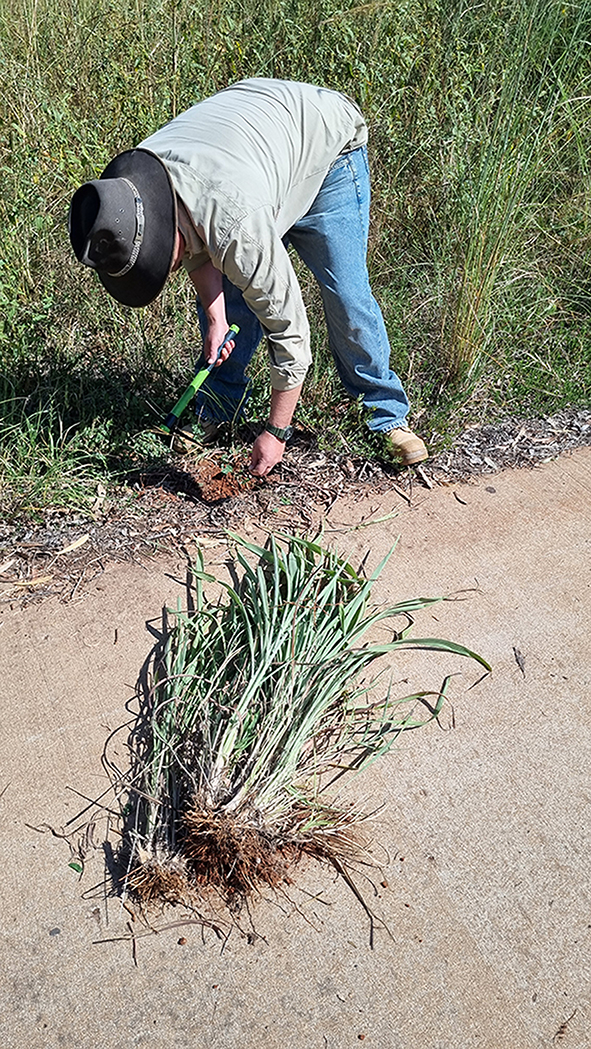
The Broome community is asked to be on the lookout for the invasive weed Gamba grass (Andropogon gayanus) after it was detected in the town for the first time in May.
The weed was discovered on a roadside in the town centre by the Department of Biodiversity Conservation and Attractions (DBCA) and reported to the local Department of Primary Industries and Regional Development (DPIRD).
DPIRD biosecurity officers removed the weed and additional surveillance undertaken in the town centre has found no further detections of the weed to date.
Last year Gamba grass was detected and successfully removed along several roads near Kununurra.
DPIRD senior biosecurity officer Cai Christian said one of the ways Gamba grass seeds could be spread along roadsides was by cars.
“With the busy tourist season underway, and an increase in cars and caravans travelling through from the Northern Territory, it is important for locals and visitors to the area to be biosecurity aware, know what to look for and where to report any potential sightings of the weed,” Mr Christian said.
“We are also working with Wilinggin Aboriginal Corporation, DBCA and the Kimberley Rangelands Biosecurity Association to raise awareness about Gamba grass in the region.”
Gamba grass grows to form tussocks that are bigger, taller and more dense than native grass species capable of growing up to four metres tall and producing hundreds of thousands of seeds each year.
It has strappy leaves that can grow up to 60 centimetres in length, with a distinctive white midrib, which are covered with soft hairs, while fluffy flower heads form on tall stems between April and June, depending on weather conditions.
Left uncontrolled, Gamba grass out competes native grass species and elevates the fire risk in the State’s north, impacting local biodiversity.
The community is asked to report Gamba grass sightings via DPIRD’s MyPestGuide Reporter app or to its Pest and Disease Information Service on 9380 3080 or padis@dpird.wa.gov.au.
