


Background
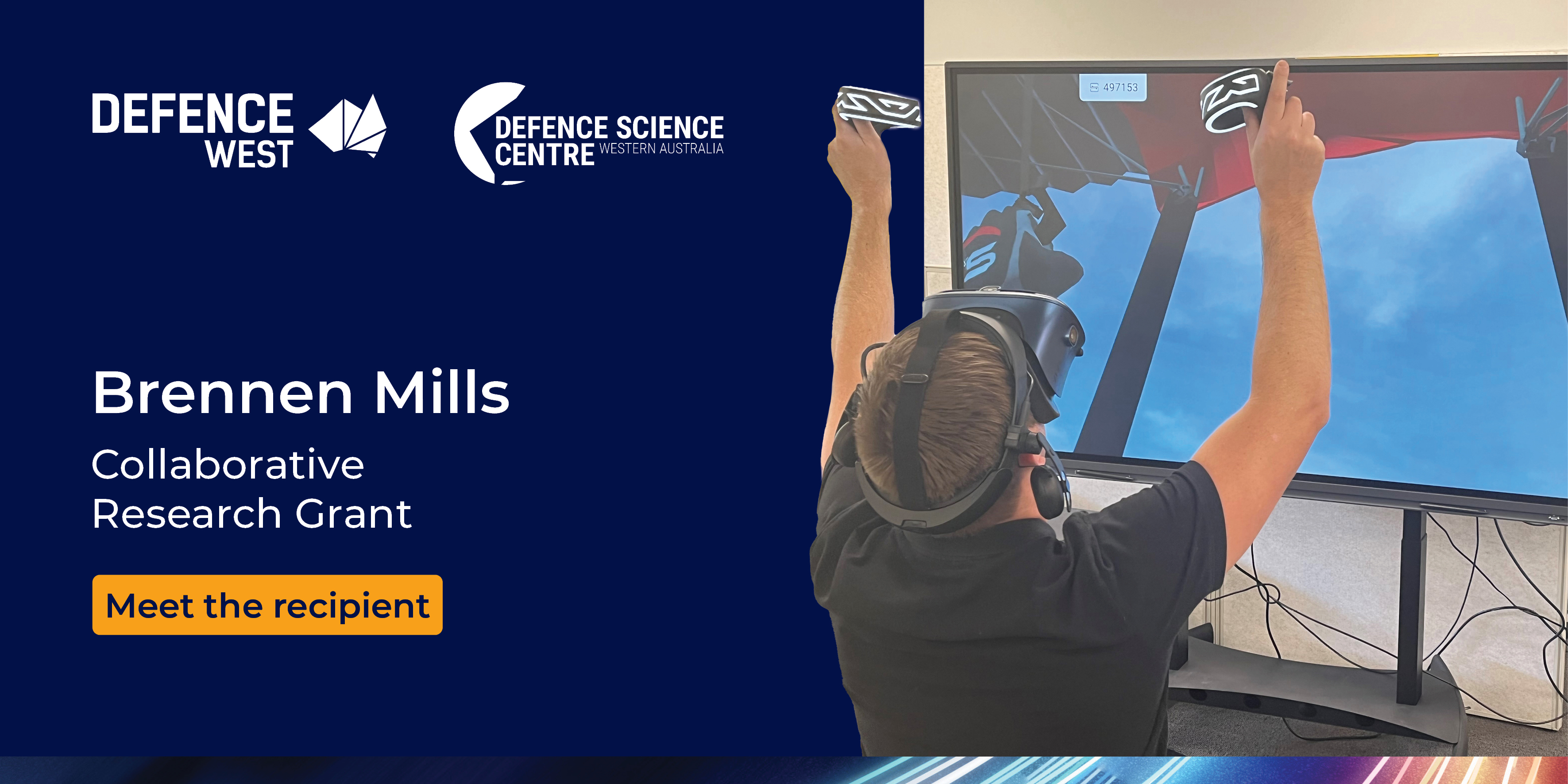
Brennen Mills, Director of the Edith Cowan University Simulation & Immersive Digital Technology Group (SIDTG) is developing a VR-enhanced simulator that will revolutionise standardised parachutist training.
“While knowledge acquisition can occur via traditional training techniques involving training manuals, lectures and procedures practice, experiential learning is limited to actual jumps,” Dr Mills said.
Safe and effective advanced tactical parachute training necessitates repetition-of-practice, this can prove a timely and costly exercise and is often stymied by compressed timeframes and weather conditions.
“Compressed timeframes to complete manoeuvres, as well as imposed jump limits and meteorological conditions severely reduce opportunities to practice. Each of these individual descents may be interrupted by several hours of fitting and checking equipment, emplaning, climbing to altitude, circling for each individual or team to jump and returning to the administration area or drop zone,” said Dr Mills.
Approach
Originally funded in 2021 as a WA-case study, Dr. Mills and his team leveraged their CRG project to secure an additional $198,000 in funding from Defence to expand the project to develop a working VR system.
“The additional funding provided directly from Defence has allowed us to take the system from a concept exploration stage through to a technology demonstration phase,” said Dr. Mills.
The final system would be highly configurable, allowing users to specify the altitude and the bearing of the parachute at canopy opening, as well as wind speed and heading at different altitude intervals.
“The system will recreate a first-person view, visualised and displayed to the user through a virtual reality headset, and allow the user to control a virtual parachute from canopy opening to the point just before the user virtually lands. After the VR experience, the system will allow the user to review their parachute descent,” said Dr Mills.
Outcome
The project, which was co-designed from its inception with Defence and local WA small to medium sized enterprises (SMEs), was completed mid-2023, with a subsequent evaluation project component occurring later in the year.
Dr. Mills notes he has been ‘astounded’ by the expertise and flexibility of the ECU SIDTG development team and is very pleased with how things are progressing.
“The system is well on its way to providing an immersive, interactive, simulated parachute descent under canopy in a virtual version of a real environment,” Dr Mills said.
The DSC, part of the Department of Jobs, Tourism, Science and Innovation, offers support to Western Australian institutions to develop local capabilities and research to find solutions for current and future Defence developments.
Learn more about Defence Science Centre grants programs
 Print this page
