


Background
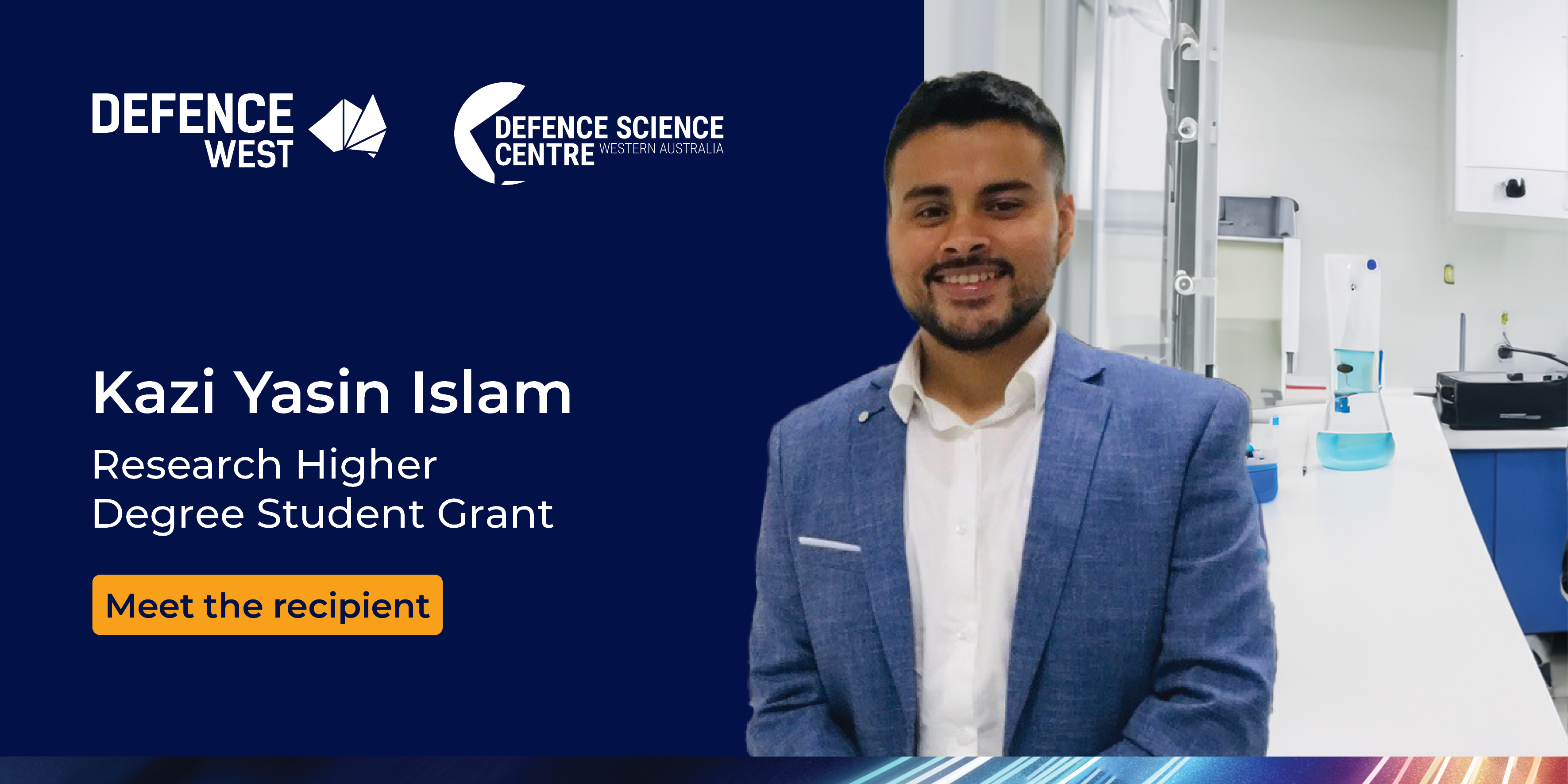
Kazi Yasin Islam, a PhD student from Edith Cowan University, was awarded a $15,000 Research Higher Degree Student Grant in 2020 to investigate the energy efficiency of underwater communications systems.
Following the completion of his project, Kazi has gone from strength to strength, presenting at conferences across Australia, and winning a national science communications competition.
“My research attempts to find the optimum balance between security and energy consumption, where underwater communications can be conducted securely while ensuring the network’s longevity,” Kazi said.
The Defence Science Centre RHDSG provides funding to students working on collaborative Defence relevant projects and/or undertaking defence industry placements as part of their study.
Kazi says his RHDSG project has opened up professional opportunities and helped him understand how his laboratory research can be applied to the real world, including Defence, to make a difference.
Approach
Kazi’s RHDSG project sought to determine if undersea communications systems that combine different communication ‘modes’ can reduce energy consumption and simultaneously improve network throughput for underwater communications.
“Scarcity of energy supply is a major issue in underwater networks used by Defence, industry and civilians, as it is expensive and difficult to recharge or replace batteries once they are deployed underwater.”
The project demonstrated that hybrid, multi-modal physical layer technologies that combine underwater acoustics, optics, and/or magnetic induction, can significantly reduce energy consumption and simultaneously improve network throughput for underwater networks.
“Military applications of the research include diver-to-diver and/or diver-to-surface platform communications, border monitoring and control, underwater reconnaissance and surveillance, and submarine communications,” Kazi said.
Outcome
It is expected that the multi-modal technology will help build next-generation underwater wireless networks, expanding opportunities in undersea exploration in multiple sectors.
“Scientific applications include studies into water properties, aquatic lifeforms, marine ecology, tectonic plate movement, underwater volcanoes, and tsunami dynamics, and the research could also help industry explore oil and gas reservoirs, extract natural resources, and monitor underwater pipelines,” Kazi said.
Kazi has attended multiple forums as part of and following the completion of his RHDSG project, including the 2022 Technology Surprise Forum in Canberra, where he was awarded $10,000 to write a technical paper and present his research and network with potential collaborators from industry, Defence, and academia.
“Some of these networking opportunities have also created possibilities for employment after the completion of my PhD,” Kazi said.
Kazi was also awarded the Vice Chancellor’s Award in the 2022 Pitch it clever science communication competition hosted by Universities Australia.
He competed against 43 academics across Australia and received $3,500 plus professional development opportunities for the top award.
Round 5 of the Research Higher Degree Student Grant is now open. Submit your application now!
 Print this page
