


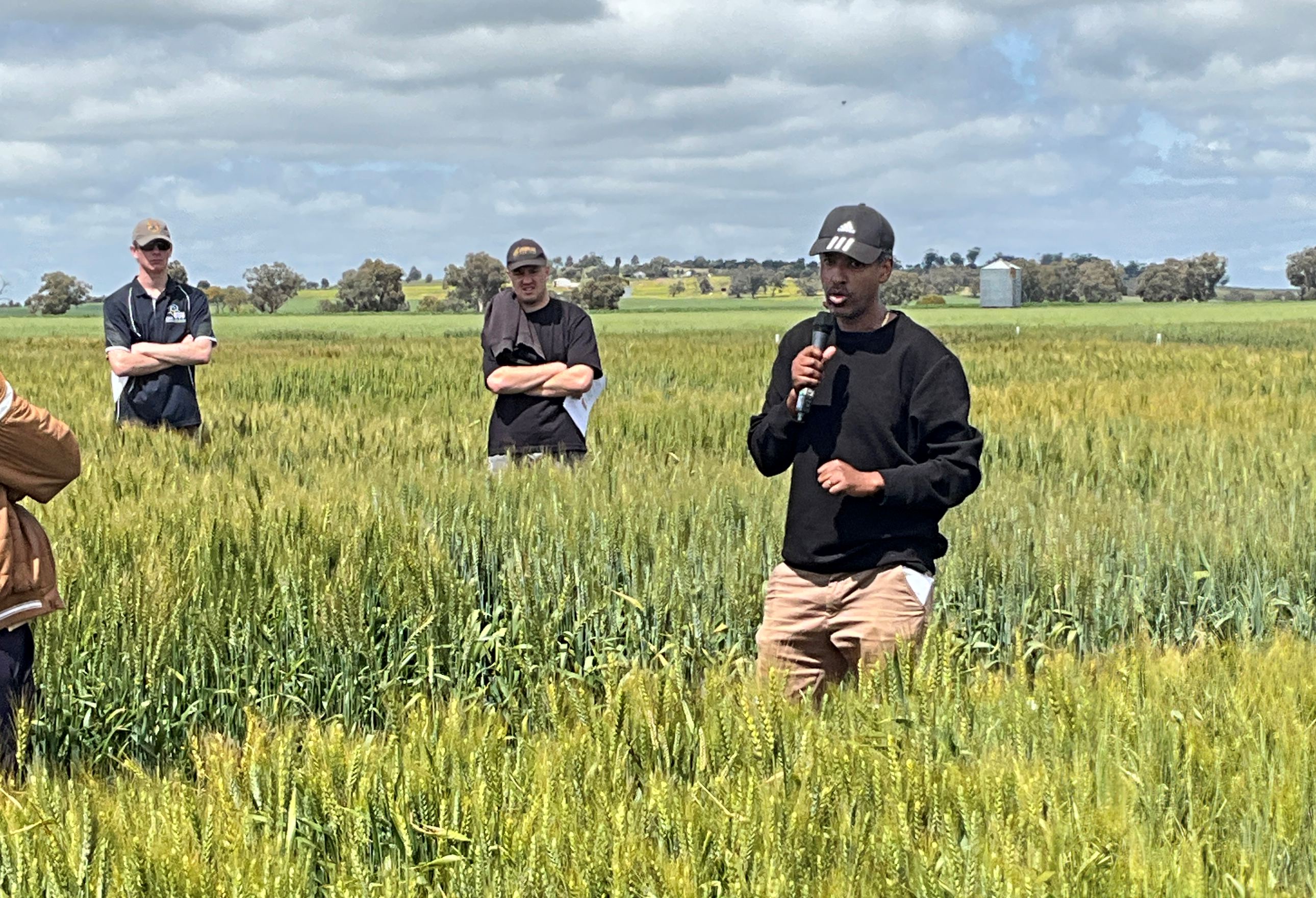
Research showing bactericide spray treatments have potential to reduce the risk of frost damage to cereal crops and deliver improved yields and profits to growers was revealed at the State’s premier grains conference in Perth today.
The field research at the Department of Primary Industries and Regional Development’s (DPIRD’s) Dale research site in 2023 and 2024 was presented at the Grains Research and Development Corporation (GRDC) Research Updates.
Frost damage costs the Australian grains industry more than $300 million in lost yields and quality each year.
Previous DPIRD research, backed by GRDC and the Council of Grain Growers Organisation (COGGO), has confirmed ice nucleating bacteria (INB) on wheat stubbles and senesced lower leaves can increase the risk of frost.
This research project, which includes GRDC co-investment, tested three Cuprous and Zinc oxide based formulations and one potassium soap on wheat and barley crops, in a mild frost environment.
DPIRD research scientist Amanuel Bekuma said while more research was required to verify the findings, the initial results were encouraging.
“The trials showed targeted lower canopy bactericide applications, particularly Cuprous oxide formulations, can transiently suppress ice nucleating activity (INA) and reduce leaf freezing potential by up to three degrees celsius,” Dr Bekuma said.
“The treatments were most effective within one to seven days of application, with little difference between seven to 10 days, which suggests INA suppression is strongest in the first week, then dissipates.
“As the frost events during the study were relatively mild, INA suppression didn’t translate to a detectable reduction in frost damage and yield benefits, highlighting the need for ongoing research under more damaging frost events.”
The next research step is for more research to refine the treatment formulation and application technique, while pursuing research to get a better understanding of the environmental interactions and bacterial re-colonisation.
The study’s findings will also inform future cereal genetics research on the INB hosting capacity and potential to reduce INA, potentially leading to more robust, high performance varieties that deliver higher yields and profits to growers where frost damage is a risk.
The presentation paper ‘Targeted bactericide application reduces Ice Nucleating Bacteria (INB)-mediated freezing in older leaves of wheat and barley’ can be found on the GRDC website.
 Print this page
