


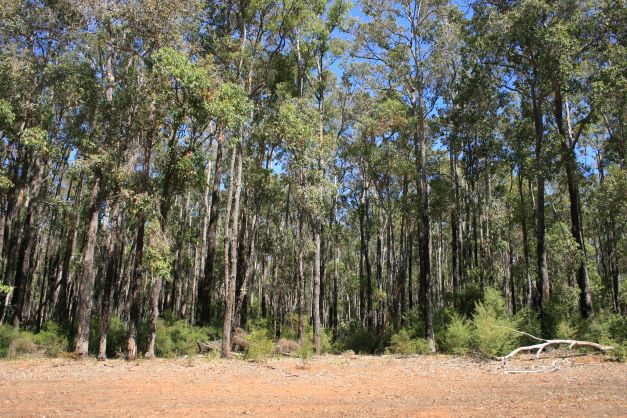
The State Government made the decision to end the logging of native forests from 2024.
The ever-increasing impacts of climate change, the importance of maintaining biodiversity and forest health and the need for carbon capture and storage mean that it is essential that we act now to protect WA's forests.
From 2024, timber taken from native forests will be limited to ecological thinning activities to promote forest health and approved clearing for mining operations.
The timber industry as we know it today and the volumes currently available will not be available post 2023 and the future industry will primarily be based on a smaller ecological thinning residue resource not suitable for large scale traditional milling.
Native forestry support programs
The State Government recognises this represents a significant change and a commitment has been made to support workers, businesses and communities in the South West with links to the forestry industry through a $50 million Just Transition Plan.
Programs are currently being developed, focusing on workforce and business transition support, which will investigate new employment opportunities, reskilling and retraining programs and ways to support businesses to pivot or retool to new timber opportunities or transition to new industries.
It is anticipated that these programs will be available in the first half of 2022, to enable sufficient time for workers and businesses to make informed, supported decisions about their future well in advance of December 2023.
The State Government is committed to ensuring that any timber derived from the approved activities results in the best return for the State in terms of employment opportunities, and environmental benefit.
The State Government will work in collaboration with industry to address any issues that may arise for broader industry.
Thinning definition and available area
Ecological thinning is broadly defined as operations where smaller trees are removed to reduce current and future moisture stress.
Post 2023, ecological thinning will occur in State forests and timber reserves that are currently available for harvesting under the Forest Management Plan.
The number of trees removed will vary depending on the dominant forest type (jarrah, karri), forest condition (dense regrowth) and site characteristics (current and predicted climate).
Indicative volumes post 2023
Forecast indicative volumes presented are gross bole volume (underbark) (GBV) that is the volume between the stump and crown break.
The forecasts assume the area of ecological thinning has been maximised to provide the greatest benefit to forests under a future continued drying, warming climate trend.
Total karri GBV may be similar to that currently available.
Karri sawlog and laminated veneer lumber (LVL) volume combined is likely to be less than 15% of this total forecast GBV.
Jarrah sawlog volume will come exclusively from mine site clearing with less than 10% of the forecast GBV likely to be sawlog.
There will be a high proportion of marri in the volume arising from ecological thinning of jarrah regrowth and minesite rehabilitation.
The forecasts assume mine clearing will continue at similar levels to recent years and that there is full recovery of material. However, it should be noted that the future levels of mine site clearing are subject to other approval processes separate to the Forest Management Plan.
The State Government anticipates that supply of firewood will continue, noting it will be produced from ecological thinning residue material of smaller diameter than currently used.
Disclaimer and key assumptions
The information provided in these Key Messages is provided on a preliminary indicative basis only and on a ‘for information only’ basis.
The information provided is not to be relied on, is subject to change, and will be superseded by the FMP 2024-2033 once approved. As such no guarantee is provided on its accuracy, correctness or completeness either express or implied.
The State Government, its agents and representatives will not accept any liability for any loss or damage arising from reliance on the information provided in this briefing.
This information is based on the limited information presently available to the State Government at this stage of preparation of the FMP 2024-2033.
Future timber supply under the FMP 2024-2033 will be subject to the usual contracting processes by the Forest Products Commission.
Economic factors affecting timber volume availability from ecological thinning (such as minimum operational timber yields, cost of harvest and haulage) have not been considered in this work.
 Print this page
