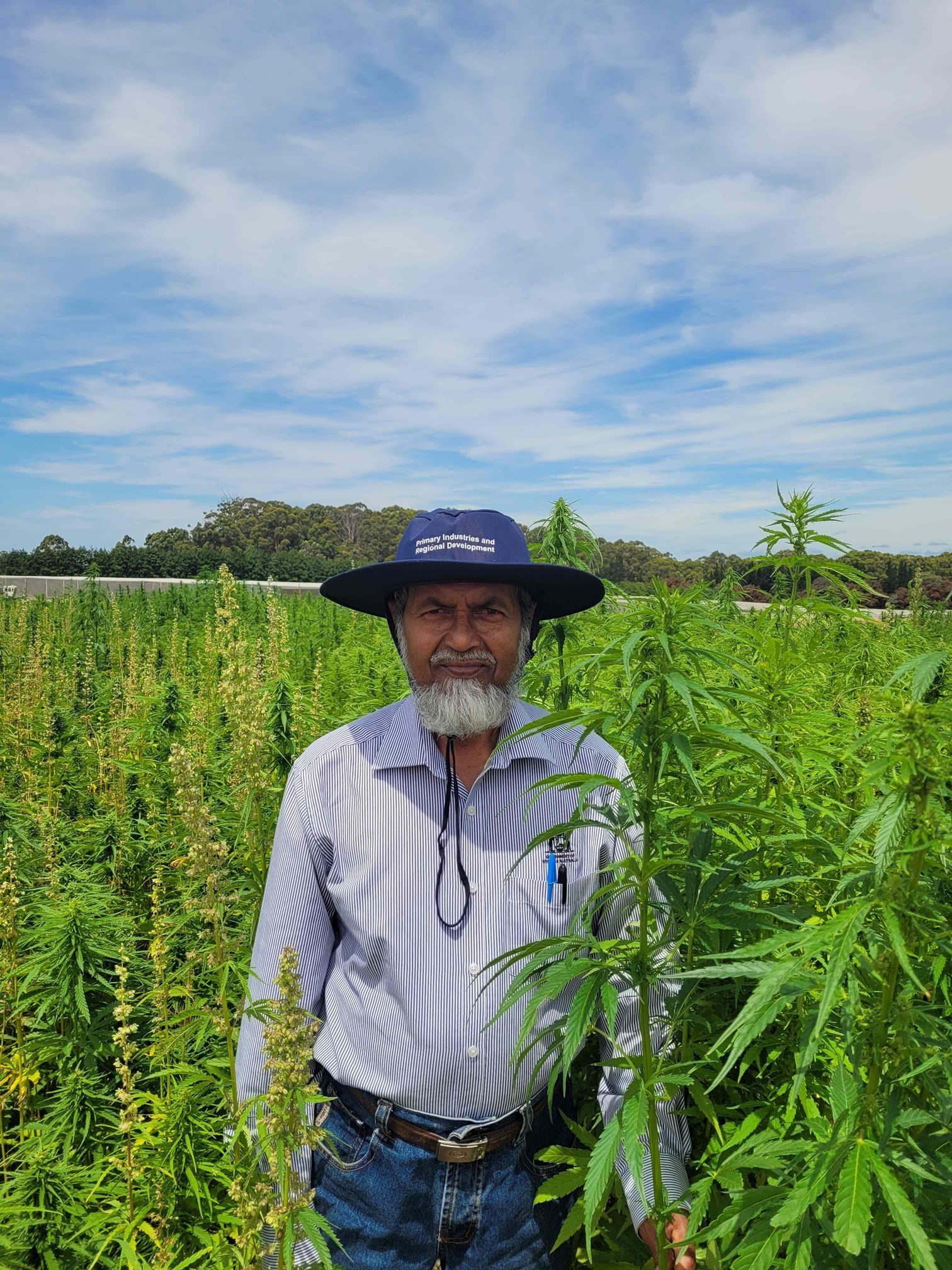
Industrial hemp production in Western Australia has shown promise, with encouraging results from two variety trials at Manjimup and Kununurra.
The joint Western Australian Department of Primary Industries and Regional Development (DPIRD) research with AgriFutures Australia will give interested growers confidence to select varieties suited to their location.
The research forms part of AgriFutures Australia’s national Industrial Hemp Variety Trial (IHVT), which includes as sites in Victoria, South Australia, Tasmania and the Northern Territory.
A national webinar to discuss the research will be held later this month (November).
Interest continues to grow in industrial hemp – prized for its high protein and polyunsaturated fatty acid health benefits – which can be used as a whole seed, flour or oil in baked goods, cereals, milk and as a spread.
The recently completed three year trials tested a total of 36 varieties at DPIRD’s Manjimup Horticultural Research Institute and its Frank Wise Institute of Tropical Agriculture.
The varieties were sourced from Australia, Canada, China, France and Poland, and were evaluated across early and late season sowing times.
Crop evaluations included grain yield, oil and protein content, seed weight, test weight and tetrahydrocannabinol (THC) levels.
DPIRD senior research scientist Shahajahan Miyan said there were several strong performing varieties among the 17 varieties trialled at the Manjimup site.
“The top performing varieties were CFX-2 from Canada, Bialobrzeskie from Poland, ECO-Excalibur from Australia and Henola from Poland, in terms of yield and oil content,” he said.
“While ECO-Excalibur produced the highest yield, it was not significantly different to the next seven highest yielding varieties, which ranged from 545-1405 kilograms per hectare, with Henola and CFX-2 producing the most consistent results.
“The protein content varied from a low of 24 per cent in the French variety Orion-33 to a high 27 per cent in Chinese line Yuma, while the oil content ranged from 21.6 per cent in another French variety Fibror-79 to 30.2 in Yuma.”
Time of sowing appeared to have little impact on variety performance, suggesting a suitable planting window of November to December.
At Kununurra, 19 industrial hemp varieties were trialed from 2022 to 2024 during the winter dry season, across early, mid and late sowing times.
“The best-performing varieties were the late-maturing Chinese varieties Bama Han Cold King Gee and Yuma, which had higher grain yields of 1420 kg/ha on average, when planted in April,” Kununurra research scientist Rhys Flynn said.
“Grain yield of these late maturing varieties decreased with each subsequent time of sowing.
“The best performers for protein content were Bundy Gem from Australia, Futura-75 from France, and Rajan from Poland which had an average of 26.6 per cent protein content in the grain.
“Late-maturing varieties will yield highest when sown at low densities in April but that comes at the high risk of not being able to harvest the larger plants so May planting is seen to be ideal with less risk to plant establishment.”
Both trials highlighted that seed quality should not be compromised for better plant establishment and yields.
AgriFutures Australia Emerging Industries Manager Kelly Kornacki said the insights would boost growers' confidence and further the organisation’s industrial hemp program of research.
“The Western Australian sites, along with the other IHVT trial locations, played a vital role in building a strong foundation for Australia’s industrial hemp industry,” she said.
“Each site offered unique conditions, enabling the development of region-specific recommendations.”
To register to join the Industrial Hemp Variety Trial national webinar on Thursday, 27 November at 8.30am visit the AgriFutures Australia website and search for ‘IHVT webinar’. Registered participants who are unable to attend will receive a link to the webinar recording.
For more information about the Industrial Hemp Variety Trials visit the AgriFutures Australian website.