


A successful surveillance and eradication program developed in Western Australia to target an invasive insect pest is proving world’s best practice and is about to be introduced to South Africa’s Cape Province.
The destructive European wasp is a declared pest which has been prevented from establishing in Western Australia due to the diligent efforts of Department of Primary Industries and Regional Development (DPIRD) officers, industry and the community.
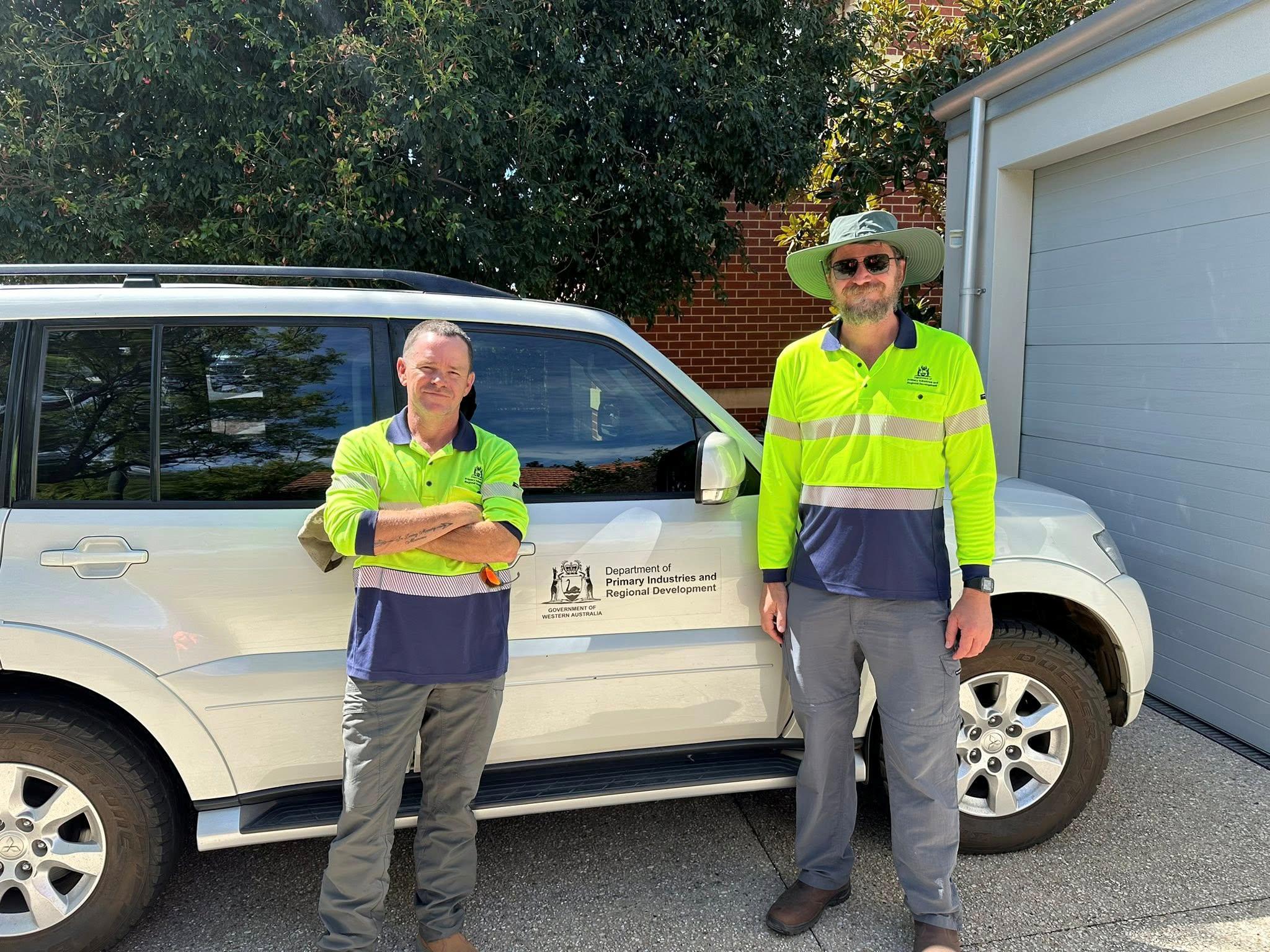
A delegation from the South African National Biodiversity Institute and Department of Conservation Ecology & Entomology, Stellenbosch University recently travelled to WA to see the department’s collaborative approach to European wasp control in action.
DPIRD senior technical officer Marc Widmer hosted the delegation and will assist South Africa to set up their own program.
“Globally, European wasps rank among the worst invasive pests which can cause severe ecological damage, as well as agricultural and socio-economic impacts,” Mr Widmer said.
“They are starting to spread in South Africa which is why the South African delegation reached out wanting to learn more about our eradication and surveillance program.”
Mr Widmer said WA was the only place in the world within the wasp’s range that had prevented European wasp from establishing and spreading for so long.
“We are really punching above our weight in terms of the success of this program, and it is no mean feat to achieve the results we have been recording as part of our 48-year program,” Mr Widmer said.
“Our surveillance program is unique to WA, the traps have been designed and made by DPIRD, and communications with industry and the community are unique to our program.
“This is a real feather in DPIRD’s cap.”
Mr Widmer said South Africa’s program hopes to mirror DPIRD’s baiting and surveillance models. Each year DPIRD deployed thousands of surveillance traps and relies heavily on surveillance effort to detect new wasp activity.
“Our team deploys more than 3000 traps across WA every year which is a big effort and involves a lot of coordination, developing maps and active grid systems,” he said.
“These traps detect about 95 per cent of wasp populations each season, and the other five per cent are picked up through public reporting.
“Although the wasp hasn’t established in WA, there is a constant influx of newly mated queens from the Eastern States, which hibernate in cargo and machinery, which is why we need to remain vigilant and implement our program every season.”
Mr Widmer said he had also been contacted by other countries interested in the work being done by DPIRD in the eradication of European wasps.
 Print this page
