


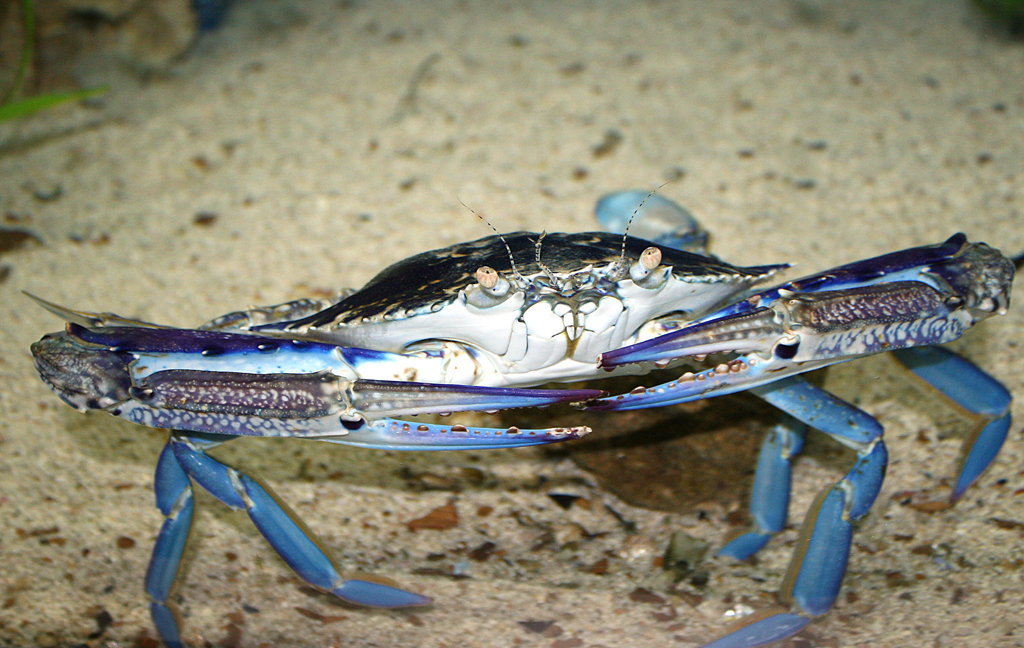
The Department of Primary Industries and Regional Development research has investigated the migration of crabs from the Swan-Canning Estuary to Cockburn Sound over winter when salinity and water temperature in the estuary drops.
Samples of recently moulted crabs collected from either the estuary or Cockburn Sound in May 2024 have revealed the mineral signature of each shell and the potential link between the two crab populations.
With the help of scientists from DPIRD’s Diagnostic Laboratory Services, preliminary work showed that blue swimmer crabs incorporated mineral elements from their surrounding environment into their shells when they moult.
This mineral signature can be used to determine provenance or place of origin for the crabs, helping scientists better understand the connectivity between crab populations.
DPIRD research scientist David Harris said crabs in WA’s South West spawned in spring and grew rapidly over summer months before moulting to maturity in autumn. With declining water temperatures, the crabs do not moult again until the following summer.
“Ahead of the summer moult, DPIRD researchers collected approximately 1,200 crab samples from Owen Anchorage and Cockburn Sound to determine the proportion with elevated levels of manganese, suggesting they migrated from the Swan Canning Estuary,” Mr Harris said.
“There is now potential to replicate this study in other South West estuaries such as the Peel Harvey Estuary to test our current findings.
“Understanding where the crabs have potentially migrated from will help increase efficiencies in the monitoring and management of blue swimmer crab stocks in WA.”
Crabbing is a very popular pastime for Western Australian fishers, with blue swimmer crabs typically found in estuaries and embayments from Esperance to Augusta and north to Karratha.
Recreational fishers are reminded that the blue swimmer crab fisheries from the Swan and Canning rivers to Minninup Beach south of Bunbury are closed annually from 1 September to 30 November to protect female crabs during the spring spawning season.
 Print this page
