


Research and development are an important part of DPIRD’s operations, generating innovation and opportunities, while supporting crucial biosecurity defence measures.
DPIRD Primary Industries Chief Scientist Ben Biddulph said the department was committed to investing in early career scientists, building on the knowledge and expertise of its more seasoned experts located across the State.
“Young scientists are an asset to our organisation, bringing new insights to research, development and innovation, as well as enthusiasm and fresh approaches,” Dr Biddulph said.
“DPIRD has a reputation for high quality scientists, who work hand-in-hand with industry, academia and other research organisations to generate relevant, meaningful benefits that improve sustainability, productivity and profitability.”
DPIRD also champions emerging scientists, supporting several grains and horticulture post doctorate students.
Support for early career scientists is also a feature of the recently launched WA Agricultural Research Collaboration between DPIRD and the Commonwealth Scientific and Industrial Research Organisation (CSIRO), Curtin University, Edith Cowan University, Murdoch University and The University of Western Australia.
The Collaboration will harness the expertise, experience, assets and reputations of its participants to capture research funding and opportunities to deliver far reaching benefits to WA primary industries and regional communities.
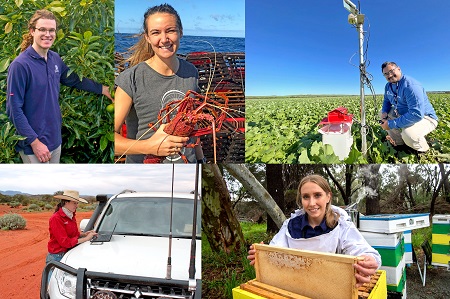
Some of DPIRD’s ‘Young Guns’ include:
Project officer Jessica Bikaun (Perth) – clocks up plenty of kilometres conducting apiary inspections and working with beekeepers, as part of her role delivering the National Bee Biosecurity Program in WA – all while completing her PhD.
“I work with beekeepers to improve their biosecurity practices and prepare for exotic bee threats, the importance of which has been highlighted with the recent incursion of varroa mite in NSW,” Ms Bikaun said.
“Growing up on a small cattle farm north of Perth taught me a deep respect for the grit and resilience of primary producers.
“When people ask why I work with bees, I usually say, ‘I looked too close and I got addicted’. I love working with industry stakeholders to find practical solutions to their problems.”
Development officer Charlotte Thomson (Kununurra) – is able to satisfy her two professional passions working for DPIRD, science and communications, as well as her personal passion for animals.
A New South Wales native, Ms Thomson is now right at home working with cattle across the northern rangelands, collaborating with pastoralists to improve herd productivity, profitability and sustainability, as part of the department’s Northern Beef Development program.
“My job involves a lot of travel to some amazing and remote places and I enjoy meeting and engaging with producers and other people in the livestock industry,” she said.
“Communication is an integral part of science, taking research outcomes and extending them for adoption. The job is a great balance between being in the cattle yards, travelling, office work and events.”
Avocado research scientist Declan McCauley (Manjimup) – relishes continuous learning and making discoveries in his job with DPIRD.
“I enjoy making an observation, asking a question, designing an experiment to test that question and then collecting and interpreting the results,” Mr McCauley said.
“The practical research I’m involved at the department is helping WA’s avocado industry produce high quality fruit for consumers in Australia and around the world.”
Research scientist Dr Saleh Adnan (Geraldton) – has expert insight into insects that has taken him from Kununurra to the Mid West, helping growers manage pests in their crops.
As an entomologist, Dr Adnan undertakes insect surveillance activities and develops integrated management strategies for major insect pests of broadacre and irrigated crops in WA.
“Insects are an integral part of our ecosystem and play a divergent role in agricultural production systems either in the form of pests or beneficials,” Dr Adnan said.
“I enjoy supporting WA growers and the grains industry to achieve precise agricultural production systems by deploying modern pest management strategies.”
Research scientist Emma-Jade Tuffley (Perth) – applies science to support the sustainable management of one of WA’s most iconic fisheries, the West Coast Rock Lobster Fishery.
Ms Tuffley has released more than 10,000 tagged lobsters, as part of her PhD research examining factors that affect lobster catchability.
She is also looking at the biology, behaviour and ecology of western rock lobster, as part of a five year project working with sector bodies and fishers to identify and solve knowledge gaps.
“You can’t have sustainable fisheries management without a good understanding of both the stock and the ecosystem,” Ms Tuffley said.
“My work is helping provide the science and knowledge to ensure the sustainable management of the fishery.”
 Print this page
