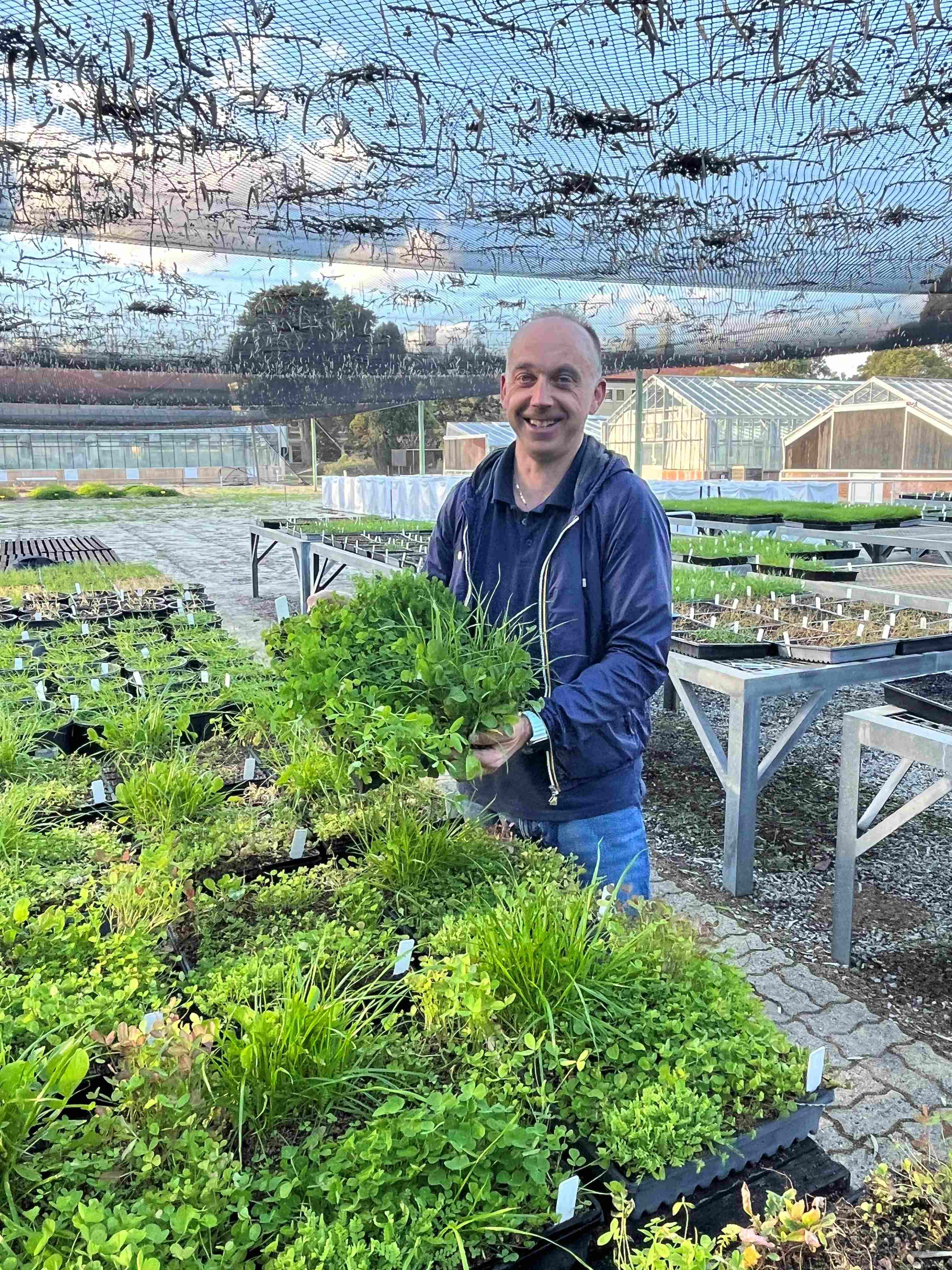
Western Australian research investigating the use of diverse pasture mixes to secure year-round feed supply is showing potential to help sheep, beef and dairy producers boost farm productivity, profitability and climate resilience.
The national Pasture 365 project, led by Deakin University and funded by the Australian Government's Future Drought Fund, is coordinated in WA by the Department of Primary Industries and Regional Development (DPIRD) in partnership with The University of Western Australia.
Pasture 365 aims to identify reliable pasture species mixes and combinations to fill seasonal feed gaps to improve drought resilience, suppress weeds and maintain consistent productivity over time.
More than 20 different pasture mixes are being evaluated across five key sites in WA, including Katanning and Manjimup, supported by grower demonstration sites at Warner Glen (Margaret River), Busselton and Boyup Brook.
DPIRD senior research scientist Roberto Busi said the field trials would demonstrate how diverse pasture systems have the potential to strengthen grazing businesses by providing more reliable feed.
“Mixes of annual and perennial legumes, grasses and herbs have been sown at DPIRD's medium rainfall Katanning Research Station and high rainfall Manjimup Horticulture Research Institute, as well as the grower demonstration sites,” Dr Busi said.
“These field trials are helping to identify clear differences in how pasture mixes perform under contrasting rainfall conditions.
“The data will inform practical pasture recommendations to help growers manage drought and climate risk, while the multi-year trials help build a clearer picture of long-term benefits for pasture mixes.”
Now in its third year, Pasture 365 has already revealed clear differences in how pasture mixes are performing, with early front-runners emerging at the Katanning and Manjimup sites.
“At Katanning, a simple lucerne-based mix has produced the best early results,” Dr Busi said.
“Several more diverse combinations of tall wheat grass and veldt grass with serradella and subclover or species mixes with lucerne, including Mediterranean cocksfoot, chicory and tedera, are also performing well.
“Interestingly, one of our most complex 12-species mixes has actually underperformed – showing that more diversity doesn't automatically mean better production.
“At Manjimup, we're seeing a clear seasonal story emerge, with annual pasture mixes growing fastest in their first year but in year two, more diverse, perennial-based mixes of combinations of chicory, cocksfoot, lucerne and plantain have moved ahead.
“The results are really encouraging for growers who are looking for feed that lasts.”
As spring approaches, researchers will assess the treatments for dry matter production, botanical composition and seasonal growth patterns, alongside weed infestation dynamics and species persistence.
Dr Busi said some unexpected weed-related observations during the 2026 growing season had prompted further inquiry.
“Interestingly, plots containing plantain have appeared to be less weedy over time, which may be due to the perennial herb’s ability to regenerate and persist through new seed recruitment,” he said.
“It is an encouraging aspect of the research that will require some more attention.”
Deakin University Centre for Regional and Rural Futures Director, Rebecca Lester, said the WA research was an important component of the overall research project.
“As we have trial sites across Southern Australia, we are able to compare the efficacy of species-diverse pasture across a range of climates and environments, while developing pasture mixes suited to local conditions,” Professor Lester said.
“The unusually long-term funding means that we can monitor how species composition varies across time and assess both the economic and welfare benefits for landholders much more accurately than most trials allow.
“We’re already finding some interesting and unexpected results, which we think will help inform landholders of the potential benefits of using diverse pastures to enhance drought and climate resilience.”
More detailed information is available in a ‘Pasture 365 – growing diverse pastures for optimised grazing’ flier, available on the DPIRD website.