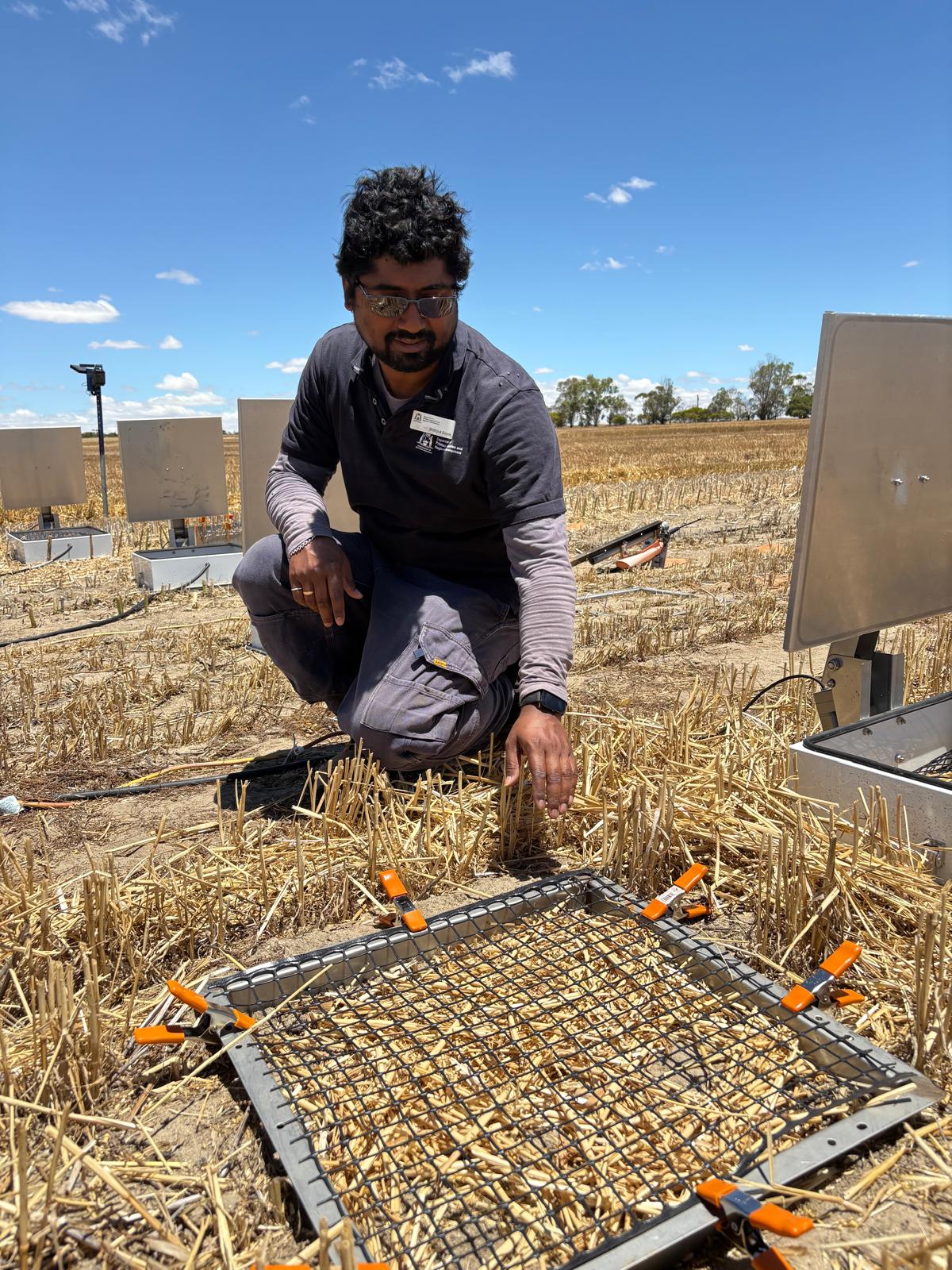
Western Australian field research indicating greenhouse gas emissions from decomposing crop residues is much lower compared with the national benchmark was profiled at the 2026 Soil Science Australia National Conference in Perth today.
The research was undertaken by the Department of Primary Industries and Regional Development (DPIRD), as part of a project led by the Queensland University of Technology (QUT), with co-investment from the Grains Research and Development Corporation.
The Wongan Hills analysis is one of five experiments conducted by the national project to quantify nitrous oxide emissions – the most concerning greenhouse gas – from residue decomposition across Australian cropping systems.
Crop residue decomposition from stubbles is a significant contributor to on-farm greenhouse gas emissions in the Australian grain industry, with residue decomposition from retained stubbles accounting for about 20 per cent of total emissions, based on current emission factors.
Despite its importance, accurate estimation of nitrous oxide emissions from crop residues remains a key uncertainty in Australia’s national greenhouse gas inventory.
WA project lead, DPIRD research scientist Bidhyut Banik, said the project data would provide a better representation of Australian grain production’s contribution to the nation’s carbon footprint.
“In WA’s dryland grain production systems, where crop residues are typically retained, there is limited field-based evidence to inform emissions factors reporting,” Dr Banik said.
“Preliminary findings suggest current WA nitrous oxide emissions from crop residue decomposition is one fourth lower than the national default of 20 per cent of total emissions from residue decomposition.
“The outcome of this research is to provide robust, field-derived evidence to support the refinement of national emissions factors and improve the accuracy of Australia’s greenhouse gas inventory.”
The WA study compared wheat and canola crops where all residues were retained, including leaves, stalks, husks and surface residues, with crops where residues were removed over two growing seasons. Root crowns were left in place in both cases, as standard farming practice in WA farming systems.
Researchers employed a semi-automated chamber system, developed by QUT, which uses variable gas measurements frequencies to capture seasonal variability, including rainfall and short-term emission events throughout the year.
These measurements were combined with soil moisture, temperature, mineral nitrogen and residue quality data to better understand the environmental drivers influencing nitrous oxide fluctuations.
“Our research found WA nitrous oxide emissions from crop residue decomposition were low due to WA’s dry climate, which limits the microbial activity responsible for nitrous oxide emissions, while occasional fluxes occurred in response to summer rainfall events,” Dr Banik said.
“These rainfall events generated short-lived emission peaks, which persisted for up to four days before declining – supporting WA’s low nitrous oxide measurements and reinforcing the value of our intensive sampling strategy.”
The data will inform the Australian Government’s annual emissions inventory report to the United Nations.
“This quantification of Australia’s greenhouse emissions from crop residues will feed into the greenhouse gas inventory calculations across a cross-section of crop types, including cereals and oilseeds,” Dr Banik said.
“Combined with climate and soils data, this research will better reflect the carbon footprint of Australian grain growers and the sustainability credentials of the Australian grains industry – helping the industry remain internationally competitive in the global marketplace.”