A new specialist team will help the Western Australian community to manage trees impacted by polyphagous shot-hole borer, as new quarantine areas come into effect.
The new Capacity Building and Training team will support landholders, industry and local governments, as the national biosecurity response transitions to long term management of the borer.
Department of Primary Industries and Regional Development (DPIRD) Deputy Director General Biosecurity and Emergency Management Mia Carbon said the specialist team included four units, each dedicated to either local government, industry, community and general information.
“They will deliver an integrated pest management program, along with training, technical workshops and community education to help prepare for long-term management,” Dr Carbon said.
“The team will also work with arborists, nurseries and the horticulture industry to ensure they have the latest tools and knowledge to manage the borer.”
It comes as the National Management Group met this week to finalise the Transition to Management (T2M) plan, after determining earlier this year that shot-hole borer was no longer technically feasible to eradicate.
It was agreed that the Transition to Management response would be cost shared by the Commonwealth, States and Territories.
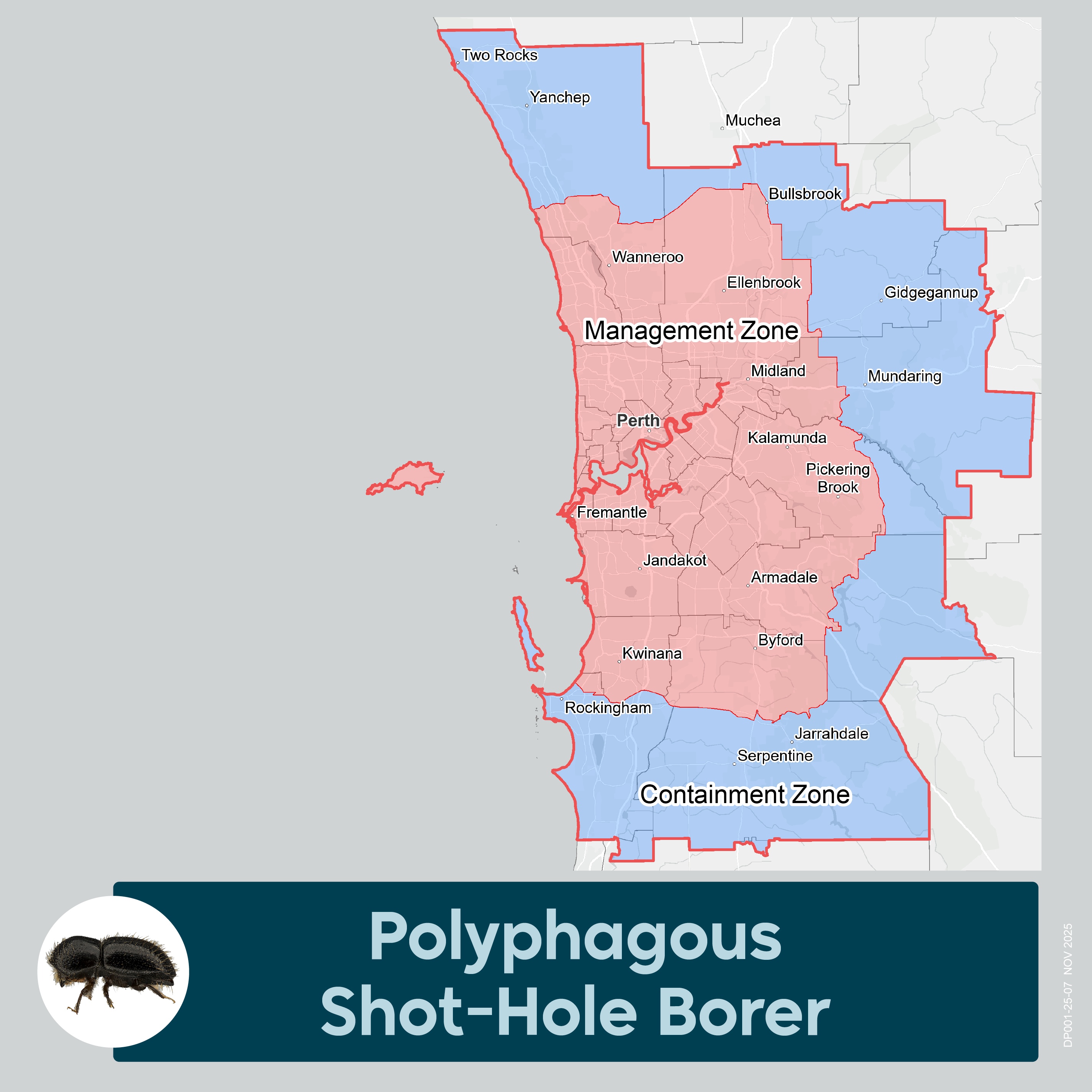
Under the T2M, a new Quarantine Area Notice will come into effect on Friday (14 Nov) for the entire Perth metropolitan area to minimise the spread of the borer.
The quarantine area will have an inner ‘management zone’, which covers the main area of borer infestation, and an outer ‘containment zone’, where there are very low levels of infestation.
Landholders in the ‘management zone’ will not be required to remove trees affected by the borer.
It will be their responsibility to manage their own trees and decide on management options – as with other existing plant pests or diseases – supported by DPIRD’s advice and training program.
The national response will no longer undertake tree removal or pruning in the ‘management zone’.
In the ‘containment zone’, DPIRD will identify and prioritise the pruning and removal of infested trees.
Maps, including an interactive map on the DPIRD website, will made available for landholders to understand which zone they are in and what that means for management of their trees.
DPIRD is working directly with owners of infested trees that were designated for pruning or removal during the eradication phase of the response.
In these cases, landowners will have the option for DPIRD to prune or remove the tree at no cost or to retain and manage the tree themselves.
Dr Carbon said in addition to the national cost-shared funding, the WA Government has provided $2.5 million to support local government efforts to manage infested trees in the inner metropolitan management zone.
“This is to support local governments affected by polyphagous shot-hole borer in inner-metro areas with the management of high-priority and significant trees through pruning, removal and responsible waste management.
“The State Government has also provided $2.17 million funding for research initiatives through the WA Agricultural Research Collaboration, which are investigating control options and treatments.”
Movement restrictions on firewood, green waste and untreated plant material still apply – these controls are fundamental to helping protect WA’s horticultural and regional areas.
Dr Carbon said biosecurity was a shared responsibility and everyone’s support was needed to protect Perth’s tree canopy and the State’s horticulture industries.
“Early detection and management of high-risk infestations, particularly in the containment zone, remain critical to managing the spread and impact of shot-hole borer,” she said.
“Effective biosecurity needs everyone to work together and continue to report suspect detections through the MyPestGuide Reporter app.
“Landowners can also access information, training and guidance through the app, on DPIRD’s website or via the PSHB information line on 9368 3080.
“By working together, we will have the best chance of limiting the spread of the borer and minimising its impact on our tree canopy and valuable horticulture industries.
“We are as committed as ever to working towards practical options to manage this complex pest.”