


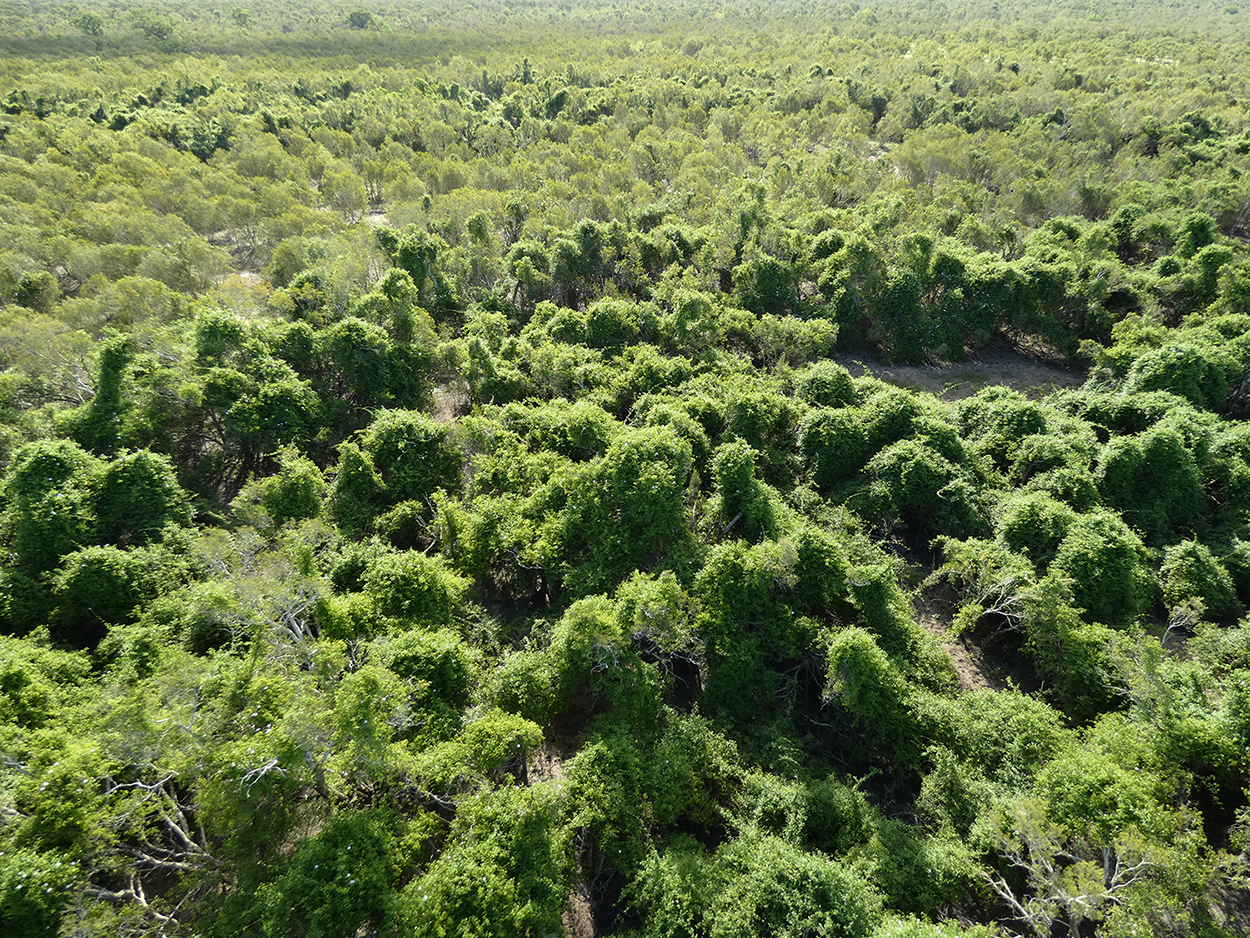
A newly amalgamated committee working together to target a toxic weed has led to the discovery of large rubber vine (Cryptostegia grandiflora) infestations in the Kimberley region, estimated to be at least 15 years old.
The East and West Kimberley committees joined forces to form the Western Australian Rubber Vine Advisory Committee (WARVAC) to take a united approach to tackle rubber vine across the entire region.
The WARVAC includes the Department of Primary Industries and Regional Development (DPIRD), Department of Biodiversity Conservation and Attractions (DBCA), Kimberley Rangelands Biosecurity Association, Indigenous rangers and Traditional Owners.
DPIRD Regional Business Development project manager Noel Wilson said the committee expanded the rubber vine search areas in 2023 and 2024 which led to large new discoveries in the West Kimberley along the lower reaches of the Fitzroy River, outside of the previously delineated zone.
“This collaborative and consistent approach across the entire Kimberley region is proving successful with three big infestations detected during an expanded delineation aerial survey,” Mr Wilson said.
“The committee is working with pastoralists to ensure access to infested sites by grading roads and opening tracks, as well as with qualified contractors to conduct the control work.
“Rubber vine is highly toxic to stock and once it has built up, it is nearly impossible for stock and people to move through the area.
“It is vitally important to our primary industry stakeholders that we tackle this weed as if it was to go unmanaged, it would strangle trees and choke out the river as well as a lot of other water points in the Kimberley, including culturally significant areas.”
Aerial surveys over nine days in 2024 identified more than 170 flowering rubber vines located close to existing known locations in addition to about 60 hectares of dense infestation.
Mr Wilson said the surveys laid the groundwork for the department’s teams to conduct ground control over two-week stints during the dry season.
Rubber vine plants are destroyed manually by removing them from the host tree and cutting the stumps which are painted with herbicide or spraying in high-density areas.
DPIRD is working alongside the Nyinkina Mangala rangers, Walalakoo Aboriginal Corporation land owners, Yeeda Pastoral and the Kimberley Agricultural and Pastoral Company (KAPCO) on this years long project which aims to eradicate the species from the Kimberley.
Rubber vine is a weed of national significance and is a declared pest in Western Australia.
WARVAC plans to further expand the search area for rubber vine, with funding being sought for 2025 and beyond.
 Print this page
