Published
20 August 2010
Ministers

Marble Bar, in the heart of the east Pilbara, today officially became home to a world-first power station that combines renewable and traditional sources of generation.
Mines and Petroleum Minister Moore, representing Energy Minister Peter Collier, officially opened Horizon Power's Pippunyah Solar Diesel Power Station today.
Mr Moore was accompanied by Mining and Pastoral MLC Ken Baston.
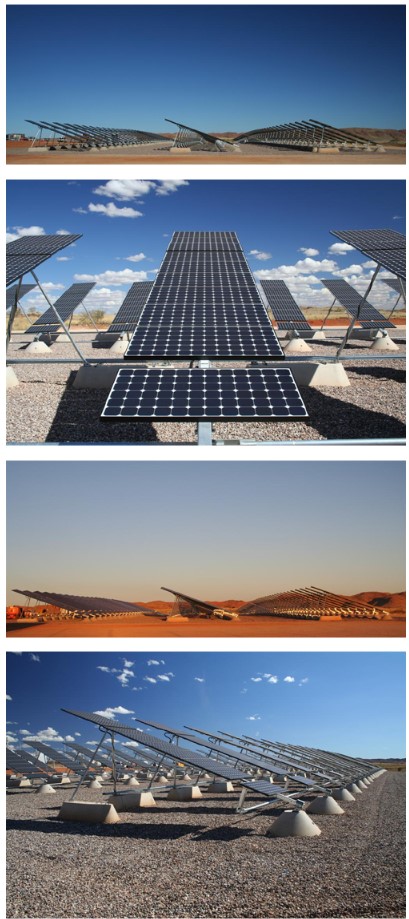
The state-of-the-art station incorporates a single axis tracking solar farm with diesel technology and a fly wheel energy storage system.
The Minister said the combination of technology is the first of its kind in the world and ensures a very high level of solar energy penetration and a reliable supply of power to the town.
"The station is powered by the biggest tracking solar farm in Australia," he said.
"The 1,350 panels, an award-winning design of SunPower, move on their axis to follow the path of the sun and produce a generating capacity of 1,160 kW."
Mr Moore said regional Western Australia, particularly the Pilbara, was critical to the rest of the nation and the State Government was proud to support leading-edge technology that was efficient, reliable and environmentally-friendly.
"Marble Bar is significant for many reasons; the three billion year-old rock on which it was based, the world record it held for the most consecutive days of maximum temperatures and, now, a world-first in power generation technology," he said.
Mr Collier said the Pippunyah Solar Diesel Power Station was among a number of renewable energy projects under development by Horizon Power - including solar-diesel stations in the remote Aboriginal towns of Kalumburu and Yungngora (Noonkanbah).
Mr Collier said the station began powering the town of Marble Bar in May but the rigorous testing period was only completed at the end of July.
"When the demand for energy and temperatures are high around the middle of summer, the solar panels will provide up to 89 per cent of the load," he said.
Horizon Power managing director Rod Hayes said the business would focus on delivering the most reliable, safe, affordable and secure power generation, to even the most remote locations in its 2.3 million square kilometre service area.
"This project goes to the heart of what Horizon Power aims to achieve in remote and regional areas of WA - innovative solutions, long term partnerships and real engagement with our customers," Mr Hayes said.
Mr Baston welcomed the project as an example of the State Government's work to improve facilities and services in regional WA.
Mr Baston said Horizon Power had engaged with the Njamal people - the traditional custodians of the 45,373 square kilometre east Pilbara region - to develop the new station.
"The group chose the name Pippunyah, which is the name of the river that runs below the power station," he said.
Marble Bar is a hot spot on the North-West tourist route and Horizon Power has built a tourist information bay to explain the significance of the station.
The same solar-diesel hybrid generation model has been used to develop and build a power station at Nullagine, 88km south of Marble Bar.
The Nullagine station, powered by 900 single axis tracking solar panels, is under construction and expected to start supplying the town in October.
The project is supported by the Federal Government, through the Renewable Remote Power Generation Program, and implemented by WA's Office of Energy.
Project facts at a glance
The new power station will:
. generate 1,048 MWh of solar energy per year
. provide 65 per cent of day time energy demand from solar power
. save 1,119 tonnes of greenhouse gas emissions per year
. save between 35-40 per cent diesel consumption per year (about 412,000 litres of fuel annually).
Minister's office - 9422 3000