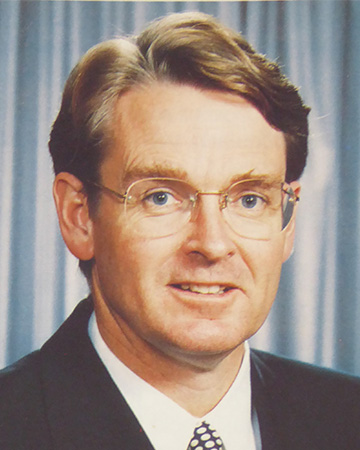
Historic State Budget delivered
9/6/94Premier Richard Court today delivered an historic State Budget aimed at continuing the reforms and good financial management which have returned confidence and jobs to the Western Australian economy.
9/6/94
Premier Richard Court today delivered an historic State Budget aimed at continuing the reforms and good financial management which have returned confidence and jobs to the Western Australian economy.
The Premier said the Budget was the first in the State's history to be brought down before the start of the financial year, the first to provide forward estimates of revenue and expenditure and the first since records commenced 33 years ago to move the total public sector substantially into surplus. This surplus is being used to reduce State debt.
Mr Court said that the Government had halted and reversed the growth in the State's net debt. He said the latest estimates suggested net debt would fall in 1993-94 and that more substantial reductions were expected in 1994-95.
"Translated to a household basis this represents a reduction of $830 from $13,000 per household during 1992/1993 to $12,170 during 1994-1995.
"In contrast during the period 1988-1989 to 1992-1993, net debt per household increased by $2,380."
Mr Court said this landmark Budget was aimed at boosting business confidence and contained no new taxes or tax increases.
The Premier told Parliament the Coalition Government was determined to build on its early achievements of stimulating economic growth, creating more jobs and providing a better lifestyle for Western Australians.
To continue this improved outlook, the Budget contained measures to:
· further reduce State debt with a view to restoring the State's AAA credit rating;
· reduce the tax burden on business with new concessions on payroll tax;
· continue the process of public sector reform to provide the best value for money for taxpayer funded services; and -
· protect the environment, tackle serious law and order issues and improve health and education services.
Mr Court said a main focus of the Budget had been to ensure responsible financial management and to overcome the excessive debt inherited from the previous Labor Government.
"Last year we promised to arrest the growth in State debt in our current term," he said.
"That objective is being met well ahead of our most optimistic expectations.
"It is also the first Budget to provide forward estimates of revenue and expenditure which make clear the Government's financial management strategies.
"This will enable Government agencies to plan with confidence for the full year knowing precisely what resources are available to them.
"Having the Budget delivered early will also improve overall accountability in the public sector - a major priority of this Government."
The Premier said the Government had been able to reduce State debt earlier than expected, through responsible financial management and reform of the public sector.
"The reduction in State debt outlined in this Budget will be critically important in restoring the State's AAA credit rating," Mr Court said.
"This Budget also puts us within reach of our major promise of eliminating the deficit on the Consolidated Fund in the Government's first term.
"A deficit of just $33.1 million is expected on the Consolidated Fund in 1994-95, an improvement of $72.2 million on this year.
"This encouraging trend is maintained in the forward estimates which show the Consolidated Fund is planned to be in balance in both the following financial years, even with accelerated payments of State debt.
"In addition, for the first time in 33 years, the total State public sector is expected to record a surplus in 1993-94 and an even greater surplus in 1994-95.
"This major improvement in the State's financial position is a direct result of the Government's moves to restore the State's credibility.
"This Budget will lift the already growing confidence in the State's financial management and in the future of the Western Australian economy.
"It is in direct contrast with the cavalier financial management of the previous Labor governments, which saw debt blow out and confidence shrink at a time when they had record revenue collections."
The Premier said the Government had again been able to provide further tax relief for business, although that capacity had been hamstrung by the Federal Government's unfair approach to Commonwealth/State financial relations.
Mr Court said the payroll tax concessions provided in the Budget would assist small and medium size businesses:
· A lifting of the payroll tax exemption by 22 per cent - from $450,000 to $550,000 - would mean an additional 700 businesses would pay no payroll tax.
· A further 4,300 businesses - about 60 per cent of those liable for payroll tax - would benefit from lower assessments. The concession would take effect from July 1 and cost about $13 million in 1994-95 and about $15 million in a full year.
Mr Court said that in line with his Government's sound financial management, a tight hold had been kept on expenditure with a real fall in recurrent expenditure estimated to be 1.5 per cent in 1994-95 with further real reductions the following two years.
Highlights of the Budget's expenditure allocations included:
· More resources for police, with spending up 9.2 per cent to $293.7 million, including $52 million over three years for upgrading equipment and improving the standard of police stations. There were also new juvenile justice initiatives, including an allocation of $1.8 million for a pilot work camp for up to thirty young offenders.
· Over $1.2 billion for education, including provision for an additional 239 full-time teachers and 77 support staff and a $6.5 million funding boost for school maintenance.
· $1.5 billion for health, including capital works costing $74.1 million and a 105 per cent increase in funding for breast cancer screening services.
· Funding measures to implement priority areas identified by the Aboriginal Social Justice Taskforce.
· A $1.1 million boost to improve the health of the Swan and Canning Rivers and $9 million to beautify the Perth central business district.
The Premier said the Budget built on initiatives taken last year to assist industry development.
"Western Australia is now leading Australia economically because of our efforts to encourage private sector investment," he said.
"As a result, the rate of private investment in WA in the past year has been increasing five times faster than the national economy.
"Major initiatives in the area of industry and resources development provided in this Budget include additional funding of $2 million to encourage on-shore petroleum exploration, $2.4 million to encourage tourism and $3.5 million for export and trade development."
Mr Court said the State's total planned capital works program, including trading enterprises but excluding the impact of capital repayments is estimated to increase by $77.2 million or about five per cent to $1,602 million.
Highlights included:
· Spending of $283.3 million by the Homeswest, including a major new initiative to improve Aboriginal housing;
· $190 million in new SECWA works, including $16.7 million for preparatory work on the new Collie power station;
· WAWA funding of $65.2 million on infill sewerage as part of the Authority's $235 million capital works program;
· Main Roads spending of $182 million on road networks throughout the State.
The Premier said as an indication of the State's improving labour market, new jobs created in WA represented more than 25 per cent of total jobs created in Australia over the past 12 months.
Further progress was expected in 1994-95.
"During my second trip to Europe, I found a lot of interest in companies using Perth as their South East Asian and Indian Ocean base," Mr Court said.
"I expect to hold a number of follow-up meetings with these companies during the months ahead and this augurs well for still further export growth - and ultimately more jobs for Western Australians."