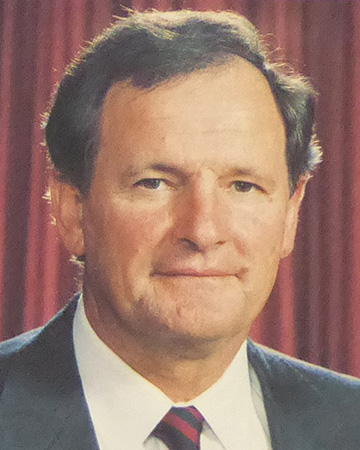
Opening of conference on 'Future Visions for WA'
20/10/93What will the year 2029 bring to Western Australians?Deputy Premier and Commerce and Trade Minister Hendy Cowan posed the question today when he opened a conference on 'Future Visions for Western Australia and Australia'.
20/10/93
What will the year 2029 bring to Western Australians?
Deputy Premier and Commerce and Trade Minister Hendy Cowan posed the question today when he opened a conference on 'Future Visions for Western Australia and Australia'.
"Assessing what WA could look like in 2029, the 200th anniversary of the State's Foundation, is an enormous task," Mr Cowan said.
"The speed of change of events is gathering pace and is faster than ever. The number and magnitude of uncertainties is now greater than it has ever been," said Mr Cowan, who spoke on Development Options for Western Australia.
He launched a document called WA 2029, which presents a range of scenarios on the development options for the State. The document is available from the Department of Commerce and Trade.
The conference was organised by the Department of Commerce and Trade and the Committee for Economic Development of Australia (CEDA).
"It is important that this document is seen as apolitical," Mr Cowan said.
"It transcends party political beliefs or vested interests.
"While the Government has supported the undertaking of the WA 2029 study, its contents and scenarios are not necessarily a reflection of Government policy."
The document is designed to promote public discussion of the sort of society Western Australians want in the future, and to seek views on the need for longer-term strategic thinking about the future.
Mr Cowan said the document painted a picture of dramatic change in an economic, social, environmental, scientific and cultural sense, and covered virtually every issue imaginable.
"Living in a global economy makes the threats and opportunities of the future so much more important - we cannot afford not to look into the future, for several reasons.
"These include being able to anticipate problems so that they may be avoided or ameliorated and, where possible, to choose the future, rather than be its victim.
"We are already in a major period of transition, which is forcing the community to embrace longer-term thinking and strategic planning.
"This transition is from a regulated and protected economy to a deregulated and open economy, from being inward-looking and inefficient to outward looking and globally competitive."
Mr Cowan said that in WA, the future he would like to see was one where the minerals sector would be bigger than today, but not as dominant in our economy.
"There would be much higher levels of processing and also production of manufactured goods from those processed commodities. The agricultural sector would remain proportionately as significant as it is now," he said.
"The application of biotechnology and land care schemes would have reversed land degradation and would have started reclaiming once unproductive land.
"Exports of agricultural commodities, particularly to Asia, would have multiplied. Processed food exports would have increased at an even faster rate and services exports would be on a world scale.
"Manufacturing based on smaller production runs, customised products for niche markets and flexible electronically controlled systems rather than capital intensive mechanical systems, will be a proportionately much larger component of the economy.
"Centres of Excellence in 'brain-based' industries, often initiated to reinforce the competitive advantages of other industry sectors, would be selling billions of dollars worth of services to the world - environmental services, desperately needed in Asia, would be the State's third or fourth largest export; and project management, engineering, mineral and other services would be big.
"The characteristics of the economy from those developments would be a population of around three million in a cohesive multicultural society which had extensive trade, investment and cultural links overseas; an economy based on real sustainable development; a more highly skilled and more educated workforce; and substantial economic development in the State's regions.
"There would be full employment based on a combination of sustainable growth and a redefinition of work and leisure. It would be a society in which quality of life - and not just in a material sense - had improved immeasurably.
"To achieve a better Western Australia through commitment to a shared vision will not be easy. The launch of the WA 2029 document today represents the first of a three-stage process.
"To be a success, the project requires maximum involvement from all sections of the community to develop that shared consensus which will be necessary to implement strategies to create the kind of future we all want.
"In securing a better future through this initiative, the real test will be the commitment that all of us give to this project. I encourage all of you to participate fully in this process."
Media contact: Peter Jackson 222 9595