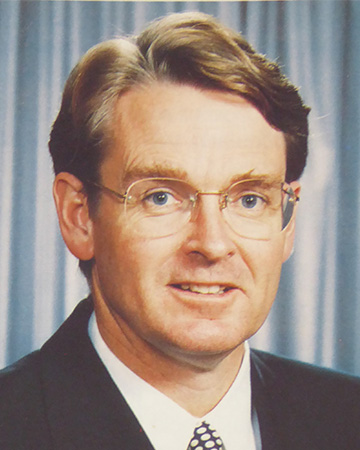
Premier details fees and charges for 2000-01 [Audio]
27/4/00 The State Government will keep its increases to essential service fees and charges to a minimum in the coming financial year, Premier Richard Court said today.
27/4/00
- a 3.64 per cent GST - taxation reforms result in a reduction in premiums of 5.78 per cent and after accounting for the 10 per cent GST, the total increase will be only 3.64 per cent; and -
- a 3.72 per cent increase - according to actuarial advice based on recent claims experience and future expectations to ensure the compulsory third party insurance fund meets solvency targets.
The State Government will keep its increases to essential service fees and charges to a minimum in the coming financial year, Premier Richard Court said today.
Mr Court said the Government would not increase its electricity, gas or public transport tariffs, and only small increases would apply to water and sewerage.
A Goods and Services Tax (GST) will apply to electricity, gas, public transport and third party insurance charges.
"Where possible, agencies have identified savings that will flow from the removal of wholesale sales tax and reduced fuel costs," Mr Court said.
"We will pass these savings on to consumers and as a result, tariff increases will be less than the full 10 per cent of the GST."
Under the Federal Government's tax reform package, the after-tax income for a 'representative' household will increase by around $1740 each year.
Of this extra income, around $140 will be spent on the GST component of the charges announced today. The total increase will be about $166.
Pensions and other benefits and allowances are guaranteed to increase by at least two per cent after inflation, and there will also be an Aged Persons Savings Bonus of up to $1,000 and a Self-Funded Retirees Supplementary Bonus of up to $2,000.
Mr Court said he was pleased the Coalition Government was able to limit increases in essential service charges in the new GST environment.
Electricity and gas
There will be no increase in electricity or gas tariffs. Since the Coalition was first elected in 1993, there has been only one rise in electricity charges and one adjustment to gas tariffs.
There will, however, be a 9.3 per cent GST effect after the abolition of wholesale sales tax and reduced fuel costs have been taken into account.
Public transport
There will be no increase in fares. The net GST effect on fares will be an average increase of 6.2 per cent.
The State Government will pass on estimated savings of 3.6 per cent resulting from reduced fuel costs and abolition of wholesale sales tax to passengers and as a result, the net GST effect on public transport fares will be an average increase of 6.2 per cent.
Increases will depend on fare type and entitlement to concessions. For example, concession fares for two-section and one-zone trips will not change.
Water and sewerage
Water, sewerage and drainage rates and charges will increase by two per cent after savings of 0.3 per cent from taxation reform. Most water and sewerage charges are not subject to the GST.
The tariff increase will assist the Water Corporation to introduce projects to ensure long-term water supply, such as the building of Harvey Dam and upgrading water treatment plants.
As well, annual sewerage charges for all country residential customers will be capped to a maximum of $550, resulting in average savings of around 15 per cent, or $114 each year, for nearly 9,000 customers.
Third party insurance
Compulsory third party insurance premiums will increase 7.5 per cent, which is made up of two components:
The increase amounts to less than $17 for private motor vehicles, taking the rate to $238.50 per year, the lowest in Australia, and still lower than the level of compulsory third party insurance premiums in 1993 which included the $50 WA Inc levy.
| YEAR | PREMIUM |
| 1993 1994 1995 1996 1997 1998 1999 2000 | $242.00 $242.00 $242.00 $192.00 $201.60 $214.15 $221.85 $238.50 |
| STATE | PREMIUM |
| Western Australia Tasmania South Australia Victoria Queensland New South Wales Northern Territory Australian Capital Territory | $238.50 $259.00 $270.00 $277.00 $286.00 $330.00 $333.00 $354.00 |
General Government charges
For these charges, the full 10 per cent GST will apply, except where there are material savings identified in commercial-type operations, where the GST effect could be slightly less than 10 per cent.
As well as GST, some charges may increase for other reasons, such as CPI movements and other cost recovery measures, as is the case each year.
As a general rule, licences, registration fees, application fees, court fees and other regulatory charges will be GST-free. Most health and education charges and all fines and penalties will be GST-free.
Impact on 'representative' household of changes in tariffs and charges for 2000/1 (based on 'average' consumption) - $
 | Annual Expenditure | Savings (wholesale Sales tax & fuel) | Pre-GST Total | 10% GST | GST- Inclusive expenditure |
| Electricity | $684.62 | $4.38 | $680.24 | $68.02 | $748.26 |
| Gas | $324.03 | $2.07 | $321.96 | $32.20 | $354.15 |
| Public Transport | $799.50 | $37.22 | $762.28 | $76.22 | $838.50 |
| Annual | Savings (WST and fuel) | 10% | Additional expenditure | Estimated 2000/01 expenditure | Net change in expenditure |
| Electricity | 684.62 | -4.38 | 68.02 | 0.00 | 748.26 | 63.64 |
| Gas | 324.03 | -2.07 | 32.20 | 0.00 | 354.15 | 30.12 |
| Public transport a | 799.50 | -37.22 | 76.22 | 0.00 | 838.50 | 39.00 |
| Water | 282.26 | -0.85 | 0.00 | 6.49 | 287.90 | 5.65 |
| CTP | 221.85 | -12.82 | 20.90 | 8.56 | 238.49 | 16.64 |
| Sewerage and drainage | 454.35 | -1.36 | 0.00 | 10.45 | 463.44 | 9.09 |
| Other b | 336.22 | 0.87 | 0.00 | 0.95 | 338.04 | 1.82 |
| Total | 3,102.83 | -57.83 | 197.34 | 26.45 | 3,268.78 | 165.96 |
- a. Transport proposes to increase fares by an overall average of 6.2%, based on anticipated overall indirect GST related tax reform savings of 3.6%. As such, the average fare increase, and cost savings, will vary depending on the number of zones travelled and the entitlement to concessionary fares.
b. 'Other' includes motor vehicle licence and recording fees, licence fees, debits tax and financial institutions duty.
- consumes:
- property has an average gross rental value for sewerage and drainage rating purposes ($6,720);
- purchases five standard 2-zone Transperth fares and ten concession 1-zone Transperth fares each week. Transperth fares are purchased using the lowest cost means available (ie using MultiRider Plus);
- the household owns one car, a Holden Commodore;
- only one adult in the household is employed, earning average weekly ordinary time earnings which is directly credited into the household's bank account (for the purposes of calculating financial institutions duty).
MODEL PARAMETERS
The model assumes that the 'representative' household:
- - 4,700 kilowatt hours of electricity per annum;
- 14.6 units of natural gas per day, or 18 gigajoules per annum; and -
- 306 kilolitres of water per annum.