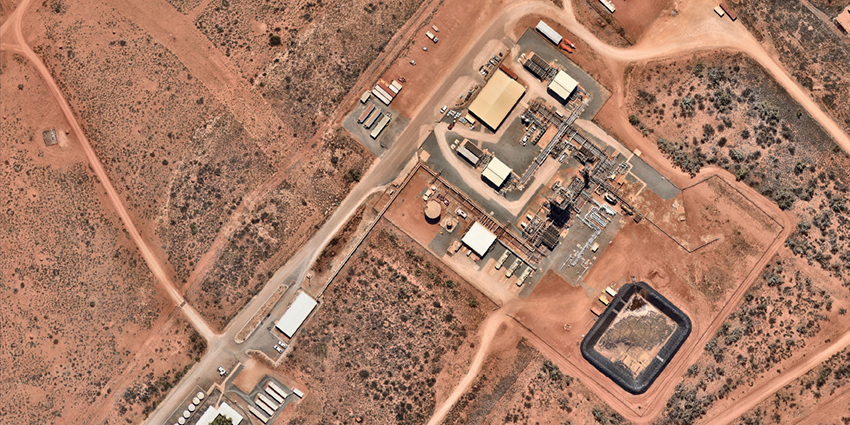
Underground gas storage (UGS) projects play a crucial role in Western Australia's domestic gas market. These projects involve injecting surplus natural gas into porous sandstone reservoirs during low demand periods (usually summer), allowing it to be accessed during peak demand periods, particularly in winter. This process provides additional on-demand supplies and can mitigate short-term price spikes.
Western Australia has two major underground natural gas storage facilities - Mondarra and Tubridgi, both of which are depleted gas fields. The department regulates the underground gas storage activities for the Mondarra and Tubridgi through existing agreements with the operators of both facilities.
Mondarra Underground Gas Storage Project
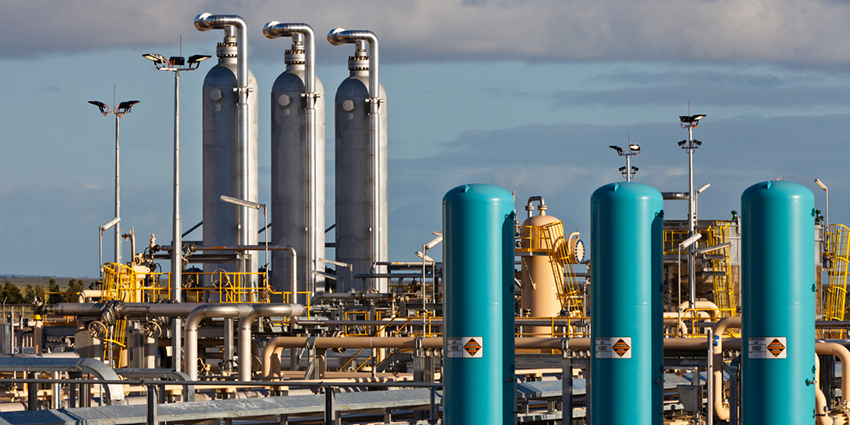
Mondarra Location and History
The Mondarra Field is located within Production Licence L 1 in the northern Perth Basin, approximately 20 kilometres southeast of Dongara. Mondarra was discovered in 1968 and produced from 1972 to 1994, after which it was converted to a small-scale gas storage facility. The capacity of the storage facility was expanded from 2010, with commercial operation of the expanded facilities commencing in August 2013.
The Mondarra UGS project played a crucial role in reducing short-term supply risks following the 2008 Varanus Island incident in WA. The facility helped efficiently manage gas production and consumption in response to that disruption and continues to enhance flexibility in the WA gas market.
Mondarra Field Characteristics
The Mondarra Field is situated around 2700 m depth below surface. The reservoir comprises Upper Permian Dongara Sandstone, a medium to coarse grained quartzose sandstone deposited in a marine environment. Average porosity of the Dongara Sandstone is around 15% for the storage area and 20-25% across the productive section, with average permeability around 130 millidarcies. The field initially contained around 26 billion cubic feet (bcf) of gas in place, equivalent to around 27 Petajoules (PJ). Production was primarily through Mondarra 1 and yielded around 24 PJ of gas.
Mondarra Storage and Production Facility
The Mondarra Field was first converted into a UGS facility in 1994. A major upgrade was completed in 2013 with maximum storage capacity of approximately 18 PJ. Gas injection rate is up to 70 Terajoules/day (TJ/d) and withdrawal rate of up to 150 TJ/day. Gas storage is managed via three injection/withdrawal wells (Mondarra 6, Mondarra 8, Mondarra 9) with the gas processed through the Mondarra facility. The facility is located at the intersection of the Dampier to Bunbury Natural Gas Pipeline (DBNGP) and the Parmelia Gas Pipeline (PGP). The facility is currently operated by APA Group.
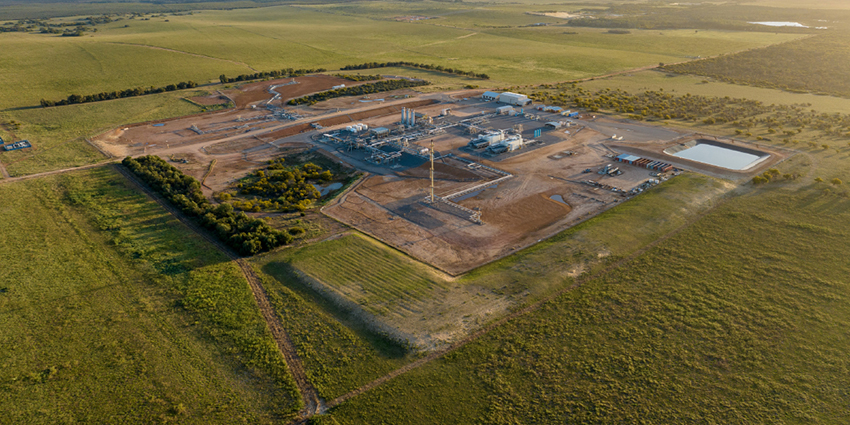
Tubridgi Underground gas storage project
Tubridgi Location and History
The Tubridgi Field is located within Production Licence L 9, onshore Carnarvon Basin, approximately 25 kilometres west of Onslow. The field was discovered in 1981 with the drilling of Tubridgi 1 with gas production commencing a decade later in 1991. Production ceased in October 2004 and the field was converted into a storage facility from 2016.
The Tubridgi UGS facility is currently one of Australia's largest, enhancing the flexibility and security of gas supply for the Western Australian domestic market. The facility has been injecting gas back into the reservoir from domestic gas pipelines, including the Dampier to Bunbury Natural Gas Pipeline (DBNGP).
Tubridgi Field Characteristics
Gas was discovered at Tubridgi within a broad, low relief, anticlinal closure. Reservoirs include the Triassic Mungaroo Formation, plus the Lower Cretaceous Flacourt Formation, and Birdrong Sandstone of the Winning Group. The reservoir is situated a depth of around 500 m, with porosities around 23-25% and permeabilities ranging from 600 to 5,600 millidarcies. The reservoirs are sealed by Muderong Shale. Gas in place was 138 billion cubic feet (bcf). The Tubridgi wells produced around 69 bcf of gas (69 PJ) before production ceased in October 2004.
Transformation into an Underground Gas Storage Facility
In 2016, five new wells (TGS 1, TGS 3, TGS 5, TGS 6, and TGS 9) were drilled and completed for UGS purposes and have been instrumental in the underground storage and recovery of gas. Furthermore, a 3D seismic survey acquired over the field in 2019 led to the drilling of three additional wells in 2023 (TRW 2, TRW 8, TRW 10) and discovery of additional recoverable indigenous gas within the field.
Tubridgi Storage and Production Facility
Initially approved for a maximum storage capacity of 42 petajoules (PJ), an extensive expansion project in 2019 increased this capacity to 57 PJ. In February 2020, the maximum storage capacity was redefined to 60 PJ, and a successful test of the withdrawal capability was conducted. Today, the Tubridgi Gas Storage facility boasts an impressive storage capacity of 60 PJ, with injection and withdrawal capacities of 90 and 65 TJ/d respectively. The Tubridgi facility is currently operated by AGI Tubridgi Pty Ltd.