


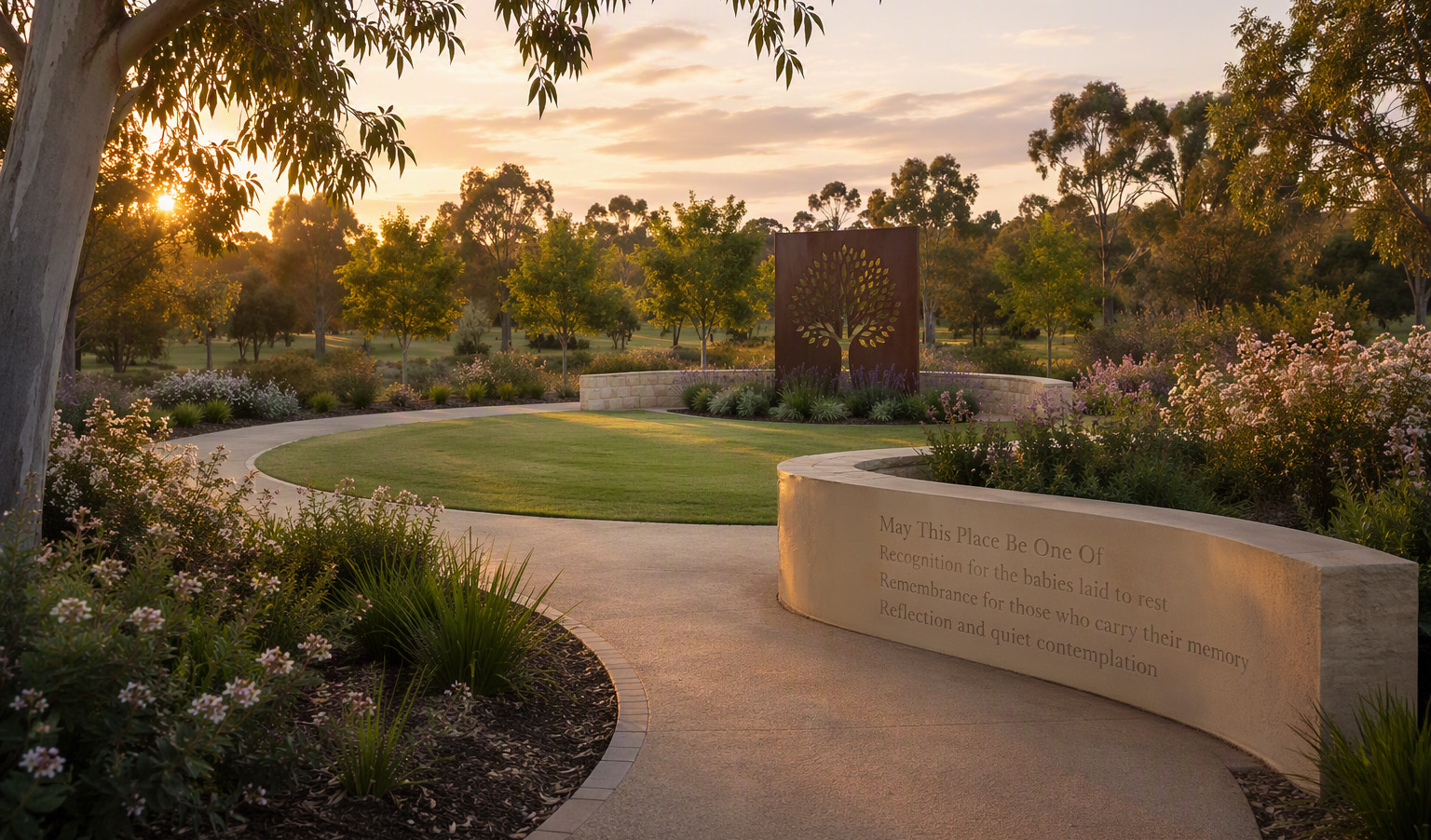
The Historical Stillborn Memorial Project seeks to acknowledge and truthfully reflect on past burial practices in Western Australia, and to provide respectful commemoration of these spaces today. It includes information about babies laid to rest in communal graves, the majority of whom were stillborn, reflecting past practices where babies who died before or shortly after birth were often interred without individual markers or formal recognition. It also offers context on why many babies were buried in this way and outlines the work currently being undertaken by the Metropolitan Cemeteries Board (MCB) to respectfully acknowledge and commemorate these places.
We recognise that this is a sensitive and deeply personal subject matter. You are encouraged to take your time, and to step away at any point if reading this information becomes difficult. A list of support services is available at the bottom of this page.
Acknowledgement
The loss of a baby is a profoundly personal and often lifelong experience. We acknowledge the grief carried by parents, families and communities, and recognise that for many people, practices in the past did not provide the information, choice or recognition that families would expect today.
This project is approached with care, respect and compassion for all those affected.
Historical context: stillborn burial practices in Western Australia
For much of the early to mid‑twentieth century, stillborns and babies who died shortly after birth in Western Australia were often laid to rest in communal or shared graves rather than individual marked graves. These practices reflected the medical knowledge, social attitudes and administrative systems that existed at the time.
In many cases, families were not fully informed about where their baby was buried or how they would be remembered. Records were often limited, and individual grave markers were not commonly provided. While these practices were considered standard during that period, they have had lasting emotional impacts for many families.
Historical research undertaken by the Metropolitan Cemeteries Board indicates that communal burial practices occurred across Western Australia over many decades and within a wide range of religious and cultural communities. Through extensive review of historical records, the MCB has identified over 14,000 babies buried in approximately 500 public communal graves across MCB‑managed cemeteries. These burials span a period of over 100 years, predominantly from 1899 to 1980, reflecting long‑standing practices of their time.
While these figures help explain the scale of historical practices, each burial represents an individual life and a family affected by loss. The purpose of sharing this information is not to overwhelm, but to acknowledge the historical context and to explain why many families continue to seek understanding, recognition and a place for remembrance today.
Understanding this history is an important part of acknowledging past experiences and supporting respectful and meaningful commemoration.
How practices have changed
Medical care, social understanding and approaches to bereavement have changed significantly over time. Today, families experiencing stillbirth are offered greater choice, involvement and recognition, and practices place strong emphasis on dignity, cultural safety and remembrance.
This project does not seek to reassess past decisions by today’s standards, but rather to acknowledge historical practices and their impacts, and to consider how they may be respectfully recognised now.
About the Historical Stillborn Memorial Committee
The Historical Stillborn Memorial Committee has been established to:
- acknowledge historical stillborn burial practices
- recognise and honour the babies who were buried and the families affected
- support truth‑telling, remembrance and healing
- ensure commemoration is guided by families, communities and cultural perspectives
The project is commemorative in nature. It does not involve the disturbance of graves, exhumation of remains, investigation of individual cases, or compulsory identification or naming.
The Joint Patrons of the Committee are His Excellency the Honourable Chris Dawson AC APM, Governor of Western Australia, and Mrs Darrilyn Dawson, reflecting the significance and care with which this work is being undertaken.
The Committee brings together clinical expertise, lived experience and cultural perspectives and includes:
- representatives from King Edward Memorial Hospital
- representatives from Red Nose Australia
- community members with lived experience
- cemetery sector expertise
All Committee processes are guided by trauma‑informed practice, cultural safety and respect.
Listening to the community
Community consultation is a central part of this project. The first phase of consultation is focused on listening to families, cultural communities and stakeholders to understand:
- what respectful acknowledgement looks like
- how communal burial areas may be commemorated
- what should be avoided to prevent further distress
Participation is entirely voluntary. People may share as much or as little as they choose, and may skip any questions.
Share Your Feedback
https://haveyoursay.dplh.wa.gov.au/historicalburialpractices
This survey closes at 6.00pm AWST on Monday 21 September 2026.
Commemoration approaches being explored
Guided by community consultation, the Committee is considering a range of commemorative approaches, which may include:
- enhanced memorial gardens as focal places for reflection
- public artworks that support storytelling and remembrance
- section‑level markers acknowledging communal burial areas
- optional, family‑initiated recognition (opt‑in only)
- digital resources supporting transparency and learning
No approach will be finalised without careful consideration of consultation outcomes.
Cultural respect and inclusion
This project recognises that cultural beliefs, spiritual practices and expressions of grief vary widely. Aboriginal cultural perspectives are being consulted throughout this project, with guidance to ensure that language, processes and commemorative approaches are culturally safe and respectful.
Community voices are central to shaping how remembrance occurs.
Care of burial areas and cemetery renewal
As part of long‑term cemetery stewardship, some areas at Karrakatta Cemetery contain communal graves that have undergone renewal to improve accessibility, safety and amenity, and to enable future burials. Renewal works do not disturb existing human remains, and the placement of permanent structures or significant landscaping is avoided over the communal grave locations of these babies to ensure ongoing dignity and respect.
As a result, many of these areas, which previously included a mix of marked graves alongside government graves without individual markers and ground surfaces that were often dusty or bare, are now maintained as lawned and landscaped spaces intended to support reflection and remembrance. The current project provides an opportunity to consider how recognition and commemoration can occur within these environments, while maintaining respect for the babies interred and the families and communities connected to them.
Support for families
Reading about stillbirth and burial practices may bring up difficult emotions. If engaging with this information causes distress, you are encouraged to seek support from someone you trust or from specialist bereavement services, including:
- Red Nose Australia – 24/7 Support Line: 1300 308 307
- The Pink Elephants Support Network – Helpline: 1300 726 306
- Yorgum Healing Services Aboriginal community support – 1800 469 371
- Griefline – Helpline: 1300 845 745
Contact and updates
You can email community@mcb.wa.gov.au if you have any questions or phone 1300 793 109 if you’d like to speak to someone about this project.
Privacy and confidentiality are respected at all times.
