


The Department of Local Government, Industry Regulation and Safety (LGIRS) collects personal information for the purpose of:
- assessing your application
- verifying your eligibility
- maintaining licensing records
- undertaking compliance, audit and enforcement functions where required
Your personal information collected is required for the department to comply with the Building Services (Registration) Act 2011, Building Act 2011, Building and Construction Industry (Security of Payment) Act 2020.
If you do not provide the requested information, LGIRS may be unable to process your application or provide the relevant licence or service required.
Your information may be included in an online licence search, published in a register, shared with other divisions at LGIRS, as well as to relevant government agencies, regulatory bodies, local governments, and third parties where authorised or required by law, including for verification, compliance, enforcement, policy, educational or audit purposes.
Please refer to the Privacy Policy on our website for more information about how we handle your personal information, how you can request access to or correction for the personal information we hold about you, and who to contact if you have a privacy enquiry or complaint.
Step 1: PLAN AHEAD AND LEAVE ENOUGH TIME
An owner builder approval is required prior to applying for a building permit from your local government authority.
Step 2: CHECK ELIGIBILITY
An owner builder approval is required prior to applying for a building permit from your local government authority. Check your eligibility using our fact sheets.
Detached house fact sheet
Shed/carport fact sheet
Small commercial building fact sheet
Step 3: APPLY FOR OWNER BULDER APPROVAL
Apply for owner building approval with LGIRS once you've confirmed your eligibility. Owner builder approval generally takes approx. 6-8 weeks from lodgement and fees are non refundable.
Step 4: APPLY FOR A BUILDING PERMIT
Once granted, you have 6 months to apply to your Local Government authority for a building permit.
An owner-builder is a person who manages building work and carries out the following types of building work on their property:
- Construct a detached dwelling, including a granny flat.
- Carry out additions and alterations to an existing free-standing dwelling.
- Construct a non-habitable building such as a private garage, carport, shed or the like.
- Construct or make additions and alterations to a small commercial building - Limited to a maximum of two storeys high and 500m2 of floor area and is not a detached house, Class 10 building or farm building.
An owner-builder assumes the responsibilities, risks and liabilities of a professional builder. A registered building contractor or owner-builder approval may be necessary if a building permit is required, and the estimated value of the building work exceeds $20,000. For Class 10a buildings, including sheds, carports and private garages, the threshold for the building work is $50,000.
Before you apply
1. You'll need:
- To provide evidence that you are the owner of the land.
- Certificate of Title (issued in last 3 months by Landgate)
- OR A copy of your contract to purchase the property (freehold), showing you as the buyer, dated within 3 months of your application.
- AND If you're leasing the land, the lease document must contain a specific term allowing the lessee to undertake building work without the consent from all registered owners. Check the application form for full lease requirements.
- To be an individual (not a corporate body, trust or other entity).
- Have sufficient knowledge of the duties and responsibilities of an owner- builder.
- complete an appropriate owner-builder course
- OR hold a current, or previous, Building Practitioners registration in Western Australia;
- OR be registered in the building industry as an architect, building surveyor or building engineer in Western Australia;
- OR Previous registration as a building practitioner or in the building industry
- AND must have a construction induction training card (white card or blue card)
- Not have been granted a building permit as an owner builder within the last six years or must have applied to waive that requirement.
- Meet the owner-builder use of land requirement when the work is completed:
- No immediate intention to rent or sell the property.
- If the work relates to a detached house, you must intend to live on the property when the work is completed.
- If the work relates to a Class 10 building (eg a shed or carport) or a small commercial building, you must intend to personally occupy or use the land,
- No immediate intention to rent or sell the property.
2. Complete the application form
Land owned by more than one owner?
If the land is owned or leased by more than one person, everyone listed on the title, contract, or lease must sign the application. All owners share responsibility for managing and supervising the building work, but only one person needs to show they understand the owner‑builder obligations.
How to apply
Online
The fastest, simplest way to apply is online.
Owner-builder approval online submission
By post or in person
| By Post | In Person |
|---|---|
If posting your application and Post to: Licensing Services |
Customer Service |
After your application has been submitted
Approval applications typically take 6-8 weeks to process. We’ll contact you if we need any additional information, and you’ll receive an email once your approval has been finalised.
Owner builder responsibilities
Show moreResponsibilities
Before taking on a building project as an owner-builder you should be aware that owner-builders take on many of the responsibilities of a registered builder. These responsibilities include:
- complying with all building standards including the Building Code of Australia and safety regulations under the Work Health and Safety Act 2020;
- Obtain and comply with building and planning approvals (including the building permit).
- Schedule and manage trades on site, and supervise the quality of their work.
- Maintain a safe work site and appropriate insurance cover.
- Arrange required certifications and ensure all work meets building standards.
- Rectifying any defective work.
The statutory responsibilities of an owner-builder cannot be delegated, no matter who is employed or contracted to carry out the work.
Carrying out and supervising the building work
Owner-builders are responsible for the supervision of the building work. Owner-builders may choose to undertake all or part of the building work themselves except where licensed tradespersons such as electricians and plumbers are required by law, or to engage a registered builder to oversee part or all of the building work.
Please note that contracting out any of the work does not lessen an owner-builder’s responsibility.
Selling your owner built home
Show moreOwner-builders are responsible for the building work carried out for a minimum of seven years. You may be responsible for rectifying any faults identified by the purchaser after sale. If the owner-builder sells the home within seven years from the date of a building permit being issued, they are required under the Home Building Contracts Act 1991 to have in place a policy of home indemnity insurance that covers subsequent owners if problems with the building develop and the owner-builder is unable or fails to rectify faulty or unsatisfactory workmanship due to disappearance, death or insolvency.
The home indemnity insurance policy must cover the purchaser of the home and subsequent owners for the remainder of the seven-year period.
All residential building work valued over $20,000 (except for a Class 10, which is $50,000) must be covered by home indemnity insurance, however home indemnity insurance is not required for 'associated work', such as building only a pergola, fence or swimming pool.
Home indemnity insurance can be obtained by contacting an approved insurance provider.
Approved owner builder home indemnity insurance providers:
QBE Insurance (Australia) Pty Ltd
Phone: 133 723
Frequently asked questions
Show moreDo you need a licence for your building project?
A registered building contractor or owner-builder approval may be necessary if a building permit is required, and the estimated value of the building work exceeds $20,000. For Class 10a buildings, including sheds, carports and private garages, the threshold for the building work is $50,000.
Check with your relevant local government office or the licensing team at the Department of Local Government, Industry Regulation and Safety (LGIRS) to determine when owner-builder approval is required.
Where building work is substantially one job, it should be performed under one building permit by a registered builder or owner-builder. You may not split building work into separate projects, each valued below $20,000, or $50,000 for Class 10a buildings, to avoid occupational licensing.
What is owner-builder work - description of building works
Owner-builder work is building, altering or adding to a:
- detached house (Class 1a(i) building);
- domestic shed, garage, carport (Class 10 buildings); or
- small commercial building – shop, office, warehouse and factory.
What is a detached house?
A detached house is a single, independent, Class 1a(i) dwelling that is completely separated from any other dwelling on the same or adjoining allotment.
Detached houses have no common walls, shared roof, or connecting floor plates with other houses. They are not connected to any other dwelling type.
Vertical or horizontal additions and/or alterations that create a separate tenancy (including granny flats or ancillary accommodation) that share any common building elements with another residential dwelling are not considered a detached house.
A detached house can have a garage, carport or shed attached to it. The house is still detached as long as it is not connected to another dwelling.
There are no limits to the height, floor area, financial value or number of storeys allowed for an owner-built, detached house.
More information on Class 1 buildings is in Part A6G2 of the Building Code of Australia (BCA), or contact the permit authority at your relevant local government for further advice on what is a detached Class 1a(i) dwelling.
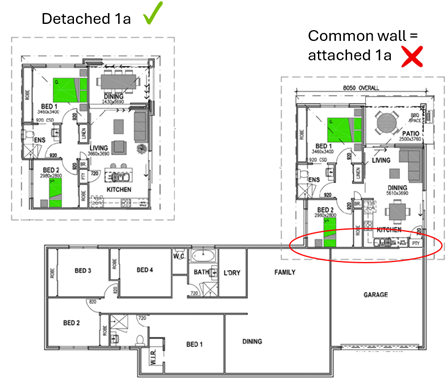
An attached house
An attached house does not constitute owner-builder work.
Floor plans of an attached house, such as a townhouse or duplex, typically feature shared walls with neighbouring units, while maintaining separate living spaces and independent access to each dwelling.
What class of building is applicable ?
A Class 10 building is a non-habitable building or structure. It can be free standing or attached to another Class of building. There are no limitations on the size or financial value of owner-built Class 10 buildings.
Typical examples include private sheds, carports and garages.
A Class 10 building cannot be used for habitable purposes. Habitable outbuildings (sleepouts, games rooms, playrooms, pool houses etc.) or frequently occupied commercial use sheds are not Class 10 buildings.
More information on Class 10 buildings and structures is in Part A6G11 of the Building Code of Australia (BCA). Alternatively, contact the permit authority at your relevant local government for advice on what is a Class 10 building.
Note: Some low risk, low value Class 10a buildings do not need a building permit. ‘Farm buildings’ and ‘incidental structures’ (such as swimming pools, retaining walls, fencing, patios etc.) are also exempt from the need for occupational licencing.
What is a small commercial building?
Commercial buildings include shops, offices, warehouses and factories.
Owner-builder approvals for small commercial buildings are limited to a maximum of:
- two storeys high; and
- 500 m2 of floor area.
Floor area
The 500m2 maximum floor area applies to the entire building, and not just the part of the building affected by the proposed building work
The building’s floor area is calculated in accordance with the NCC definition of ‘Floor area’. It is measured over the enclosing walls of each storey, and includes all internal areas. It also includes unenclosed covered areas (balconies, canopies, verandas etc) and any mezzanine areas.
‘Floor area’ is different from the gross lettable floor area, floor area ratio or building footprint dimensions that are determined for planning or leasehold purposes.
Height
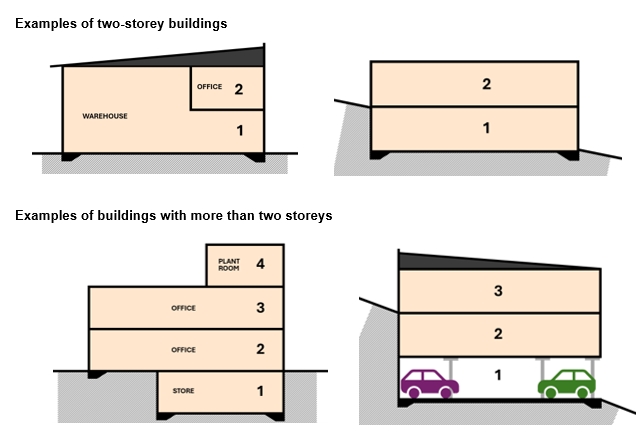
A storey extends from one floor level to the underside of a roof or the soffit of another floor level above it.
To calculate the number of storeys for a commercial building, count from the ground slab at the very bottom of the building (even if that storey is below ground) and include all floors between the lowest floor level and the top of the building. This includes enclosed and unenclosed floors. All habitable and non-habitable floors that can be accessed and occupied, including basements, roof terraces, swimming pools and plant rooms.
Applying to be an owner-builder
r.22 of the Building Services (Registration) Regulations 2011 defines the requirement to be approved as an owner-builder.
Eligibility
To be eligible, an applicant must:
- Be an owner of the land.
- Be an individual (not a corporate body, trust or other entity).
- Have sufficient knowledge of the duties and responsibilities of an owner-builder (either complete an appropriate owner-builder course or be a registered building practitioner).
- Not have been granted a building permit as an owner-builder within the last six years or must have applied to the board to waive that requirement at attachment A (page 6) of the Form 75.
- Intend to live on, occupy or use the land when the work is completed (i.e. no immediate intention to rent or sell the property).
Land ownership
S.39 of the Act defines what an 'owner' is whilst R24A defines the prescribed interests in the land.
An owner-builder must:
- be included as an owner on the certificate of title for the land;
- be named as a purchaser on a Contract to Purchase an estate in fee simple in the land; or
- be party to a lease agreement which explicitly grants the tenant a right to develop the land.
Evidence that the applicant is the owner of the land must be provided with an application for owner-builder approval.
Where a Certificate of Title is provided as proof of ownership, the Record (digital or otherwise) must have been issued by Landgate within three months of the date the application is made. A current Record of the Certificate of Title can be ordered from Landgate. The date of issue is displayed at the bottom of the Record.
A copy of a contract to purchase an estate in fee simple in the land (freehold purchase) showing the applicant as the purchaser must be dated within three months of the date the application is made.
If the applicant is leasing the land, the lease document must contain a specific term allowing the lessee to undertake building work without the consent of each person whose name is registered as a proprietor of the land. Further details of the lease requirements are noted on the application form.
More than one owner?
If the land is owned by more than one person, the application form (Form 75) must be signed by every person listed as a registered proprietor on the Certificate of Title, every buyer on a Contract of Purchase, or every lessee on a compliant lease agreement.
Each owner then becomes jointly responsible for supervising and managing the building work, however, only one person is required to demonstrate appropriate knowledge of the duties and responsibilities of an owner-builder.
Owner-builder duties and responsibilities
Owner-builder approval will only be issued if you have sufficient knowledge of the duties and responsibilities of an owner-builder.
To satisfy this requirement, at least one of the applicants must have a general construction induction training card (white card or blue card) and, either:
- hold a current, or previous, Building Practitioners registration in Western Australia;
- be registered as an architect, building surveyor or building engineer in Western Australia; or
- have completed owner-builder training with Western Australian specific content within the previous 24 months.
Evidence of recent owner-builder training or confirmation of your building practitioner registration details form part of the application.
Intent to occupy
If the owner-builder work relates to a house, you must intend to reside on the land on which the work is to be carried out, when the work is completed. Where multiple dwellings are created on one allotment, you can satisfy the requirement to reside on the land by occupying one of the dwellings.
If the work relates to a Class 10 building or a small commercial building, you must intend to occupy or use the land on which the work is to be carried out when the work is completed.
A small commercial building is intended to be the owner’s workplace.
If you intend to develop a property for immediate sale, then the owner-builder pathway is not appropriate. This would not satisfy the intention to reside on, occupy or use the land. The sale or disposal of an owner-built dwelling is restricted by the Home Building Contracts Act 1991.
Selling an owner-built dwelling within seven years of the date on which the building permit was granted is an offence (penalty of $10,000) unless you obtain home indemnity insurance.
Time between projects
The six-year limit between applications for owner-builder approvals starts when a building permit is granted. If an owner-builder approval is issued but not used, because a building permit was never issued, the person or people named on the approval may apply for a new owner-builder approval.
When a building permit is granted to an owner-builder, the person or people named on the owner-builder approval must wait six years from the date the building permit was issued before making any further applications.
The six-year restriction may be waived if:
- hardship would be suffered if the application for owner-builder approval was refused; or
- the new building permit will be for the same land as the previously granted permit/approval.
To apply for a waiver on the six-year limit, lodge an owner-builder application and complete the eligibility waiver section on the last page of Form 75.
Validity of owner-builder approval
If no application for building permit is made, an owner-builder approval expires 6 months after its date of issue.
If an application for building permit is made within 6 months of the approval’s issue, and a permit is not granted, the owner-builder approval expires when the application for building permit is refused. If the building permit is granted, the owner-builder approval remains valid for the duration of the building permit.
Building permits are valid for two years. However, you may request longer when you apply for the permit, or you can apply to the local government to extend an existing building permit at any time after the permit is granted.
