


The Keep Australia Beautiful Council congratulates current and past entrants.
It is hard to think of a movement or campaign that has stirred such pride and action in our regional and remote communities as the Tidy Towns Sustainable Communities program.
Western Australia State Title Winner
Award history
| Year | Community | Year | Community |
|---|---|---|---|
| 2025 | Williams | 2024 | Port and South Hedland |
| 2023 | Pingelly | 2022 | Gascoyne Junction |
| 2021 | Boddington | 2020 | Narrogin |
| 2019 | Bunbury | 2018 | Collie |
| 2017 | Kalgoorlie‑Boulder | 2016 | Greenbushes |
| 2015 | Albany | 2014 | Toodyay |
| 2013 | Walpole | 2012 | Port and South Hedland |
| 2011 | West Arthur | 2010 | Westonia |
| 2009 | Port and South Hedland | 2008 | Kambalda |
| 2007 | Walpole | 2006 | Cue |
| 2005 | Collie | 2004 | Kojonup |
| 2003 | Collie | 2002 | Wyalkatchem |
| 2001 | Bridgetown | 2000 | Wyalkatchem |
| 1999 | Bruce Rock | 1998 | Bruce Rock |
| 1997 | Denmark | 1996 | Denmark |
| 1995 | Denmark | 1994 | Mukinbudin |
| 1993 | Paraburdoo | 1992 | Tom Price |
| 1991 | Paraburdoo | 1990 | Albany |
National Tidy Towns Award winners from WA
Australia’s Tidiest Town Awards were introduced in 1990. Winners from WA in the now Australian Tidy Towns Sustainability Awards are:
| Year | National Winner |
|---|---|
| 2026 | Williams. View The Guardian article, 2026 about the history and a little bit about Williams. |
| 2023 | Gascoyne Junction |
| 2015 | Toodyay |
| 2006 | Collie |
| 2003 | Wyalkatchem |
| 1998 | Denmark |
50 Years of Tidy Towns - 1969 to 2019
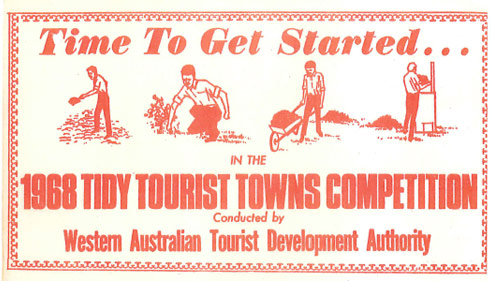
The idea for the first Australian Tidy Towns competition was touted by the Western Australian Tourist Development Authority (WATDA) in 1968 to promote tidy and presentable towns the Tidy Towns Award program received instant success with 59 entries in its first year and the first awards in 1969.
Tidy Towns in WA emanated from an Irish project, ‘Tidy Towns & National Roadside Gardens Competition’ after R.H. Hiller, the Director of the WATDA was contacted by an agent from the Irish Tourist Board, based in Sydney. The agent stated they 'had problems much the same as your own in bringing about the development of transport, accommodation, amenities, and of tourist attractions, on the scale required by the traveller of today' and offered to share information on their own initiative and its well received success.
The Tidy Towns competition was launched in 1968 by the WATDA with the judging taking place from November 1968 through to February 1969. Four judging categories were set according to town size and prize money ranging from $400; $600; $1000; and $1500 (smallest to highest population size). The winning towns were announced in March of that year.
Unlike today, the inaugural competition did not stretch statewide; metropolitan (not just regional) entries were accepted; and local government agencies (rather than communities) were the competitors.
Points were awarded after taking the following into consideration:
- effort involved and general cleanliness of Town
- absence of litter and unsightly objects
- appearance of Commercial and Residential premises
- colour, colour harmony of all buildings
- standard of fences and paved areas
- appearance of lawns, gardens, trees, shrubs, etc
- tidiness of private yards and blocks.
Some towns took the competition very seriously. One Shire, for example, circulated public notices to its townsfolk to elicit their support with ‘Depositing and Removal of Refuse, Rubbish, Litter and Disused Material’. A later notice was sent which stated that: ‘Some townspeople have made an effort to comply with Council’s suggestions while others have made no attempt whatsoever.’ An inspection of the town was undertaken, followed by enforcement of the Shire’s by-laws.
Backed by the Premier, Sir David Brand’s press statements, the first year of the Tidy Towns’ program was a great success. Fifty-nine towns entered, and due to the high level of interest shown, two judging committees were formed comprising representatives from Main Roads, the County Shires’ Association, Perth City Council, the Local Government Association and the Nurserymen’s Association of WA.
Competition winners were announced by the Honourable David Brand, MLA at a buffet luncheon at the Palace Hotel, on 17 March 1969. In order of smallest to largest town population, the winners were: Corrigin, Merredin, Medina/Calista, and Bunbury. Bunbury was also named the overall State Winner.
Over the years, there have been some changes to the competition including a broader environmental focus. Traditionally, the program focused on tidy streets, litter prevention and beautification. Now communities investigate and conserve assets such as their cultural heritage, bushland and rivers and limit their impact on the environment through recycling and resource recovery. The awards promote pride in communities, the protection of cultural and natural heritage values, and a sustainable future.
The benefits of involvement in the Tidy Towns Sustainable Communities Awards program include increased tourism and marketing opportunities, increased youth participation, and community cohesion.
At a glance for media enquiries - A short History
Tidy Towns is one of Australia’s longest-running community awards programs.It began as a Western Australian tourism initiative in 1968, expanded to a national awards program in 1990, and today recognises sustainabilityachievements in regional and rural communities across every state and territory.
A 1968 tourism idea, borrowed from Ireland. The concept was originally an Irish one, the “Tidy Towns & National Roadside
Gardens Competition,” and was brought to Australia by the Western Australian Tourist Development Authority in 1968.
The first judging ran from November 1968 to February 1969, with 59 entries across four categories based on town size. Prize money ranged from $400 to $1,500. At that point the competition was metropolitan as well as regional, and it was local councils, not community groups, who were the competitors.
National expansion
At the national level, Keep Australia Beautiful was founded by the late Dame Phyllis Frost, a longtime advocate for social causes. The story goes that she was galvanised into anti-litter action after watching rubbish fly from a semitrailer on the road between Melbourne and Bendigo in 1963. KAB’s national association formed in 1971, with state branches including KABVIC and KESAB among the founding bodies. In 1972, then Prime Minister Gough Whitlam launched “Live Without Litter Week.” The Australian Tidy Towns Awards went national in 1990.
From tidy streets to sustainability
The program has evolved considerably over more than five decades.Traditionally focused on tidy streets, litter prevention and beautification, the awards today cover circular economy projects, climate adaptation, cultural heritage, youth leadership, biodiversity, and community resilience.The awards are now known as the Australian Sustainable Communities Tidy Towns Awards. The judging cycle runs across the year:state and territory winners are announced between August and November, a national judging panel assess each finalist community, and the national ceremony is held between March and May.
