


Proactive audits: early intervention and education
What do balustrades, cladding, re-roofing and building surveyors have in common? They’ve all been part of Building and Energy’s proactive building audit program over the past decade.
The audits are a key part of Building and Energy’s three-pronged approach to building compliance, alongside dispute resolution and enforcement.
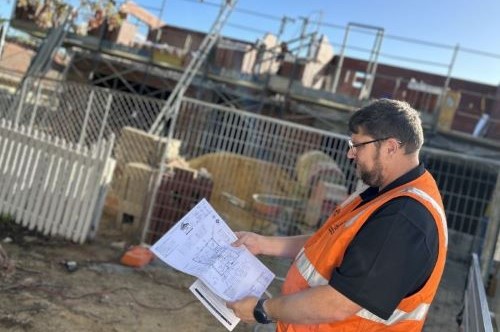
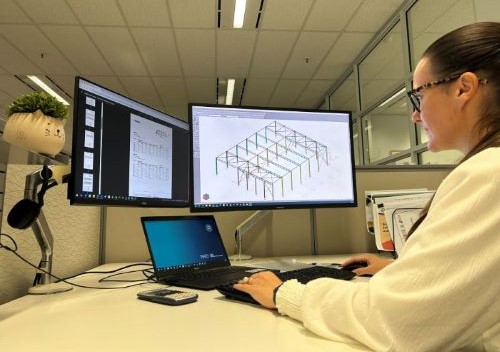
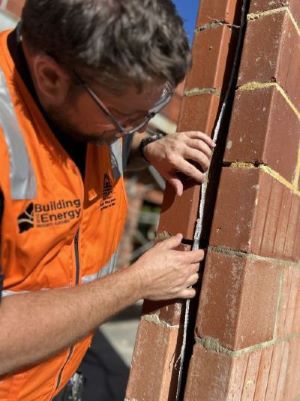
The audit team – experienced building surveyors, builders and engineers – carries out general inspections (to monitor how well building standards are applied) and compliance inspections (to monitor the work and conduct of individual building service providers).
“Our audit program is an early intervention to identify non-compliance in design and during construction, and to educate industry participants on the applicable technical standards,” Audit Manager Paul da Costa explains.
“If necessary, further compliance action may be taken on particular audit findings, but our priority is helping the broader building industry identify, prevent and rectify common faults, ensuring a better outcome for all building owners and users.”
Building and Energy regularly publishes audit reports and related communications to raise industry awareness. The audit team’s focus areas are determined by a risk-based and intelligence-led approach, including industry consultation.
The latest Audit Priorities Statement puts the spotlight in 2025-26 on waterproofing of balconies, aspects of disability access, energy efficiency and fire services (for general inspections) and building surveyors and – for the first time – fire safety and structural engineers (for compliance inspections).
“We also remain flexible in our approach to potentially include particular issues of interest that may arise,” Paul says.
The priorities are guided by the goals set out in the recently published Towards 2030 Audit Strategy, which are to:
- minimise potential harm to public health and building occupants;
- focus on high-risk aspects of construction;
- audit building service providers to encourage industry participants to perform work correctly and avoid costly mistakes;
- raise the standard of compliance with technical standards to avoid serious defects for building owners and occupants and reduce building disputes; and
- be agile and responsive to industry and regulatory changes and Government priorities.
Updates on the audit team’s work and findings will be published in future issues.
For more information on the audit process please see Building services audit program.
Compliance findings: Subcontractor payments
Building and Energy recently concluded two rounds of compliance inspections focussing on compliance with the Building and Construction Industry (Security of Payment) Act 2021 (SOP Act). Issues were identified with 80% of the construction contracts reviewed.
The top four issues identified were:
- Construction contracts did not contain mandatory information required by section 13 of the SOP Act.
- Construction contracts included terms that may be, in certain circumstances, inconsistent with the provisions of the SOP Act.
- Registered building contractors had failed to comply with the retention trust provisions of the SOP Act.
- Registered building contractors had sub-contracted a prescribed building service to a person not entitled to undertake that service.
For more information of the SOP Act please see Subcontractor payment disputes (Security of Payment Act).
Key takeaways for industry
Construction Contracts
Registered building contractors - make sure your construction contracts, including purchase orders over the value of $20,000:
- Are in writing.
- Include your builder’s registration number.
- State the full legal names of both parties.
- Include the amount to be paid (or how that amount is to be calculated).
- Give a good general description of the construction work to be carried out or goods being supplied.
To assist you in meeting the requirements of the SOP Act Building and Energy’s website provides a template - small construction work contract, for subcontracts between a registered building service provider and a subcontractor, for the carrying out of a building service.
Building and Energy cannot provide you with advice on this contract. If you are unsure about any of the terms of the contract, or how to fill out and execute the contract, please consider seeking your own independent advice such as from a construction contracts specialist or lawyer.
Retention
The SOP Act retention trust scheme applies to any new ‘construction contracts’ entered into after 1 February 2024 valued over $20,000 (including GST) that require the holding of retention monies.
Under the retention trust scheme, retention amounts must be placed in a separate retention money trust account with a bank or other financial institution.
For more information see Retention Trust Scheme – Retention Money Trust Accounting Guidelines.
Subcontracting a prescribed building service
Individuals, partnerships and companies that contract with others to provide painting services valued over $1,000 must be registered as a ‘painting contractor’. Please see our painters' registration webpage for more information.
Registered building contractors who contract with painters must ensure they are dealing with a registered painting contractor. A registered builder must not contract directly with a painting practitioner or a painter who does not hold current a registration as a ‘painting contractor’ in their own right.
You can check that a painter holds the correct registration at Building and Energy licence and registration search.
Implementing NCC 2022 in Western Australia
The Building Regulations 2012 specify which edition of the Building Code of Australia (BCA) - Volumes One and Two of the National Construction Code (NCC) apply in different situations. The NCC is published and updated by the Australian Building Codes Board (ABCB).
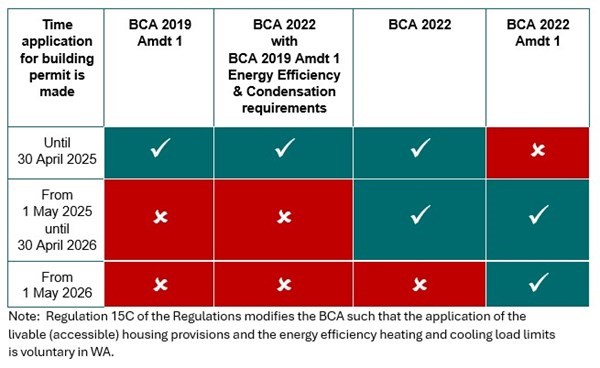
NCC 2022 was adopted in WA on 1 May 2023. Transitional arrangements allowed continued use of NCC 2019 Amendment 1 until 30 April 2025. From 1 May 2025, NCC 2019 Amendment 1 can no longer be used for building permit applications.
NCC 2025 was expected to be released on 1 May 2025 but is delayed. In response, the ABCB released NCC 2022 Amendment 1, which must be used together with NCC 2022.
From 1 May 2025, building permit applications must comply with either NCC 2022 (for up to 12 months) or NCC 2022 Amendment 1 .
Note: Transitional arrangements do not apply to swimming pools, classification changes, or unauthorised work. Refer to Part 4 of the Building Regulations for full details.
The current transitional arrangements are summarised below:
Modifications and variations to the Building Code specifically for WA are found in the Building Regulations and Schedule 11 of the NCC.
Modifications through the Building Regulations
Modifications via the Building Regulations (NCC 2022 and Amendment 1):
- Regulation 15C continues to exclude:
- Separate NatHERS heating and cooling load limits for energy efficiency
- NCC Part H8 - Liveable Housing Design provisions
- Regulation 15D extends the transition period for new bushfire construction requirements for:
- Class 9b schools and early childhood centres
- Class 10a buildings or decks directly connected to those buildings in bushfire-prone areas
For more information refer to Industry Bulletin 169 - Building Amendment Regulations (No. 2) 2025: Bushfire requirements for Class 9 vulnerable use buildings.
Changes have also been made to BA3 (Certificate of Design Compliance) and BA18 (Certificate of Building Compliance) forms for statements that need to be made by a building surveyor in relation to Class 9 vulnerable buildings.
Refer to Industry Bulletin 170 - Updated Building Act forms for building surveyors – BA3 and BA18 for more information.
WA variations to the NCC:
- NCC 2022 includes WA variations relating to structural provisions for buildings located in wind Regions B and D.
Refer to Industry Bulletin 147 - Western Australian State Variation NCC 2022 Buildings in wind Regions B and D for further information.
- NCC 2022 Amendment 1 includes WA variations that provide additional compliance options using local building practices and products.
Refer to Industry Bulletin 168 - New Western Australian State variations to the National Construction Code 2022 for more information.
Note: There are other existing modifications to building standards through the Building Regulations and other WA variations and additions in the NCC.

 Print this page
