


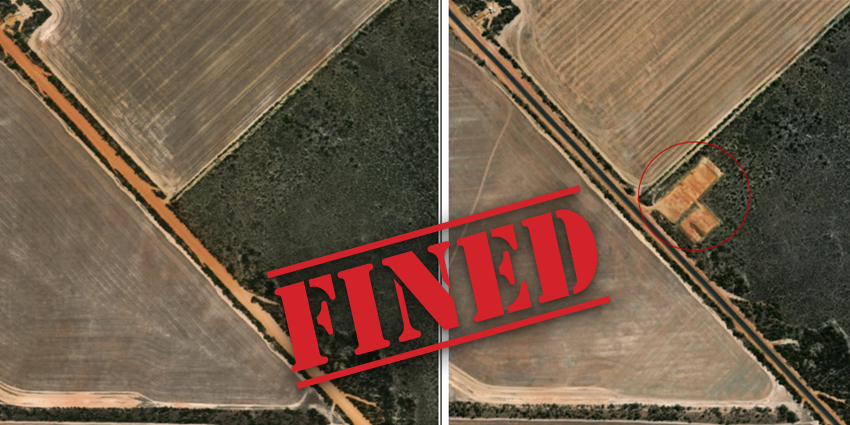
The unauthorised clearing was detected by the Department of Water and Environmental Regulation (DWER) using satellite imagery obtained from the European Space Agency’s Copernicus Sentinel-2 mission. DWER also used very high-resolution satellite imagery captured by Maxar Technologies and Airbus Defence and Space, which enables the detection and investigation of clearing in remote parts of Western Australia.
The investigation found 1.7 hectares of native vegetation was cleared within DWER’s water reserve containing Cuffy’s Dam, a water supply used by the nearby Newdegate community. An additional 4.3 hectares were cleared within nearby nature reserves, including the Dunn Rock Nature Reserve which is an important habitat for flora and fauna conservation.
The cleared areas had been used to extract gravel for road works.
The vegetation cleared within the nature reserves consisted of Eucalypt shrublands and was likely to have contained priority flora species, which are species listed as possibly threatened and requiring further survey work and taxonomic study.
In the Albany Magistrates Court on 19 October 2022, the Shire of Lake Grace was convicted on four charges of unauthorised clearing of native vegetation contrary to section 51C of the Environmental Protection Act 1986.
The maximum penalty for companies who commit the offence is $500,000.
DWER Executive Director Compliance and Enforcement, Kelly Faulkner, said unauthorised clearing in the Wheatbelt is a serious concern to the community.
“These are often the most significant remnants of the natural environment in what are generally heavily cleared landscapes,” she said.
“They serve an important role in supporting species of plants that are at threat of extinction, as well as helping to protect water quality in catchments.
“Local government authorities and contractors are reminded that a clearing permit is required to clear native vegetation to extract gravel.”
