


Ensuring that RTO course information, enrolment and informing students about the suitability of the training product for them are key components within Quality Area 2 of the Registration Standards 2025 (2025 Standards). This Fact Sheet focuses specifically on Outcome Standards 2.1 and 2.2.
The intent of Outcome Standards 2.1 and 2.2 is that students are able to make informed choices prior to enrolment, and the RTO has mechanisms in place to advise students on whether a training product is suitable for them (based on their learning needs, skills and competencies). These requirements ensure students have a successful experience with the RTO.
In line with these responsibilities, where an RTO engages a third party to deliver services on its behalf, the RTO retains full responsibility for ensuring that the third party complies with all relevant aspects of the 2025 Standards, including the provision of clear, accurate and current information to students prior to enrolment.
The enrolment process generally consists of a series of steps, often initiated by a student and in some cases, the student’s employer. An example of a simplified enrolment process is depicted in the below diagram and explained in further detail. The RTO systems used in the enrolment process will vary in scale and complexity, depending on the size of the RTO, its operating environment and learner cohort.
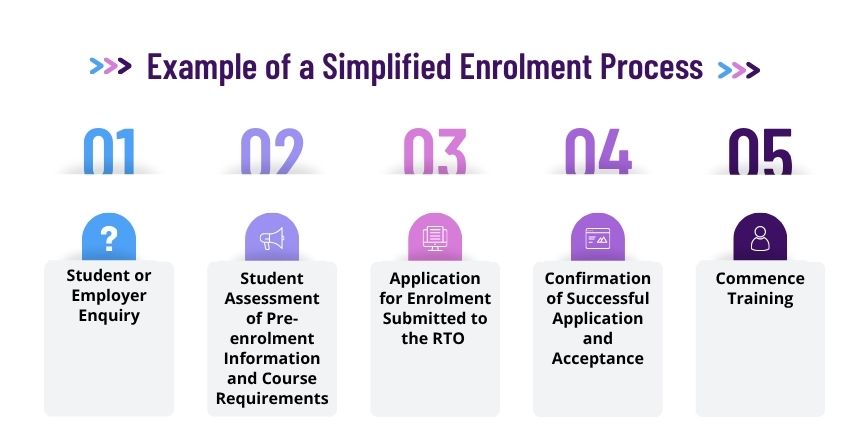
Step 1 – Student or Employer Enquiry
A prospective student or employer will enquire about a training product verbally, in writing or via a website. This stage is considered exploratory and where the enquirer is gathering general information about the RTO, eligibility requirements, costs, location of training, the training pathway and study options to help them determine suitability in terms of their needs and aspirations.
Step 2 – Student Assessment of Pre-enrolment Information and Course Requirements
The prospective student gathers adequate information from the RTO about the training product in which they wish to enrol, any entry and course requirements such as language, literacy, numeracy and digital literacy requirements, and their obligations in undertaking the training, and has the opportunity to discuss these with the RTO if required.
Examples of course information that will be important for prospective learners in their assessment include:
- specified language, literacy, numeracy and digital literacy levels/assessment;
- previous qualifications, skills and interests;
- any course pre-requisites or specified entry requirements; or
- any course selection requirements such as submission of a portfolio or attending an interview.
The prospective student assesses these requirements to determine whether they can meet the requirements of the course and wish to progress with their enrolment or consider alternative options.
Step 3 – Application for Enrolment Submitted to the RTO
Based on the information gathered by the potential student or employer, a decision is made about the preferred RTO and the training pathway that meets their needs.
The potential student or employer may commence the application process using the online forms available on the RTO’s website or via the enquiry in a paper-based format. The application form should be comprehensive and provide sufficient information from the potential student so that the RTO can undertake a review to determine eligibility and suitability as well as to the applicant so that they may continue to determine suitability.
Step 4 - Confirmation of Successful Application and Acceptance
The RTO reviews the student’s application and determines if any additional information or support may be required. The RTO will have a process to inform the potential student or employer if the application was accepted or otherwise. If the application is successful, the RTO should issue a formal offer of enrolment that clearly outlines the training product, commencement date, fees and charges, and any conditions of enrolment. If the application is unsuccessful, the RTO may wish to provide some context for non-acceptance.
It is important that the RTO provides a mechanism for the student to formally accept the offer—this could be through a signed agreement, digital confirmation, or written response. This acceptance confirms the student’s intent to proceed and ensures mutual understanding between the RTO and the student or employer.
Step 5 – Commence Training
At the point at which the potential student is enrolled and commences training, the student should be equipped with all the information they need about how their training and assessment will be delivered including contact information for any additional assistance or support that may be required.
This enrolment model provides a framework for RTOs to consider in line with Outcome Standards 2.1 and 2.2. RTOs will be able to create a process that is streamlined and easy to navigate.
Outcome Standard 2.1- Information and Enrolment
Outcome Standard 2.1 is about the provision of information and the accuracy of that information so that students can clearly understand the details of the course.
RTOs will need to consider the range of information to be included in course information and enrolment processes for their potential students and employers. This will include:
- the type of information provided to students prior to enrolment and during the course of their studies;
- when the information is provided to students prior to enrolment and during the course of their studies;
- how the information is provided to students; and
- students being informed by the RTO on how they will use the information collected to ensure training is relevant and that students are set up for success.
Let’s take a deeper dive into Standard 2.1 and what RTOs should consider into their practices to ensure they meet the required standard for audit purposes.
It is the RTO’s responsibility to ensure that any information provided by them or any third-party with whom they have an agreement is:
- clear – information is easily understood and free from confusion/ambiguity;
- accurate – information is factual, precise, free from errors and reliable; and
- current – information is up-to-date and timely.
The RTO needs to be able to identify which information VET students require prior to enrolment and then communicate that information.
Understanding ‘what students need to know prior to enrolment’ can be ascertained via a range of mechanisms suitable to the size and context of the RTO but could include - using the outcomes from interviews, surveys, student feedback or focus groups.
RTOs use varied communication strategies to engage with students including written and verbal. Written communication generally extends to websites, course flyers, text messages, social media and emails. Regardless of the method of written communication, RTOs should ensure all information, across all platforms, is consistent and informative. The challenge for RTOs is maintaining information currency when change is omnipresent!
The type of information that RTOs should consider including in their pre-enrolment information includes:
- details on the training product such as the unit code and title, qualification code and title, skill set code and title, accredited course code and title;
- whether the RTO’s services are provided by them or via a third-party;
- use of industry experts if relevant, Compliance Standard 7(3);
- where the training will take place including different sites for different learning components of the course;
- the learning pathway whether employment based or institutional based;
- the mode of delivery such as classroom, online, workplace including any work placement requirements (mandated or otherwise);
- course duration in either hours, days, weeks, months or years including specific dates;
- the objectives or learning outcomes of the course;
- the methods of assessment, such as written, observation, case studies, portfolios, Recognition of Prior Learning (RPL);
- the resources that a student may require to complete the course such as uniforms, personal protective equipment, technology, text books;
- the cost of the training and any other fees that may not be explicitly implied, such as additional resources not funded under the ‘course fee’;
- whether there are minimum requirements for language, literacy, numeracy or digital literacy;
- whether there are pre-requisites for the course;
- whether the student will need to hold a level of skills or experience to enrol in the course;
- what support and level of support is available;
- fees, charges and any relevant government subsidies (including equipment, uniforms etc);
- student rights, obligations and requirements;
- details of the certification the student will achieve on completion; and
- any licensing, regulatory or legislative requirements either before, during or after completion of the course.
RTOs should also be aware that there will be students that may also require additional information included in the pre-enrolment information such as:
- accessibility to and in the RTO’s premises;
- safe spaces for students to access culturally sensitive practices; and
- support and wellbeing services particularly where the RTO is delivering to students under the age of 18 and child safety.
The above information may come in the form of course brochures, information sheets or detailed on an RTO website. Whatever form this information is being provided by the RTO, being transparent is the key to successful student enrolments. The more comprehensive the information, the more likely it is that potential students will:
- understand how the training product will meet their needs; and
- have considered whether they have the skills and knowledge to successfully complete the training; and
- have a greater chance of success.
As mentioned earlier, the challenge for RTOs is maintaining the currency and accuracy of the information when change is omnipresent! RTOs should be constantly reviewing and revising the information provided to students to ensure ongoing relevancy and accuracy. Several ways an RTOs can ensure they are providing the right information in a way that makes sense for a student, depending on the RTO’s size and context may include:
- a dedicated person(s) to review marketing materials or ensuring it is part of a current staff members job description;
- administrative or marketing team to ensure ongoing quality information is available;
- using proof-reading tools for accuracy and grammar;
- setting up work processes that automatically trigger checks at different stages of information design; or
- creating calendar appointments that incorporates regular dates for checking information.
Consistent information provided verbally between RTO staff members and a potential student can be more challenging to monitor due to memory constraints, attention limitations and cognitive overload. However, some RTO strategies may include ‘cheat sheets’ for staff to refer to or frequently asked questions.
Background: EWE Training is a small training provider that delivers first aid training and other high-risk units of competency at their premises. EWE has engaged one staff member to be responsible for administering enquiries, training room set up and learner resources.
The staff member received an enquiry from a potential student on a day where a lot of multi-tasking was required. In the conversation, the potential student sought additional information from the staff member and booked into the course commencing in two weeks’ time.
The staff member provides course information to the potential student with the exception of having to wear PPE to the training facility.
The student turned up to the training without wearing appropriate PPE as required. The potential consequences of not providing accurate information are:
- the student being refused entry to the training site; this could lead to the student missing a day off work and payment for that work;
- the student not being able to attain appropriate certification required for them to complete a task in the workplace;
- the student having paid for a course for which they can now no longer participate; and/or
- the student wasting time and money travelling to and from the training facility.
To avoid this situation from occurring, the RTO could implement the following to ensure potential students are provided with clear, accurate and current information. For example:
- scripts/checklists for RTO staff to use during an enrolment conversation; and
- following up the verbal conversations in writing.
Information must be easily accessible to potential students.
Accessibility to training information means that all students should have access to information that can be easily understood including potential students with disabilities.
RTOs could provide information in formats that are not only easily accessible but include simplified language, video clips, large fonts, pictures and be compatible with screen readers and other assistive technologies.
The provision and accessibility of student support and wellbeing services are required to address any student challenges (personal or academic). RTOs should consider what type and level of support students may require including:
- tutoring and academic support – provided by professionals to aid training content understanding and develop effective study habits;
- accessibility to resources such as those found in a library or online;
- personalised guidance – access to counsellors (through the RTO or an organisation’s Employee Assistance Program);
- career development and work placement support – to assist students explore career options and ‘best fit’ work placements; and
- student advocacy services which allow students a voice to be heard and a safe place to bring up challenges affecting their studies.
Depending on the size and scale of an RTO, the support services provided will vary, however, students should be provided with the type of support available and the contact details for those involved, including any external agencies. This information will generally be communicated on a RTO’s website, student handbook, course flyer or verbally via the trainer. The RTO should ensure that the information provided is factual and does not overstate the level of support a student is able to access.
Student Obligations
A potential student should understand their obligations and fee commitment prior to formalising their enrolment so that they can effectively manage their finances and have trust in the RTO to deliver the services advertised. Many courses are funded through government programs such as participation programs or traineeships and apprenticeships. As part of the RTO’s contractual obligations with the State government, they are required to provide accurate fee and subsidy information. Funded RTOs can refer to the Department of Training and Workforce Development’s (DTWD) website for the annual VET Fees and Charges Policy.
Student fees cover the cost of training instruction and other essential components of a student’s education such as assessment and administrative services. Students may feel misinformed if an RTO does not provide information on ‘additional costs and charges’ prior to enrolment. RTOs may charge a student additional costs such as:
- replacement qualifications or statements of attainment;
- re-assessment fees;
- textbooks, industry specific materials, equipment or technology;
- expenses associated with a work placement; and
- cancellation fees relating to non-attendance.
To avoid confusion and possible complaints, any additional costs should be stated up-front at the pre-enrolment stage.
RTO information about the fees and charges that apply could be available via the RTO website or in a student handbook. The key is that this information is available prior to enrolment. It is important the RTO has a transparent and comprehensive Fees and Charges Policy, leaving no room for interpretation which should include details such as:
- the cost of the training including how the RTO applies fees for skills recognition;
- how refunds are applied (full and partial);
- the process for detailing with cancellations;
- contact details in reference to fees and charges information;
- the students’ rights as a consumer;
- any VET-FEE-HELP information;
- information on grants and subsidies;
- financial hardship and concession details; and
- details on WA government funded programs.
Proactive communication with students is the key to building trust and confidence. It reduces uncertainty and can help build lasting relationships. RTOs, regardless of whether they are public, private or enterprise-based, should adopt a transparent communication style. There are many factors that can impact a student and have a positive or negative effect on their learning experience, some being more or less important. Changes such as transitioning to a superseded, deleted or expired training product are important pieces of information for a student, having paid fees for a course, they will want to ensure they receive the most relevant and up-to-date training product.
BBD Training delivers the Diploma of Leadership and Management which is delivered part-time over 2 years. The qualification has been updated to reflect the introduction of artificial intelligence into management practices and new core and elective units have been endorsed and made available. The qualification has been deemed non-equivalent. The RTO has 50 students enrolled in this qualification and the RTO has a 12-month window to transition students.
What process might the RTO adopt to ensure students understand the changes and whether they will impact them and their ability to successfully complete the new qualification?
- Appoint a qualified trainer/assessor to review the units of competency within both qualifications to determine any equivalencies.
- Create a list from the student management system of all students affected by the change.
- Prepare detailed written communication for students, informing them of the change, how they are affected and inviting them to meet with relevant personnel (either face to face or virtually) to discuss any impacts and implications.
- Develop a mapping document for each student which outlines the changes required for them to successfully achieve the new qualification and provide a copy of this to each student.
- Enrol the student in the new qualification and provide a timetable to the student for successful completion.
Outcome Standard 2.2 - Suitability of the Training Product
The intent of this Outcome Standard is to ensure that RTOs have:
- in context of the training product, procedures to review the skills and competencies of the student including language, literacy and numeracy;
- a mechanism for advising students whether a training product is suitable for them prior to enrolment – to ensure the ‘right fit’; and
- a process for how students are informed of the RTO’s decision to enrol or otherwise.
A prospective student cannot commit to enrolling in a training product or incur any financial burden in relation to that training product until advice is provided to the student on whether the training product is suitable for them, and the process should allow for a prospective student to decide not to enrol.
RTOs may conduct the review in a range of different ways, as suited to their size, context and needs of their student cohort.
Ensuring Suitability Through LLND and Skills
To set students up for success, RTOs must assess whether prospective students possess the necessary competencies to undertake the course relevant to the training product. This review protects student wellbeing by reducing the risk of enrolling in training that is unsuitable for them.
Prior to enrolment, RTOs must:
- provide accurate and accessible information to prospective students about the foundation skills and competencies (or other attributes) needed to successfully participate in the training product;
- review the prospective student’s skills, ensure they have the necessary language, literacy, numeracy and digital proficiency to undertake the intended training;
- inform prospective students about the extent of support services available (including the limits of an RTO’s ability to respond to individual needs) to provide prospective students with the opportunity to decide if the RTO is able to meet their needs; and
- where a prospective student does not have the required skills and competencies needed to successfully participate in the training product, RTOs should advise the person on the suitability of the training products for them.
RTOs may use a variety of tools to support this assessment, such as LLN assessments, digital literacy checks, interviews, online questionnaires (e.g. LLN Robot), direct observation, or review of previous work samples. These tools should be developed at the appropriate AQF level and provide meaningful insights to inform decision-making. While there is no one-size-fits-all approach, the method chosen must be proportionate to the training product and student cohort.
RTOs should also consider the Foundation Skills embedded within the training product to ensure an enrolling student will be able to meet these requirements. These essential capabilities underpin effective workplace performance and include LLND, along with broader employability skills such as communication, problem-solving, teamwork, and initiative. Foundation Skills are central to a student’s ability to engage with training and apply their learning in real-world contexts and should be a core component of the suitability review.
In addition to LLND and foundation skills, RTOs should also review other competencies relevant to the training product. These may include technical or vocational abilities, unit of competency prerequisites that must be achieved prior to enrolling or performance expectations embedded in the unit or qualification—such as physical dexterity, safety awareness, or licensing requirements to ensure enrolling students will be able to meet the training product requirements. Where these are identified, they should be incorporated into the course information available prior to enrolment so that prospective students are aware of these requirements.
No student should be formally enrolled or incur any financial costs until this review is complete, and advice has been provided.
Tailoring the Enrolment Process
Given the diversity in RTO structures, student cohorts, and delivery modes, enrolment procedures must be proportionate and tailored to the RTO’s context, the training product, and the needs of the students. The depth of the review should reflect the nature of the training. For example:
- a full-time, 12-month qualification may require a more comprehensive review than a short or online course.
- employer-initiated training may require coordination with workplace supervisors to assess suitability.
RTOs should clearly communicate the extent and limitations of available support services, enabling students to make informed decisions about whether their learning needs can be met. This includes academic support, wellbeing services, and any reasonable adjustments for students with specific needs.
Developing a Flexible and Inclusive Procedure
RTOs must develop a procedure that is flexible enough to accommodate the range of programs they offer—whether full-time 12-month qualifications, one-day short courses, traineeships and apprenticeships or assessment only pathways.
This procedure should include a review of LLND and other skills, including foundation skills, required for the training product. RTOs may need to develop new processes or update existing ones to ensure students can demonstrate the necessary competencies. Key factors to consider in developing this procedure include:
- student cohort characteristics such as employed, unemployed, previous education, socio-cultural background, disabilities, preferred language and age;
- the length and nature of the training program;
- whether the student or employer initiated the need for training;
- whether it is employment based or institutional based training pathway; and
- mode of delivery such as classroom, online, workplace including any work placement requirements (mandated or otherwise) or a combination of any of these.
In reviewing and refining enrolment procedures, RTOs may wish to draw on the following frameworks:
- The Principles to Guide Foundation Skills Assessment – good practice guidance to support a nationally consistent approach to assessing prospective learners’ foundation skills prior to enrolment in training;
- Australian Core Skills Framework (ACSF) – a tool to describe, assess and benchmark core skills;
- DigComp (Digital Competence Framework for Citizens) – a framework for identifying and describing key areas of digital competence required for the workforce;
- Core Skills for Work Developmental Framework – outlines non-technical skills and knowledge that support successful participation in work; and
- National Foundation Skills Strategy for Adults – aims to create a consistent environment for improving foundation skills among working-age Australians.
DBD Learning is a private RTO that delivers training to employers in work, health and safety (WHS). The current enrolment process for DBD Learning is face-to-face where potential students complete a hard-copy enrolment form. The details of the program are:
- the student cohort are employed staff members who have some element of WHS within their current role;
- the training program will be delivered on the employer’s premises, face-to-face over 12 months;
- the employer has initiated the training;
- the students will be enrolled in a formal qualification at AQF Level 4;
- some of the students will already hold VET or university qualifications in technical areas; and
- it is the employer who is recommending students for entry into the qualification.
Under the 2025 Standards DBD has considered, revised and expanded their enrolment process to ensure it gathers sufficient information on each student’s LLND skills and any foundational or industry-specific skills relating to the training product.
A New Enrolment Procedure
- all students are invited to attend an information session (prior to course commencement) to find out about the course.
- at the information session, as well as being provided with all the relevant information about the course, the students are required to complete a hard-copy, RTO developed questionnaire;
- this questionnaire includes both LLND and a skills quiz. The RTO used the ACSF as the main source document to develop their quiz.
- the questionnaire has been developed at the appropriate AQF level and aims to measure student capability in foundation skill areas specific to this training product such as research skills, communication skills (written and verbal), risk management and WHS tasks;
- this questionnaire also invites students to specify any specific additional support they may require;
- once students have completed the questionnaire, a relevant trainer/assessor or learning and development specialist will complete a review providing written feedback; and
- the students complete the formal application for enrolment document which should be completed prior to the first training session.
First Aid R Us (FARU) deliver only one unit of competency in First Aid. The current enrolment process is that students enrol online via the RTO’s student management system prior to commencement.
The details of the program are:
- the students have completed the First Aid unit previously and are completing it again as part of a refresher
- the training lasts one day with some pre-requisite learning required which is digital in nature
- it is often the employer who requests the training on behalf of their employees
Under the 2025 Standards FARU has considered, revised and expanded their enrolment process to ensure it gathers sufficient LLND and skills information on each student.
New Enrolment Procedure
- FARU has updated its current online enrolment process to ensure a review of student LLND and skills can be undertaken and that no fees are taken in advance of training;
- the new enrolment questionnaire, includes the collation of LLND, skills and national data collection as part of a seamless online process;
- FARU created this questionnaire internally using the Foundation Skills contained within the unit of competency as their source document along with the DigComp framework. Given that students require digital skills to complete the pre-requisite component of the training, this framework provided valuable information;
- the questionnaire has been developed at the appropriate AQF level and aims to measure student capability in areas such as communication skills (written and verbal), use of first aid equipment, interpreting documents, assessing high risk situations;
- the online system will automatically highlight if a student has challenges meeting the requirements of the unit of competency or assessment requirements. At this point, based on the information available, the student may decide not to proceed with the enrolment and may seek information about other suitable training pathways to consider;
- completed online questionnaires will be provided to members of the student support team or similar prior to training commencement; and
- where any challenges are highlighted, they will be discussed with the student prior to commencement.
WEH Training and Development offers traineeships within Aged Care industry. The current enrolment process is that, once employed, WEH are invited into the employer’s premises to meet the student and complete the necessary paperwork. The details of a new enrolment are:
- the student has English as a second language;
- the employer has initiated the training request;
- the employer and student wish to be enrolled in a formal qualification at AQF level 3; and
- the student has no formal qualifications.
Under the 2025 Standards WEH has considered, revised and expanded their enrolment process to ensure it gathers sufficient LLND and skills information on each participant.
New Enrolment Procedure
- prior to visiting the student in the workplace, WEH electronically sends the student a questionnaire that includes both a LLND and skills quiz;
- WEH did consider using an off-the-shelf product to determine the LLND needs of the students but decided to build their own product. In building their own product, they were able to target the specific skills and LLND requirements for the aged care training product;
- WEH informs the student that they can contact the RTO to discuss the quiz questions within the questionnaire if required;
- this questionnaire also invites students to specify any specific additional support they may require; and
- this questionnaire would then be reviewed by a relevant trainer/assessor prior to completion of the traineeship paperwork. Successful students will be automatically notified of their suitability onto the course.
Whichever procedure RTOs adopt to measure LLND and other relevant skills and competencies, it should:
- be sufficiently flexible and proportionate to the size and scale of RTO;
- consider the student cohort needs; and
- be cognisant of the delivery framework of the training product.
The advice RTOs provide to a student can be verbal and/or in writing. The key requirement is that advice is provided to the student about suitability and the RTO has evidence to support a review that has informed their decision-making. This will generally be included in the RTO’s enrolment procedure.
The nature of advice to a student following a review, should be prompt, concise and with an explanation of the rationale for the decision. The advice provided should allow the student with the opportunity to raise any questions or concerns with a relevant staff member. It may be appropriate, that after further discussion with a staff member, an RTO may propose an alternative, more suitable training product for the student.
The question as to who should undertake the LLND and skills review will be determined by the organisation structure and job roles of personnel within the RTO. However, it is important that the nominated individual has the appropriate skills to undertake the review.
The key change for RTOs to think about in reference to Outcome Standard 2.2 is that an RTO needs to determine a student’s course suitability prior to enrolment. Whilst it may present some initial challenges for RTOs, it also presents an opportunity: the opportunity to revisit current enrolment procedures and update them to ensure that when students are accepted onto training programs, RTOs have confidence that they will be able to successfully achieve the outcomes through having undertaken a rigorous enrolment process.
