


Up-to-date information on water resources is vital for planning and adapting operations that rely on water.
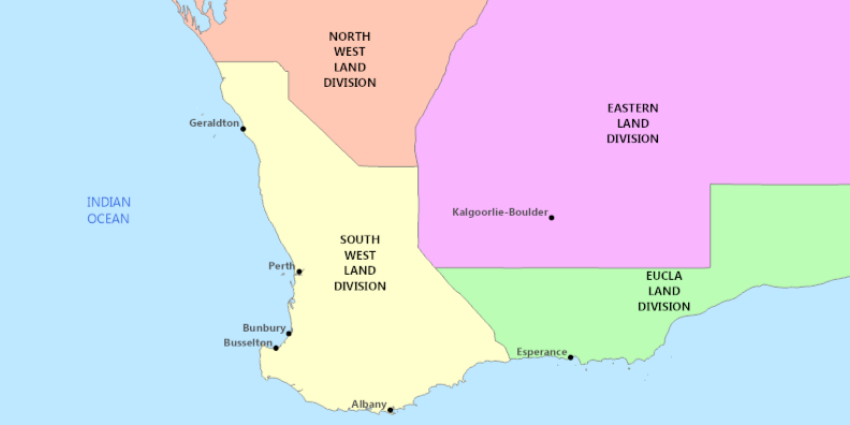
The Department of Water and Environmental Regulation (the department) tracks rainfall, streamflow and groundwater in the South West Land Division (SWLD) to help prepare for and respond to dry summer conditions. This helps the community and State Government to:
- respond to yearly changes in rainfall and streamflow
- investigate the rainfall and streamflow ranges that may occur
- collectively prepare for potential dry periods or other rainfall impacts
- coordinate any required response to manage industry, agriculture and drinking water supplies.
Compared with decades ago, more rainfall is needed now to recharge water resources to historical levels because climate change is altering the way our water systems respond to rainfall. However, intense events can still cause localised flooding. Find summaries of rainfall, streamflow, groundwater and temperature on the pages below.
We also provide a summary of the three monthly forecast.
For more information, please email info@dwer.wa.gov.au.
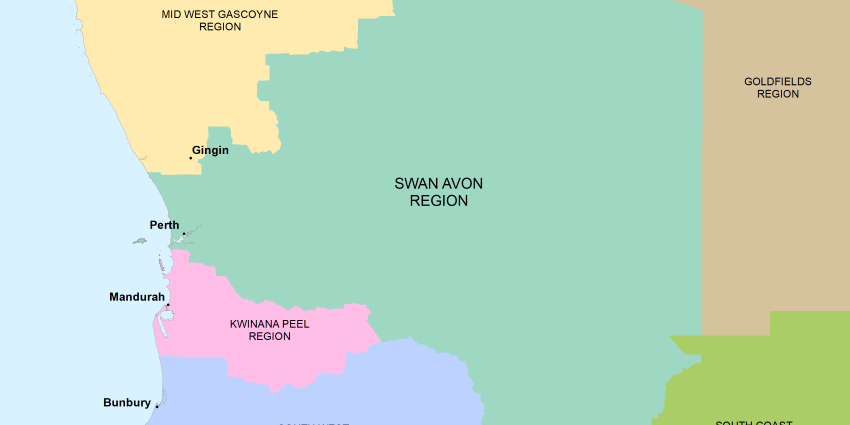
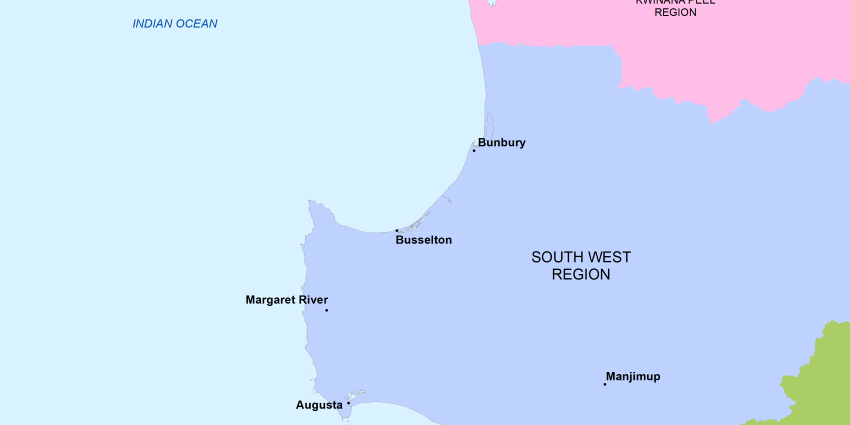
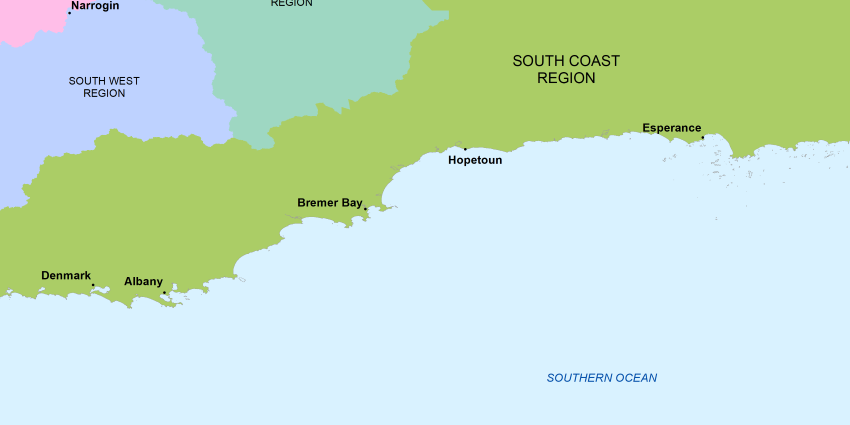
Please click on the tiles below for latest monthly updates of the South West Land Division (SWLD) or specific regions.
Rainfall, streamflow and groundwater
Useful links, water management responses, and bibliography
Show moreThe Department of Water and Environmental Regulation’s:
- river level data
- rainfall data at river monitoring stations
- water information reporting tool – access more of the department’s monitoring data, such as groundwater levels
- rural water planning – information on departmental assistance to farmers
- Climate Science Initiative – for long-term climate modelling
The Department of Primary Industries and Regional Development’s:
- rainfall to date tool – graphs the rainfall amount accumulated from the start of the grain growing season, and the projected range of finishes to the season, for a selected weather station
- monthly seasonal climate outlook newsletter – summarises data from their network and the Bureau of Meteorology.
The Bureau of Meteorology’s:
- rainfall and other climate data for a selected weather station
- seasonal streamflow forecasts
- water storage summary
- climate outlook information – includes rainfall and temperature forecasts (for 1-week, 2-week, 1-month and 3-month periods). For example, a map of the chance of exceeding median rainfall (and the accuracy of this forecast).
For more information, email groundwater.info@dwer.wa.gov.au
Departmental water management responses
The department manages water proactively and reactively. We are:
- delivering the Community Water Supplies Partnership program which boosts water infrastructure upgrades and improvements in 37 local government areas (LGAs) across the dryland agricultural area
- continually communicating with LGAs on the probability of water deficiency declarations in areas where on-farm water storage is at a median level or lower
- assessing water resource conditions and reviewing allocation limits in priority areas
- implementing rural water and allocation planning, water licensing and climate adaptation programs to safeguard resources
- monitoring and managing key estuaries and rivers through the Healthy Estuaries WA and Healthy Rivers programs
- further supporting rivers through the Creating Climate Resilient Rivers project which supports rivers to cope with short periods of extreme conditions, and to adapt and evolve to longer-term changes
- developing and delivering a research program addressing key climate challenges for the WA water sector.
The State Government has invested $25 million in the Lower Great Southern Towns Water Supply Scheme. A response to years of declining rain, the project now ensures Denmark is no longer solely reliant on rainfall for its drinking water. To date, more than $4.3 million has been committed to 37 local governments for projects to alleviate demand on scheme water and increase the availability of non-potable water supplies.
The State Government will also invest up to $15.3 million in key initiatives to improve water security for horticultural growers in the Manjimup–Pemberton region.
Bibliography
Bureau of Meteorology:
- Climate outlooks – weeks, months and seasons. www.bom.gov.au/climate/outlooks/#/rainfall/summary
- Climate and water long-range forecast. www.bom.gov.au/climate/outlooks/#/overview/video
- Western Australia in autumn 2024, 2 June 2024. www.bom.gov.au/climate/current/season/wa/summary.shtml
Footnotes
- Bureau of Meteorology. Western Australia, accessed 9 January, 2025. www.bom.gov.au/climate/current/season/wa/summary.shtml
- Lawrence, J, Mackey, F, Chiew, M, et al. Chapter 11: Australasia. Climate change 2022: impacts, adaptation and vulnerability – Australasia. Contribution of the Sixth Assessment Report of the Intergovernmental Panel on Climate Change.e. doi:10.1017/9781009325844.013
- Water Corporation. Streamflow. Accessed 30 August, 2024. www.watercorporation.com.au/Our-water/Rainfall-and-dams/Streamflow
- Gelsinari, S, Bourke, S, McCallum, J, McFarlane, D, Hall, J, Silberstein, R, Thompson, S, 2024, Nonstationary recharge responses to a drying climate in the Gnangara Groundwater System, Western Australia, Journal of Hydrology, Volume 633, 2024, 131007, ISSN 0022-1694, www.sciencedirect.com/science/article/pii/S0022169424004025
Essential information
The Bureau of Meteorology:
- issues weekly forecasts essential to the tracking information in this page; however, the department aims to update this webpage about monthly. The tracking information is relevant for the time of publication only; key information may have changed
- forecasts use a slightly different time period to the department’s historical tracking time period.
Disclaimer
The Government of Western Australia (State Government) is committed to quality service to its customers and makes every attempt to ensure accuracy, currency and reliability of the data contained in this page. This page is for information purposes only and the State Government cannot and does not represent or warrant that the document is free of errors, inaccuracies, faults or omissions. Changes in circumstances after time of distribution may impact the quality of this information. To the fullest extent permitted by law, the State Government and its officers and employees are released from liability (including in respect of negligence) for any loss, damage, cost and expense caused by use of or reliance on this document and the information contained on it.
