



The WA Government has lodged its submission to the Productivity Commission’s inquiry into the 2018 GST Reforms, alongside a People’s Submission representing the voices of more than 6,000 Western Australians — read the reports here.
The Productivity Commission released its interim report to the Australian Government, on 14 August 2026, with a final report by the end of the year. Learn about the proposed GST changes and the impacts to WA at GST WA: Homepage
The Productivity Commission’s recommendations aim to assist the Australian Government to decide if the GST Reforms made in 2018 are working as they should, or if the way GST is shared between States could be improved.
More information will be provided on this website as it becomes available.
To understand what potential changes to Western Australia’s GST share would mean we should first look at what we currently have allocated.
WA’s share of the GST
The money collected in Australia from GST is distributed to States and Territories based on how much they need to spend and how much they can raise on their own.
The GST Reforms introduced in 2018 have improved the fairness for Western Australia. Despite this WA still receives only 82% of its per person share of the GST revenue.
Without these reforms, WA would receive just 24% of its population share — or about $6 billion less each year.
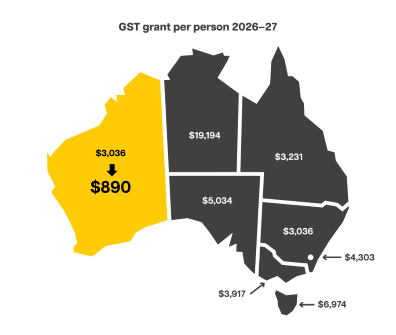
The following map shows the GST grants on a per person basis.
Even with the 2018 Reforms, WA receives the equal lowest share with New South Wales at $3,036 per person. Queensland receives 6% more, Victoria 29%, ACT 42%, and South Australia 66% more. Tasmania’s share is almost 2.3 times WA’s and the Northern Territory more than 6 times WA’s share.
Without the GST Reforms, WA’s GST grants per person would be just $890 - less than one third of New South Wales, about one eighth of Tasmania’s and one twentieth of the Northern Territory’s.
What does the current GST share mean for WA
Key facts:
- WA’s GST funds our local hospitals and schools, and it’s also invested in essential infrastructure like roads, ports and power - supporting WA projects that drive the national economy and produce almost half of the nation’s exports.
- WA receives only 9.1% of the GST share, and if the GST Reforms were withdrawn, WA’s share would fall to only 2.7%, yet:
- it is home to over 11% of the national population;
- we produce over 45% of Australia’s goods exports; and
- we make up 17% of the national economy.
- WA has the largest land mass in Australia but receives less GST than smaller States for regional and remote costs.
- In 2024-25, WA’s net contribution to the nation was over $12,000 per person – more than 11 times that of NSW (at around $1,050 per person) – the only other State making a positive contribution.
How WA’s GST contributes to the rest of Australia
Key facts:
- WA subsidises other States via the GST system by around $2 billion per year even with the reforms. Since the GST Reforms began, WA has still contributed $21 billion to the other States.
- WA produces over 45% of Australia’s goods exports but only receives around 9% of the GST share. Without the 2018 GST Reforms, WA would receive only 2.7%.
- WA produces Australia’s highest Gross Domestic Product per capita ($155,644) but receives the equal lowest GST share per capita ($3,036).
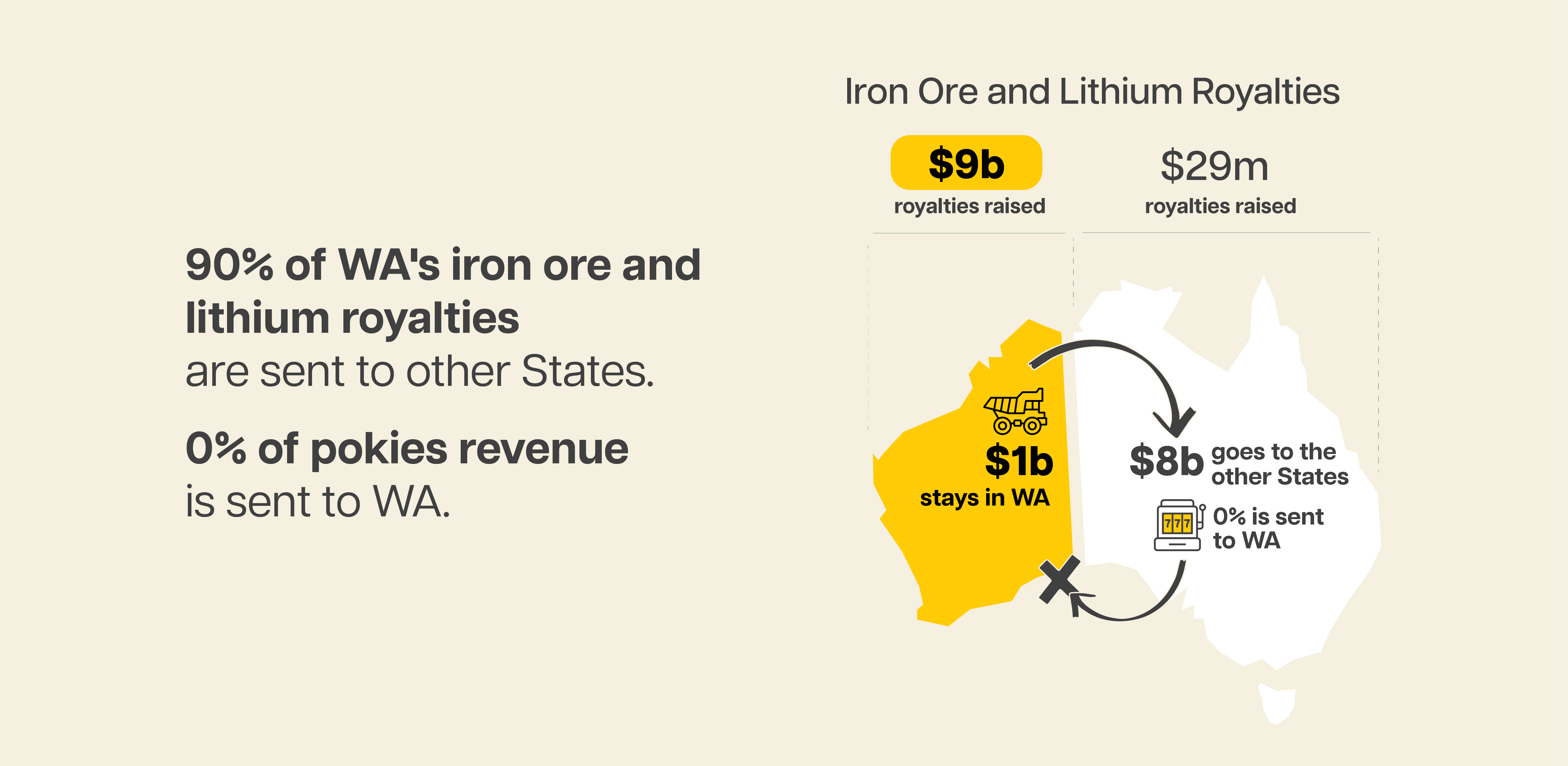
- Without the GST Reforms, WA retains only 11% of its iron ore and lithium royalties, with the other 89% given to other States. In comparison, other major mining States keep up to 98% of their mining royalties.
- Since the GST was introduced, WA has contributed $50 billion to the other States and Territories through the GST system.
A strong WA economy means a stronger national economy. WA’s GST is working for all of Australia.
Keeping WA’s fair share of GST.
WA isn’t seeking a greater share. By keeping the current GST distribution Western Australia can:
- Better fund services like health, education and police across WA, including in regional and remote areas, which cost more to deliver
- Invest in social infrastructure like new and expanded schools and hospitals, social and affordable housing
- Provide additional investment in economic infrastructure like ports, utilities and roads that grow not just the WA economy but the national economy
- Continue to grow our strong exports globally with WA already accounting for 45% of national goods exports
- Keep our economy strong, which means more jobs and a better standard of living
- Continue to contribute to Australia’s Gross Domestic Product, the GST and other revenue collections to the Commonwealth, which benefits all of Australia.
How can I take action?
The Productivity Commission review is still underway, and there are opportunities to have your voice heard.
Find out how you can stay informed and get involved.



How does WA’s GST benefit the rest of Australia?
Show moreEven with the reforms, WA still provides a GST subsidy to the rest of the nation of around $2 billion per annum.
Since the reforms were implemented, WA has still contributed $21 billion in GST to other States. Since the GST was introduced in 2000, WA has contributed more than $50 billion.
This is on top of the billions of dollars over and above our population share that flow to the Commonwealth and other States and Territories through higher company tax and other revenues that are generated from Western Australia’s strong economy.
Is WA asking for more GST?
Show moreNo. The WA Government is not seeking a greater share of the GST distribution.
WA wants to retain the 2018 GST Reforms that support both WA and the national economy.
Want to find out more about GST Reforms?
Show moreProductivity Commission
To learn more about the inquiry from the Productivity Commission visit the terms of reference. Terms of Reference – GST Reforms
Australian Taxation Office (ATO)
Learn more about how GST works in Australia on the ATO website. How GST Works
Parliamentary Education Office
Learn the background on how the GST was introduced in Australia. History of the GST
Federal Register of Legislation
Read the full text of the legislation governing GST. A New Tax System (Goods and Services Tax) Act 1999
Commonwealth Grants Commission (CGC)
Find out how GST revenue is distributed across Australia’s States and Territories. About GST Distribution
