


Privacy Threshold Assessment Template
The purpose of this resource is to help Western Australian public sector entities and their contracted service providers (called IPP entities) assess whether they are required to conduct a Privacy Impact Assessment (PIA) under the Privacy and Responsible Information Sharing Act 2024 (WA) (PRIS Act). Where an IPP entity is not required to conduct a PIA, this resource is designed to help the IPP entity consider whether there is another reason for conducting a PIA.
The OIC WA has also developed a template to assist an IPP entity to work though the considerations in this guidance and document its decision about whether to conduct a PIA. This is called a Privacy Threshold Assessment.
This is the second resource in a suite of three resources designed to guide IPP entities through why, whether and how to conduct a PIA:
- WHY: Introduction to PIAs
- WHETHER: Do I need to do a PIA?
- HOW: How to do a PIA
All three resources are designed to be read together.
Introduction
Show moreA PIA is a scalable tool for identifying, assessing and mitigating privacy risks. A PIA is an integral part of good privacy management as it:
- is a vehicle for ensuring privacy risks are managed effectively, with a view to reducing, minimising or eliminating potential negative privacy impacts on individuals and the community more broadly.
- helps an IPP entity consider how it will meet the privacy requirements of the PRIS Act, including the Information Privacy Principles (IPPs), when handling personal information.
- builds public trust by improving transparency and supporting an IPP entity meet public expectations about how personal information is handled.
The PRIS Act requires IPP entities to undertake a PIA:
- before an IPP entity first performs a high privacy impact function or activity
- when an IPP entity makes a significant change to the way in which personal information is handled as part of a high privacy impact function or activity, or
- before entering into an information sharing agreement if the activity is likely to have a significant impact on privacy, involves data integration or data linkage, or any of the proposed recipients is an external entity.
Even where a PIA is not required under the PRIS Act, a PIA can assist an IPP entity to understand its privacy risk exposure and identify how it is meeting its obligations under the IPPs, particularly in relation to legacy activities that commenced before 1 July 2026.
A privacy threshold assessment is a preliminary step in the PIA process designed to help an IPP entity determine whether a PIA is required.
Privacy Threshold Assessment
Show moreA privacy threshold assessment is a preliminary assessment to help an IPP entity determine whether it should undertake a PIA. The outcome of a privacy threshold assessment will be a recommendation about whether a PIA should be conducted. It is not a “mini” PIA to determine the level of risk and identify mitigation strategies.
A privacy threshold assessment does not need to be in a particular form. How an IPP entity chooses to conduct a privacy threshold assessment, including any approvals required, will depend on the IPP entity’s established governance and risk processes and procedures.
The OIC WA has developed a template to assist IPP entities undertake a privacy threshold assessment. IPP entities are welcome to tailor this template to suit their needs. The use of the template is not mandatory.
What is a high privacy impact function or activity?
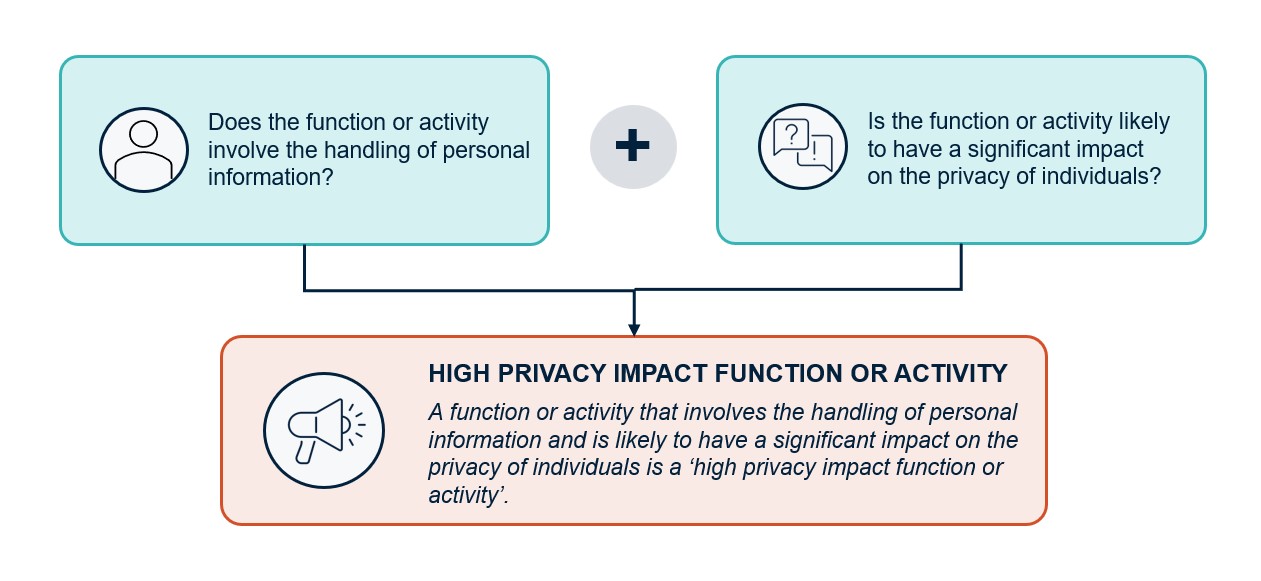
Show moreSection 79 of the PRIS Act provides:
(1) A function or activity of an IPP entity is a high privacy impact function or activity if the performance of the function or activity —
- involves the handling of personal information; and
- is likely to have a significant impact on the privacy of individuals.
What is “handling personal information”?
A PIA is only required when the project involves the handling of personal information.
Personal information is information or an opinion, whether true or not, and whether recorded in a material form or not, that relates to an individual, whether living or dead, whose identity is apparent or can reasonably be ascertained from the information or opinion. For more information see “What is personal information?”.
Personal information is “handled” when any step of the information lifecycle is undertaken. It includes collecting, holding, managing, using, disclosing or destroying personal information.
What is “likely to have a significant impact on the privacy of individuals”?
Show moreWhat does “significant impact” mean?
“Significant impact” is not defined in the PRIS Act. A significant impact on privacy is one that warrants further consideration to identify measures to prevent or mitigate that impact.
A project can still have a significant impact on the privacy of individuals even when a law requires or authorises the handling of personal information, or where an IPP entity relies on another exception to the IPPs.
Whether a project is likely to have a significant impact on privacy, and hence whether a PIA is required, is determined based on the potential impact. It is generally not assessed based on the residual risk after mitigation strategies have been implemented.
An IPP entity should not assume a project will have no privacy impact where de-identified information is being used. Where a project involves the handling of de-identified information an IPP entity should consider the risks if the information were to be re-identified. This is particularly important where a project involves a information sharing agreement under Part 3 of the PRIS Act, data linkage or data integration.
Whether a project will have a significant impact on the privacy of individuals will depend on the circumstances. Sometimes a single factor may be enough to indicate a PIA should be performed and other times multiple factors together indicate a likely significant privacy impact.
Examples of factors that may indicate a significant impact on the privacy of individuals:
The project involves | Potential impact/s |
|---|---|
| Personal information handled on a large scale | Large-scale handling may affect many individuals or involve substantial volumes or types of personal information. This can increase both the likelihood of a privacy risk being realised and the scale of the impact. |
| Sensitive personal information | Sensitive personal information can be associated with discrimination and intrusive collection practices. Some sensitive personal information, such as biometric information, is not easy to change once compromised. |
| Personal information of children or vulnerable individuals | Some individuals may be more susceptible to harm or face greater difficulty understanding, exercising or protecting their privacy rights. |
| Personal information of individuals handled without their knowledge | Individuals may be unable to make choices or exercise their privacy rights. The handling may also be unexpected or inconsistent with individuals’ expectations. |
| Tracking individuals or surveillance | Tracking and surveillance may reveal detailed patterns about an individual’s movements, behaviour, activities or associations over time. Tracking and surveillance can enable monitoring or profiling of individuals which can negatively curtail or impact individuals' behaviour and choices. |
| Inferred personal information | Inferences may reveal new or sensitive personal information that individuals did not directly provide or expect to be derived. Inaccurate inferences may affect individuals. |
| Data linkage or data integration | Combining information from different sources may create a more detailed picture of an individual than any single source. It may also enable new uses of personal information or increase the risk of re-identification of de-identified information. |
| Automated decision-making and artificial intelligence | Automated processes can be used to make or influence decisions that affect individuals quickly and at scale. Errors or bias in automated processes can be replicated widely, and individuals may have difficulty understanding or challenging how a decision was made. |
| New technology or existing technology used in a novel way | New or novel uses of technology in ways that weren’t originally intended may create new privacy risks that are not yet well understood or addressed by established safeguards. |
| Disclosure of personal information to another entity | Disclosure to a contracted service provider or another third party, including those outside Australia, may reduce the disclosing entity’s practical control over how personal information is handled. Depending on the circumstances, this may result in privacy impacts requiring further consideration. Sometimes this may be considered as part of a vendor risk assessment. |
| Personal information used to make a decision that affects an individual’s rights, entitlements, interests or liabilities, or otherwise has a significant effect on an individual’s life circumstances, opportunities, behaviour or wellbeing | Personal information used to make decisions of this nature can have serious or lasting consequences for an individual. |
| Personal information handled in a way that may result in individual harm | Personal harm may include both physical and emotional harm, denial of access to a service, discrimination, financial loss, reputational damage or identity theft. |
| Personal information handled in a way that may result in collective harm | Privacy impacts may have a collective impact on a particular group of individuals, community or the public more broadly. Collective harm may occur even when harm to a particular individual is difficult to identify or doesn’t appear significant when assessed in isolation. This is because the scale of these impacts may only be evident when viewed across a population or because the impacts accrue gradually over time. Examples of collective harm may include:
|
What does “likely” mean?
The term “likely” is not defined in the PRIS Act. It should be construed in accordance with the relevant objects of the PRIS Act which includes promoting the responsible handling of personal information. In this context, something is likely to have a significant impact when there is a real chance or possibility that it will occur. This means a significant impact is not likely if it is only a remote possibility.
If an IPP entity is unsure whether a proposed project is likely to have a significant impact on the privacy of individuals, it should conduct a PIA.
Example 1 – Function or activity likely to have a significant impact
A Department proposes to use an AI scribe to maintain a record of meetings staff have with external stakeholders. These meetings are sometimes between staff and members of the public who are accessing public services. The AI scribe summarises the discussion and organises the summary into an approved format. The staff often use the record of meeting minutes when making decisions, including in relation to the provision of services.
The Department has not used AI scribe technology before.
There are several factors indicating this trial may have a significant impact on privacy, including:
- the potential for handling personal information without the knowledge of the individuals in the meeting or in ways individuals may not expect
- the use of new technology not previously used by the Department
- potential disclosure of personal information to the third-party provider of the AI scribe technology, and
- the potential for the output of the AI scribe to be used to make decisions, including decisions affecting individuals.
Given the presence of these factors, there is a real and not remote possibility the trial could have a significant impact on privacy, and a PIA should be conducted.
Example 2 – Unclear whether the function or activity is likely to have a significant impact
A Local Government proposes to introduce an online booking system for its community facilities. Residents will be required to provide their name and email address when they make a booking on the system. The Local Government already uses the software provider of the online booking system for other community services.
The Local Government considers the online booking system might create barriers for people who have limited access to, confidence in, or ability to use online services.
The Local Government conducts a Privacy Threshold Assessment but cannot conclusively determine whether the online booking system is likely to have a significant impact on the privacy of individuals. As the Local Government is unsure, they decide to proceed with a PIA so they can consider in detail the privacy impacts of the online booking system and ensure it is implemented consistently with the requirements of the IPPs.
Example 3 – Function or activity unlikely to have a significant impact
A Local Government proposes to introduce an email subscription service for residents who wish to receive updates about upcoming community events. Residents may voluntarily provide their email address through the Local Government’s website to receive the emails and can remain anonymous. The compiled list of email addresses will only be used for the distribution of the community newsletter and residents will be able to unsubscribe at any time.
The Local Government will continue to provide updates about community events through its existing communication channels, including through social media posts and advertisements in the local newspaper.
The Local Government considers the scale and nature of the personal information handled as part of this activity means it is unlikely the email subscription service will have a significant impact on the privacy of individuals. They document their decision and rationale for not conducting a PIA.
When is a PIA required to be conducted?
Show moreA PIA must be conducted:
- before an IPP entity first performs a high privacy impact function or activity, or
- when an IPP entity makes a significant change to the way in which personal information is handled as part of a high privacy impact function or activity, or
- before entering into an information sharing agreement if the activity is likely to have a significant impact on privacy, involves data integration or data linkage, or any of the proposed recipients is an external entity.
Even where a PIA is not required under the PRIS Act, an IPP entity may also choose to conduct a PIA to understand its privacy risk exposure and identify how it is meeting its obligations under the IPPs. This is particularly important in relation to legacy activities where the privacy risks have not previously been formally assessed. For more information about how the PRIS Act applies to activities that commenced before 1 July 2026, please see the OIC WA guidance for IPP entities: Personal information collected before and after 1 July 2026.
What is a “significant change” in the way personal information is handled?
The term “significant change” is not defined in the PRIS Act.
A change to the way personal information is handled is a change to the way personal information is collected, held, managed, used, disclosed, destroyed or de-identified as part of an existing function or activity.
A change to the way personal information is handled will be significant where the change gives rise to new privacy impacts that should now be evaluated or the severity of previously identified privacy impacts increases.
There will be no significant change where the nature, scope, context and purpose of the handling of personal information have not changed and the privacy risks remain unchanged.
Example 4 – Significant change
The Department collects personal information about people who access a public health service. The Department has historically securely destroyed the records containing personal information in line with their retention and disposal authority. The Department proposes to de-identify the records containing personal information instead of destroying them so that researchers can examine patterns in service use and identify gaps in access to public health services.
This would be a significant change as there will be a change to the way personal information is handled when it is no longer required for the purpose for which it was collected. The process of de-identification will introduce new privacy risks that will need to be assessed and managed. The Department will also need to identify and manage their obligations in relation to the handling of de-identified information.
Example 5 – No significant change
A University holds the contact details of students, including both personal email addresses and mobile numbers. The University currently sends an email notification to students to inform them when they have had an assignment graded. The email notification includes a link to the online learning management system, which the student can access using their multifactor identification login credentials. The University proposes to allow students to elect to receive this notification via text message instead of by email. Both email and text message notifications are sent using the same technology platform, which the University has already conducted a PIA on.
Whilst the approved channels for communicating with students have changed, the purpose and scope of the communication remains the same. Having students elect to receive the notices via text message instead of by email does not introduce any new significant privacy risks.
Information sharing agreements
Under Part 3 of the PRIS Act, a PIA is also required to be conducted before entering an information sharing agreement where:
- the activity under the agreement is likely to have a ‘significant impact on the privacy of an individual’
- the activity under the agreement involves data integration or data linkage, or
- any of the proposed recipients is an external entity (section 176).
Guidance on what is a ‘significant impact on the privacy of an individual’ and ‘data integration and data linkage’ is set out above.
The Chief Data Officer has also issued guidelines to support responsible information sharing, including guidance about what assessments must be conducted before entering into information sharing agreements: see Chief Data Officer Guideline: Assessments for data sharing under the PRIS Act.
Next steps – how to conduct a PIA
Show moreIf your privacy threshold assessment recommends that a PIA should be conducted, the OIC WA has published guidance on ‘How to do a PIA’ .
References
Show moreArticle 29 Data Protection Working Party, Guidelines on Data Protection Impact Assessment (DPIA) and determining whether processing is “likely to result in a high risk” for the purposes of Regulation 2016/679 (2017) <ARTICLE29 - Guidelines on Data Protection Impact Assessment (DPIA) (wp248rev.01)
Information Commissioner’s Office United Kingdom, Examples of processing ‘likely to result in high risk’ <Examples of processing ‘likely to result in high risk’ | ICO>
Office of the Australian Information Commissioner, When do agencies need to conduct a privacy impact assessment? (2020) <When do agencies need to conduct a privacy impact assessment? | OAIC>
