


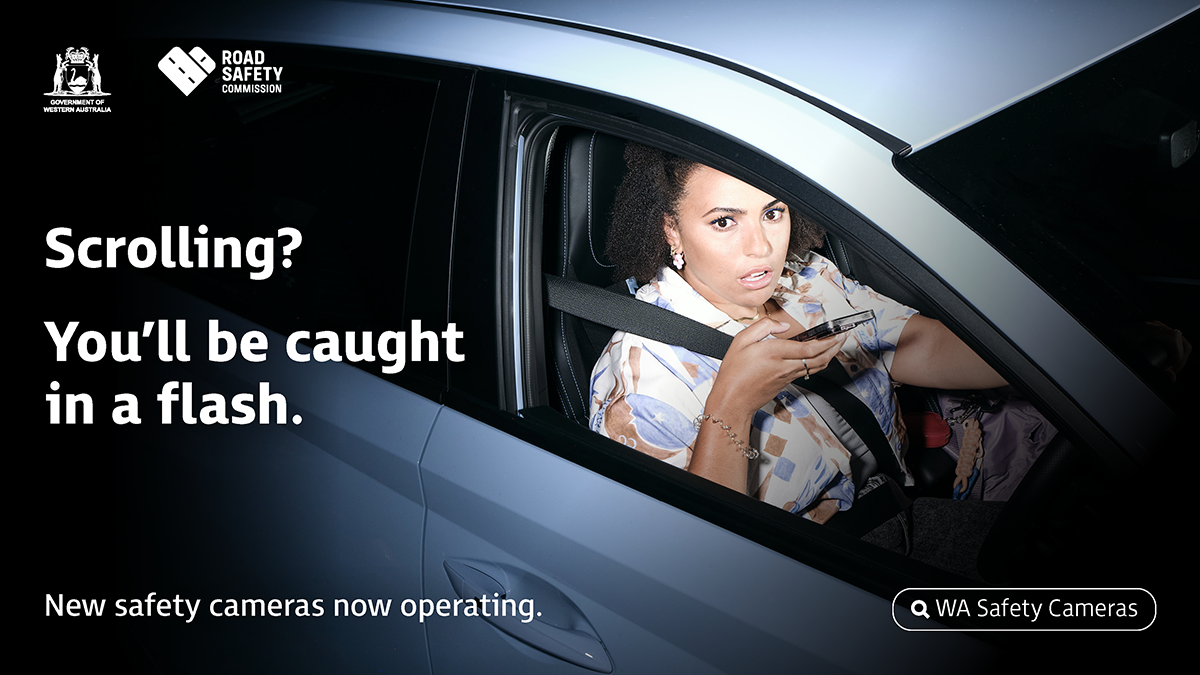
On Sunday 28 September, the Minister for Road Safety and the Road Safety Commissioner launched the ‘Caught in a Flash’ campaign - a statewide push to raise awareness about safety cameras.
The campaign is now running across TV, radio, print, online, social media, and billboards, reminding drivers that camera enforcement starts on 8 October.
The message is simple:
Touching or holding your phone?
Not wearing your seatbelt properly?
Speeding?
You’ll be caught in a flash.
The State Government has also committed over $750,000 in five new community partnerships to help educate all Western Australians about the new camera technology.
These partnerships, funded by the Road Safety Commission’s Community Initiatives Program, will deliver targeted education across metropolitan, regional, and remote communities.
Local groups will lead workshops, provide resources, and run awareness activities that meet their community’s needs.
Road Safety Commissioner Adrian Warner said the goal has always been to educate drivers and provide opportunities to change behaviour before enforcement begins.
“Too many families are left dealing with heartbreak because someone made a bad decision, speeding, texting, or not wearing their seatbelt properly. These are simple things that can have massive consequences.
“I ask every driver in WA: Make smart choices. Take road safety seriously. And help us make our roads safer for everyone.”
The safety camera program is funded by the Road Trauma Trust Account, which ensures that 100% of safety camera fines go towards road safety projects.
Learn more about the safety camera program: rsc.wa.gov.au/safetycameras
Check out the campaign: www.wa.gov.au/organisation/road-safety-commission/caught-flash
