


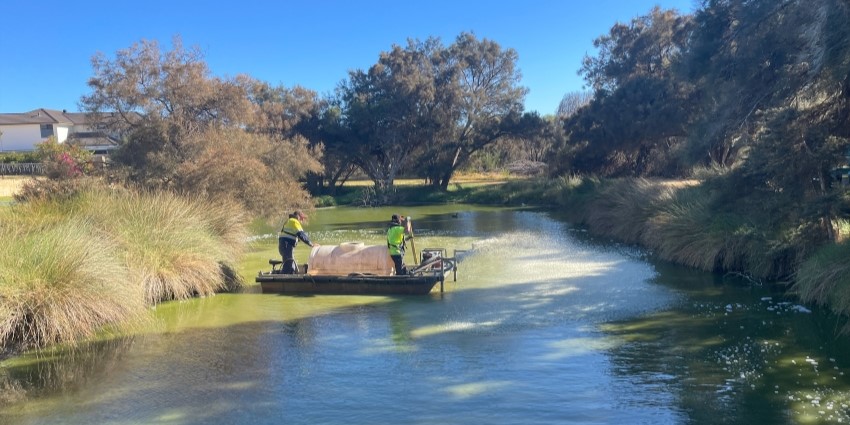
An innovative new trial is helping to improve water quality in the Peel-Harvey estuary catchment by reducing the nutrients that fuel algal growth.
Scientists from Healthy Estuaries WA have applied a specially manufactured clay-based treatment to a drain in the catchment of the Peel-Harvey estuary (Bindjareb Djilba). The clay successfully bound up to 95 per cent of phosphorus at the treatment site, preventing it from fuelling algal growth in the downstream waterways.
Many of our waterways like the Serpentine River (Waangaamaap Bilya) can receive excess phosphorus from fertiliser use in their catchment, potentially causing algal growth that can lead to fish kills and adverse human health impacts.
The Department of Water and Environmental Regulation has been working on a novel clay known as Hydrotalcite clay, or HT-clay. It is made from a natural bentonite clay modified with hydrotalcite: a phosphorus binding mineral. The manufacturing process involves mixing several raw ingredients together, causing chemical reactions where the clay becomes coated in the phosphorus binding material.
The application of the clay to reduce phosphorus concentrations in the waterways complements ongoing work through Healthy Estuaries WA in the catchment. This work with farmers is reducing the amount of fertiliser applied to farms, preventing loss of further nutrients to the waterways.
The clay production and distribution have been funded by the State Government's Bindjareb Djilba Protection Plan and Healthy Estuaries WA program.
Healthy Estuaries WA is a $25 million State Government commitment, which focuses on improving the health of Peel-Harvey estuary, Leschenault Estuary, Vasse-Geographe waterways, Hardy Inlet, Wilson Inlet, Torbay Inlet and Oyster Harbour.
The Healthy Estuaries WA program uses the latest science to monitor and manage our precious waterways, alongside successful collaborative projects involving community, scientists, farmers, government and industry. For further updates on important Healthy Estuaries work underway, visit facebook.com/healthyestuarieswa
Read the full media statement.
 Print this page
