


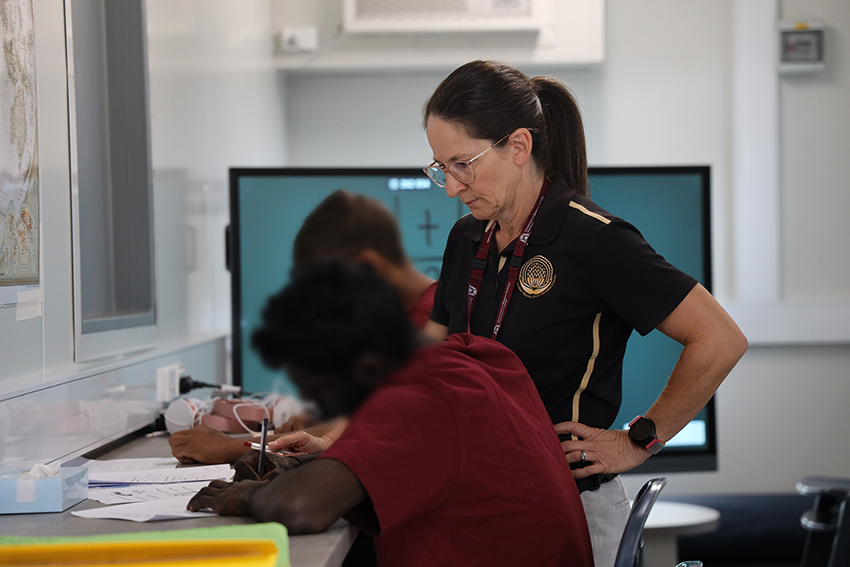
Supervised students visit the education facility on a rotational basis, generally in pairs Monday to Friday, for a personalised and trauma informed approach to learning.
Lessons target improved literacy and numeracy, as well as training opportunities.
Unit 18 Superintendent Doug Coyne said, “The move to a purpose-built classroom provides a quieter space for students to focus on their learning and further their skills.”
“One young person in Unit 18 is currently working to complete a Cert. II in Education before his release and hopes to go on to study finance and business at university.”
“Others have attained their White Card qualifications, boosting prospects for employment in construction, while another passed his Learners Permit Theory Test after completing the Keys4Life safe driver education program,” Supt Coyne said.
Alison Cannell, one of two full-time teachers working at Unit 18 said, “A lot of these young people have been disengaged from school or not attending for a long time.”
“In this small classroom environment, we find they engage well, they enjoy learning.”
“Each young person is different. We tailor programs to individual needs, target any skill gaps and measure vast improvements in literacy and numeracy.”Ms Cannell said.
Ms Cannell is a Literacy Support specialist, who’s also achieved a Graduate Certificate in Education (Learning Difficulties) to better assist young people with complex needs.
As part of the Department’s expansion of support services for vulnerable young people in detention, mentor visiting hours and numbers have also increased.
Mentors from agencies including Centrecare, Hope Community Services and the Stephen Michael Foundation regularly visit Unit 18 to provide intensive one-on-one support to young people, to improve engagement in education, programs, recreation and support emotional wellbeing.
Centrecare doubled the number of mentors working at Unit 18 this year, from two to four, and they now visit seven days a week, rather than Monday to Friday previously.
Superintendent Coyne said, “Whether it’s kicking a football, playing cards or just talking with young people, the mentors build strong relationships and provide a really positive influence.”
“The opening of a new classroom, combined with an increased presence of mentors, marks a significant improvement in the way the Department of Justice is engaging with young people at Unit 18, to try and encourage more positive futures.”
 Print this page
