


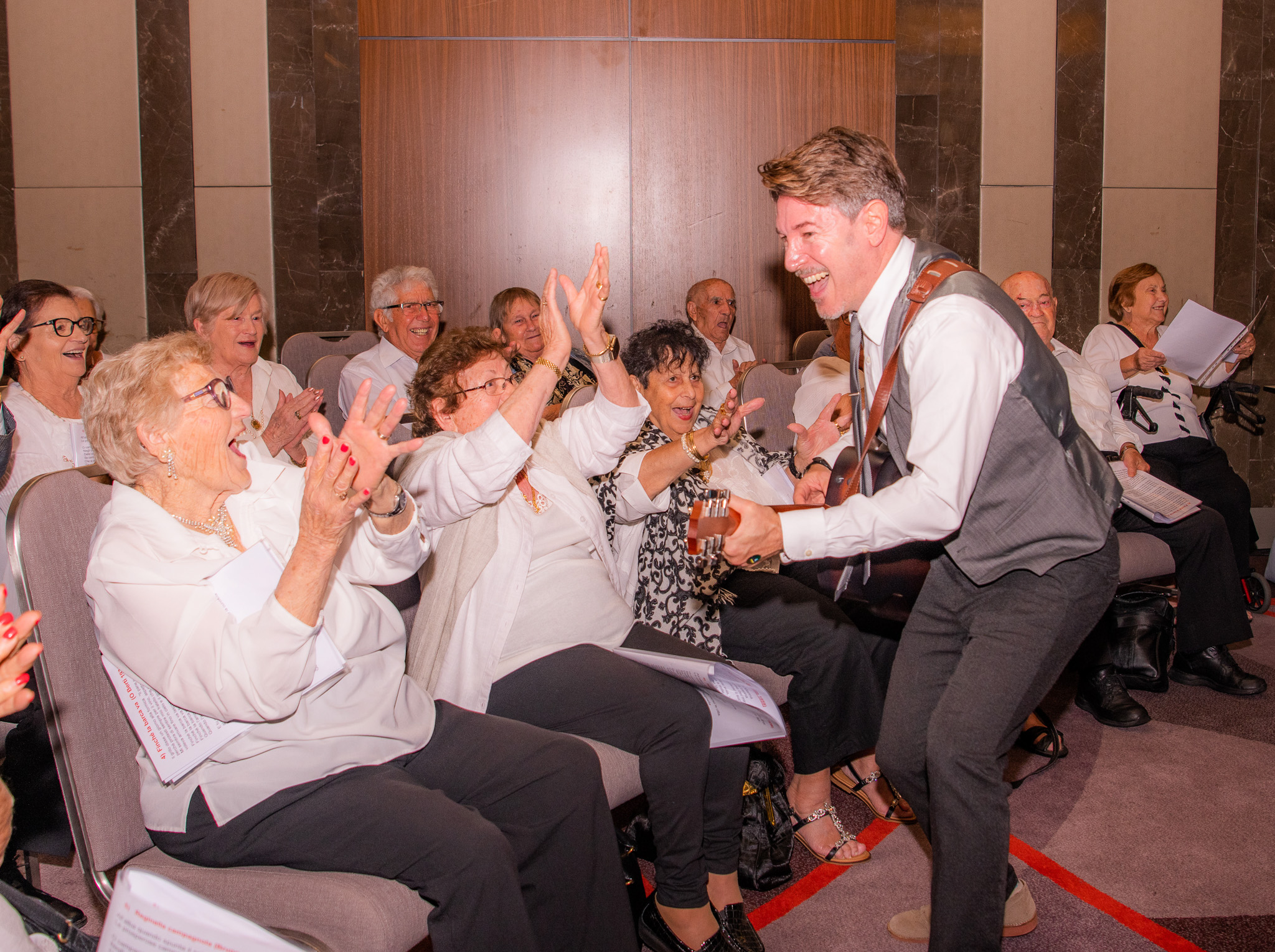
It is a rainy Friday morning, but the packed room is warm and loud. People have dressed with care for it. There is lipstick and there are good shoes. The atmosphere is buzzing with fun and the familiarity that comes with shared experience.
Some people arrive early to catch up with friends. Others compare song sheet notes. Before long, voices rise together in familiar Italian melodies that have travelled thousands of kilometres and decades through time.
“This is La Seconda Gioventù, Italian for ‘The Second Youth’, a choir bringing older Italian Australians together through music, culture and community. It was established by Dr Simone Marino, a Research Fellow at Edith Cowan University (ECU), as part of Comusichiamo, a wider research initiative exploring the relationship between music, migration, cultural identity, wellbeing and ageing.”
At its heart, the choir, in collaboration with InCasa Aged Care and Community Services, was created in response to a challenge many older people (especially migrants) face: social isolation.
As Dr Marino explains: “Many older Italian Australians have spent fifty or sixty years building a life in this country, and then they find themselves alone inside it. Friends, brothers and sisters die. Children are busy and live elsewhere. Driving becomes difficult. The language in which they are most themselves is no longer spoken around them. Isolation like that is not a small inconvenience. It wears people down.”
“The choir is a reason to get up, to get dressed, to go somewhere, and to matter to someone when you arrive. That, for me, is what engagement looks like.”
The choir offers a way back to connection
La Seconda Gioventù welcomes everyone. Older people living with and without cognitive conditions, including dementia, sing alongside partners, children, neighbours and friends. There is no separation based on diagnosis because the goal is to create community, belonging and shared experiences.
“For this generation, music is not merely entertainment. It is identity, and it is embodied history,” says Dr Marino.
The folk songs and melodies they perform were often learned in childhood, in regions such as Calabria, Sicily, Abruzzo and Veneto. They carry memories of village life, family celebrations, religious festivals, courtship, work and community traditions.
When members sing, they are not simply remembering the past. They are reclaiming relationships, places and a sense of self that are still part of who they are today.
Music becomes a bridge between cultures, generations and life experiences. It reconnects people with their heritage while strengthening bonds with those around them today.
For people living with dementia, the impact can be especially powerful. Someone who may struggle to hold a conversation can suddenly sing every word of a song learned decades ago. “The voice arrives before the explanation," Dr Marino says.
Active ageing in action
The benefits of the choir begin long before the first note is sung.
Dr Marino explains how in the early days, some members arrived reluctant to engage. They sat quietly, coats still on, unsure whether they wanted to participate.
“That is what prolonged isolation can do to a person. In gerontology it is called social frailty, the gradual weakening of the relationships, the social roles and the confidence that keep someone connected. It can be as consequential as physical frailty.” he says.
Today, the atmosphere is very different.
Members arrive early. They bring homemade food to share. They suggest songs for future rehearsals. One woman began visiting the hairdresser again before choir. Others make a point of dressing up for rehearsals or have their nails done.
The choir has even developed ambitions beyond the rehearsal room, with members eager to perform for audiences that include their children, grandchildren and great-grandchildren. While singing itself provides physical benefits through breathing, posture and movement, the real transformation is social.
The power of being seen
A La Seconda Gioventù choir rehearsal is a masterclass in active ageing and supports one of the key messages of this year’s Seniors Week.
An 86-year-old woman who has not sung publicly in decades stands up and dances a tarantella. Two men good-naturedly debate the correct version of a traditional song. Members help each other learn lyrics and share stories sparked by familiar tunes.
There are also quieter moments. A hand tapping gently in time. A smile of recognition at the opening notes of a favourite song.
Then comes the moment when everyone joins together and the room fills with song.
It is more than performance. It is participation, purpose and connection.
“Active ageing is usually described as keeping busy, and I think that is too thin,” says Dr Marino. “Busyness can be perfectly lonely. What matters is taking part in something that means something to you, in company that recognises you. Active ageing is not a programme we deliver to older people. It is what happens when we give them a reason worth turning up for and then have the sense to get out of the way.”
Ageing and dementia can change many things, but they do not erase a person's identity, emotions, humour, preferences or need for connection. Music, language, culture and shared memories remain deeply connected to wellbeing.
Dr Marino puts it simply: “All of us need somewhere we are expected, something to contribute and the sense that our presence registers with other people. You do not need to be Italian, or a good singer, to understand that.”
