


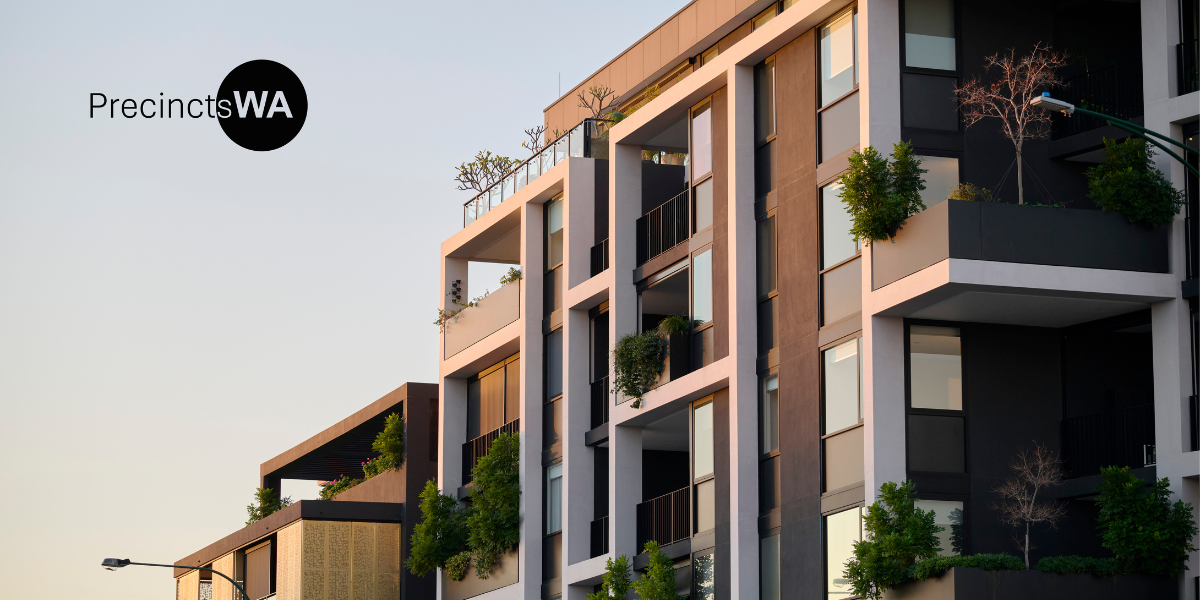
Precincts WA will support vibrant, well-connected and sustainable precincts where more people can live close to jobs, services and public transport.
By focusing growth within priority station precincts, Precincts WA supports a wider range of housing choice, better use of existing infrastructure and public transport, and more liveable, connected communities.
Precincts WA applies to 10 priority station precincts across metropolitan Perth.
| • Glendalough • Morley • Mosman Park • Redcliffe • Swanbourne |
|---|
Station Precincts Improvement Plan No. 65 is approved for eight of these precincts.
Ballajura and Redcliffe precincts are progressing under separate improvement plans and schemes already advanced. View the improvement plans and schemes page for more information.
Station Precincts Improvement Plan No. 65 is focused on walkable catchments around stations where there is strong potential to accommodate additional housing over time. More detailed planning will occur at the next stage of the process through an improvement scheme. The scheme will set out the zoning, development controls and built form standards for each precinct.
Together, the improvement plan and the improvement scheme will provide a coordinated, State-led approach to planning and development across the identified station precincts.
View the Station Precinct Improvement Plan No. 65
How it will work: Precinct ‘core and frame’ plans
A core-and-frame approach guides how future housing growth may be distributed within each of the station precincts.
The station ‘core’ is generally closest to the train station and is where the highest density buildings are expected to be located, including apartments and mixed-use development. The surrounding ‘frame’ provides a transition to nearby neighbourhoods through a mix of medium-density housing types, such as townhouses, terrace housing and low-rise apartments.
Future development in both the core and frame areas will respond to local context, providing a consistent approach while recognising the distinct character of each precinct.
View the Precinct Core and Frame Plans (PDF, 42.46MB)
Next steps
Community members and stakeholders will have the opportunity to review and provide comment on the draft Station Precincts Improvement Scheme when it is released for public consultation later this year.
Subscribe
To stay informed about future developments, you can subscribe to project updates by completing the form.
Frequently Asked Questions
Show moreWhat does the Station Precincts Improvement Plan do?
The Station Precincts Improvement Plan identifies the precinct boundaries and establishes the objectives that will guide future planning.
It focuses on walkable catchments around selected metropolitan train stations where greater housing choice, mixed-use development and improved access to transport, jobs and services can be supported.
Like other improvement plans, it is used where the Western Australian Planning Commission considers a more coordinated and strategic planning approach is required.
What is the core-and-frame approach?
The core and frame approach helps plan for different levels of housing and activity around each station in a way that responds to the local area.
The core is the area closest to the station, where the greatest mix of housing, services and activity is expected over time. The frame surrounds the core and provides a transition to surrounding neighbourhoods, with medium density housing such as townhouses, terraces, low rise apartments and other suitable housing options.
How were the core and frame boundaries selected?
The core and frame boundaries reflect the distinct characteristics of each station precinct. They have been shaped by planning considerations including natural boundaries, walkability, lot configuration and development opportunities
Why are Ballajura and Redcliffe not included in Station Precincts Improvement Plan No. 65?
Ballajura and Redcliffe have been identified through Precincts WA as priority station precincts. However, they do not form part of the recently adopted Station Precincts Improvement Plan because separate improvement planning arrangements are already underway for these locations.
The Station Precincts Improvement Plan No. 65 focuses on the remaining eight station precincts where those arrangements are not already in place.
Why is the State Government leading this planning process?
These precincts are strategically important locations around major public transport infrastructure, including significant investment delivered through METRONET and Perth’s broader rail network.
A State-led approach provides a central framework for future growth, supporting better integration and coordination across local government boundaries and improved alignment across residential development, transport and infrastructure planning.
Is this about increasing density in established suburbs?
Planning around train stations allows Perth to accommodate growth close to public transport, jobs and services rather than relying solely on expansion at the urban fringe.
This approach is about creating more housing choice while responding to the character and opportunities of each precinct.
What development standards will apply in these precincts?
The improvement plan does not determine zoning, building heights or other development controls. These matters will be considered in the next phase – the preparation of an improvement scheme – which will establish the detailed planning framework for each precinct.
It is anticipated that areas closest to stations will generally accommodate greater intensity of development than surrounding areas, consistent with the core-and-frame approach. Any proposed planning controls will be subject to public consultation before decisions are made.
Will existing residents be required to redevelop their properties?
No. The Station Precincts initiative does not require anyone to redevelop their property. It creates opportunities for future housing and investment over time. Decisions about redevelopment remain with individual landowners.
How many homes will this deliver?
Precincts WA is about creating the opportunity for more homes to be delivered in well-located areas over time.
The exact number of homes will depend on a range of considerations including decisions by private landowners and developers, market conditions and the planning settings.
Housing capacity analysis will be undertaken as part of preparing the improvement scheme.
How will the community be consulted?
Community engagement will occur throughout the process, including formal public consultation on the draft Improvement Scheme before any planning changes are finalised.
How will infrastructure keep pace with growth?
Planning for growth around stations allows us to make better use of existing infrastructure while also considering future infrastructure requirements.
The coordinated planning process helps ensure housing, transport, public spaces and services are considered together.
What about heritage and local character?
The State Government recognises that every precinct is different. Future planning will take account of local character, heritage values and place-specific opportunities.
The aim is not a one-size-fits-all outcome but a tailored approach that reflects the unique qualities of each precinct.
Is this a response to the housing supply challenge?
Yes. Increasing housing supply in well-located areas is an important part of addressing Perth’s housing needs. Planning for more homes around stations helps create opportunities for a wider range of housing types while making better use of existing transport infrastructure.
Fact Sheet: What is Precincts WA?
Fact Sheet: Improvement Plan and Scheme
Explains how improvement plans and improvement schemes work, why this planning pathway is being used, and the next steps in the process.
Fact Sheet: Precinct core and frame
Explains how the core and frame approach guides more intensive development close to stations while providing an appropriate transition to surrounding areas.
Fact Sheet: Housing density and diversity
Explains how the scheme supports increased housing supply in well-located areas through a range of housing types to meet changing community needs over time.
Fact Sheet: Heritage and character
Explains how heritage values and local character will be considered as planning for station precincts progresses.
Fact Sheet: Access and movement
Explains how station precinct planning will support a shift to walking, cycling and public transport, by locating more homes and activity close to train stations.
