


This content references Aboriginal people who have died and contains details some readers may find distressing.
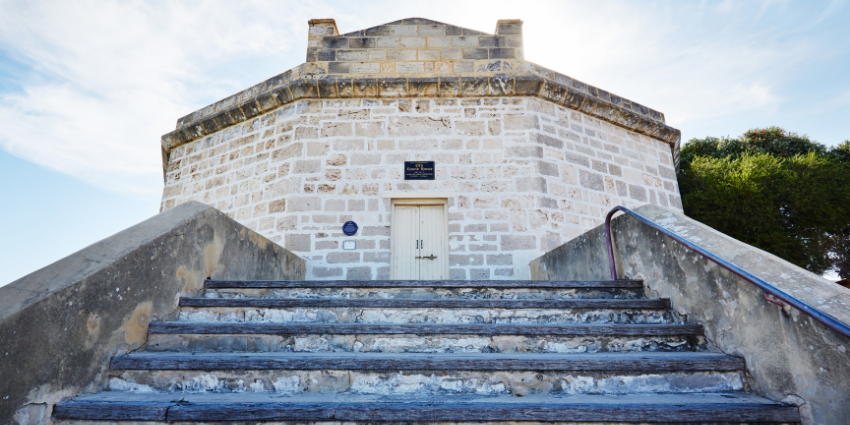
The Round House at Arthur Head Reserve, Fremantle. Image credit: Tourism Western Australia.
The oldest surviving public building in Western Australia, the Round House is located in Manjaree – an area used by the Whadjuk Noongar people for more than 50,000 years for trade and gathering. It was the first permanent structure built in the Swan River Colony, finished just 18 months after settlement. Reflecting the early colony’s emphasis on law and order, construction of the jail began in August 1830 and was completed on 18 January 1831.
The Round House held both European and Aboriginal prisoners, including the Noongar leader Yagan, and was the site of the colony’s first public execution of a European settler, 15-year-old John Gavin. For Aboriginal people, its history is deeply connected to dispossession, incarceration and the painful legacy of the Wadjemup prison system as it served as a temporary holding place for Aboriginal prisoners destined for the penal establishment on Wadjemup (Rottnest Island).
When Fremantle Prison was handed over from the British government to the colonial Government in 1886, the Round House ceased operating as a prison and was used as a police lock-up until the late 1890s. Although nearly demolished several times throughout its history, the building was saved by strong community advocacy. Today, the Round House is a popular tourist attraction that educates visitors on the confronting and layered history of the Arthur Head Reserve precinct.
The Round House and Arthur Head Reserve were added to the State Register of Heritage Places in November 1993.
Acknowledgement of Country
Show moreThe Heritage Council acknowledges the Whadjuk Noongar people as the Traditional Custodians of the land on which this place is located, their enduring and continuing connection to the land, and its great significance for Aboriginal people. We pay our respects to the Ancestors and Elders, both past and present, and acknowledge those who continue to share knowledge and journey toward reconciliation. Information on the Whadjuk Aboriginal Corporation can be found at: https://whadjuknoongar.org.au/.
History
Show moreManjaree
The Round House sits on Arthur Head, a limestone cliff face long known to the Whadjuk Noongar people as part of Walyalup. The area around Arthur Head and Bathers Beach was known as Manjaree, a significant meeting and trading place where important gatherings, exchanges and social encounters took place. Whadjuk families lived on and cared for this land, maintaining deep cultural continuity and rich Dreaming narratives linked to the river mouth, the coastline and Wadjemup (Rottnest Island). Colonisation and the declaration of the Swan River Colony in 1829 had a devastating impact on this community and its connection to Country.
Rule of law
The first twelve months of the new colony were challenging. Supplies were scarce and most settlers lived in tents. Seeking to maintain order and curb drunken and disorderly behaviour, Governor Stirling instructed that a gaol be built.
As the port for new arrivals and where most colonists were based, it was decided the goal would be constructed in Fremantle. Selecting a prominent cliff-top location on Arthur Head, which overlooked the townsite, was a deliberate colonial strategy and ensured the Round House served as a powerful visual reminder that the rule of law was firmly imposed.
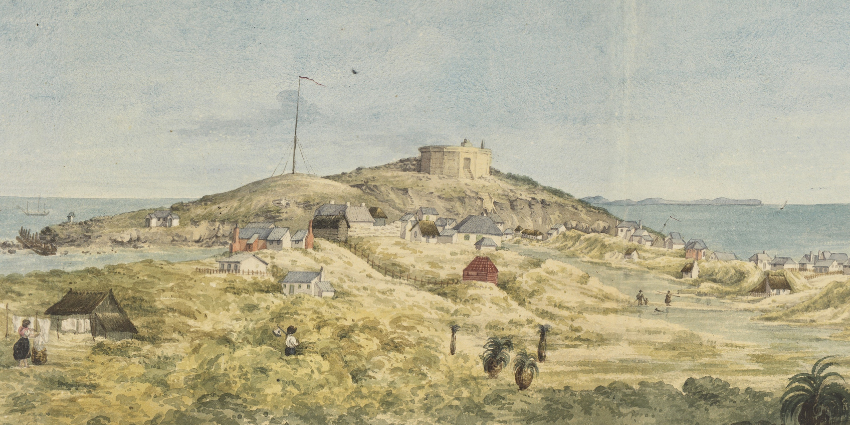
Section of a watercolour produced by Jane Currie in 1832 that highlights the imposing location of the Round House and its position over the newly established township of Fremantle. Image credit: Mitchell Library, State Library of New South Wales ML 827.
Design and construction
Designed by the colony’s civil engineer, Henry Willey Reveley, the Round House was planned so warders could monitor multiple cells from a central vantage point. Despite its name, the building is not truly round but rather a 12-sided structure. The original layout comprised eight small cells opening onto a central courtyard. The gaol was intended to house up to 16 prisoners; however, overcrowding was common and on one occasion it held as many as 43 prisoners.
Constructed by local labourers using locally sourced materials, the building was completed in just five months. This feat was considered remarkable given the shortage of skilled labour and resources in the colony at the time. In 1837, the Fremantle Whaling Company requested the construction of a tunnel through Arthur Head to connect Bathers Beach with one of Fremantle’s main streets. Whalers Tunnel, which runs beneath the Round House through the cliff face, was completed in January 1838.
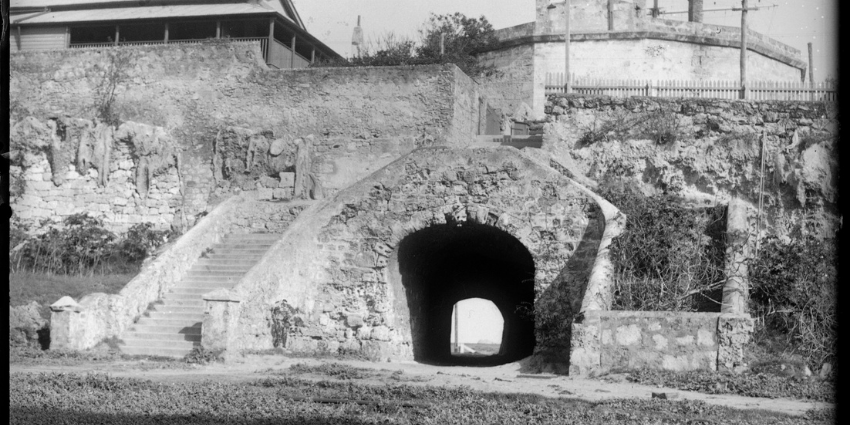
Whalers Tunnel below the Round House, Fremantle,1928. Image credit: Photograph courtesy of the State Library of Western Australia (047797PD).
Law and order
Initially, the Round House was intended to detain unruly strangers and people charged with drunkenness. Over time, its role expanded to imprison those convicted of offences under colonial law. Maintaining order was considered a central priority during the colony’s early decades, with approximately 3,500 incarcerations recorded between 1831 and 1856.
In 1844, the colony’s first public execution of a European settler took place at the Round House, when 15-year-old John Gavin was hanged for the murder of another colonist. The Round House also imprisoned prominent Aboriginal figures, including Yagan, a respected Noongar leader who resisted early colonial violence and land dispossession.
The link to Wadjemup
The Round House played a direct and devastating role in the lives of Aboriginal people during the colony’s early years. Prisoners included Noongar men charged under unfamiliar colonial laws, as well as leaders and lore men taken from across Western Australia in an attempt to disrupt resistance efforts. Many Aboriginal prisoners were held temporarily at the Round House before being transported to Wadjemup (Rottnest Island).
According to Noongar oral traditions, the island was once connected to the mainland and is deeply embedded in Dreaming narratives. Its use as a penal colony, where prisoners were forced into labour to build colonial infrastructure, represents one of the most painful chapters in Western Australia’s Aboriginal history. Today, while this history remains confronting and traumatic, the Round House is recognised as a place that should be preserved for cultural awareness, healing, Truth Telling and Reconciliation.
Later uses and preservation
When Fremantle Prison was handed over from the British government to the colonial Government in 1886, the Round House ceased operating as a prison and was subsequently used as a police lock-up until the late 1890s. It later served as accommodation for the Water Police and as a storage facility for Fremantle Ports.
During the 1920s, demolition was proposed several times due to the building’s deteriorating condition; however, strong public support ensured its survival. In the early 1970s, extensive conservation works were undertaken, making the Round House one of Western Australia’s first major heritage conservation projects.
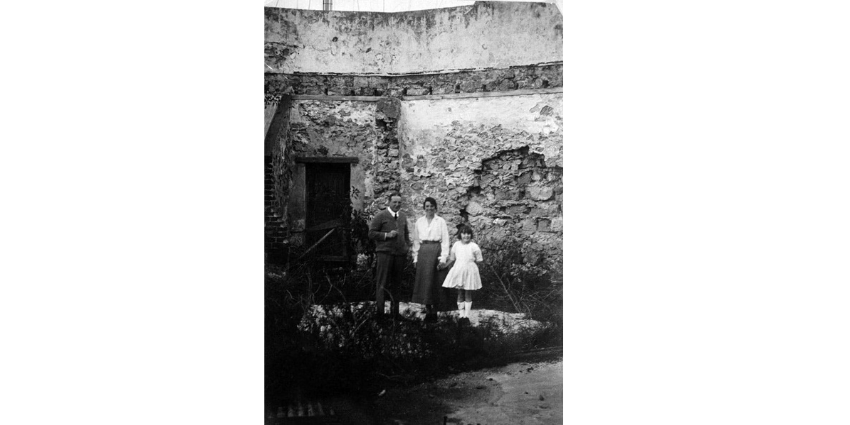
Captain Harold Rivers, Peggy Rivers and a friend standing inside the base of the Round House c1922. The photograph shows the poor condition of the building when demolition was proposed several times throughout the 1920s. Image credit: City of Fremantle Local History Centre (LH004701).
Control of the Round House eventually passed from the State Government to the City of Fremantle. Today, it continues to operate as a significant tourist attraction that explores the complex and layered history of Arthur Head Reserve.
State Register of Heritage Places and Themes
Show morePlace 896 – Round House and Arthur Head Reserve Register Entry
Themes relevant to this place, as identified in the Heritage Council’s Thematic History of Western Australia, include:
- Governing – Law, Order and Defence
- Infrastructure – Development of Settlement and Services
Sources
Show moreImage gallery
Show more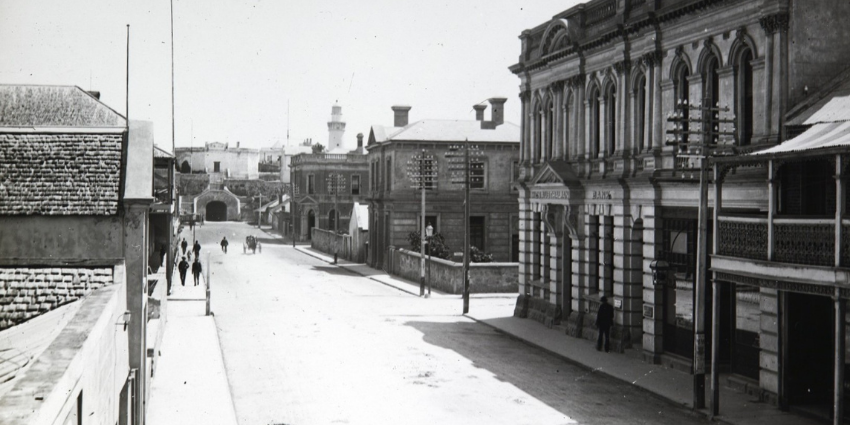
View of the Round House and it’s prominent location at the end of High Street c1890s. |
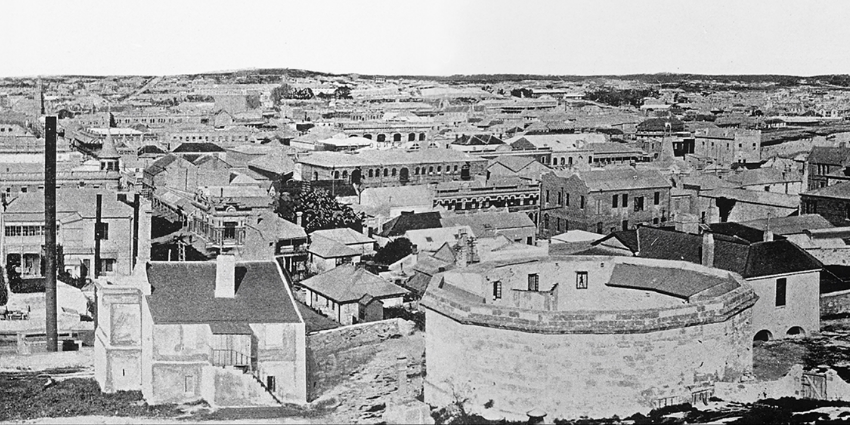
View of Fremantle, with the Round House in the foreground, of Arthur Head Reserve, 1902. |
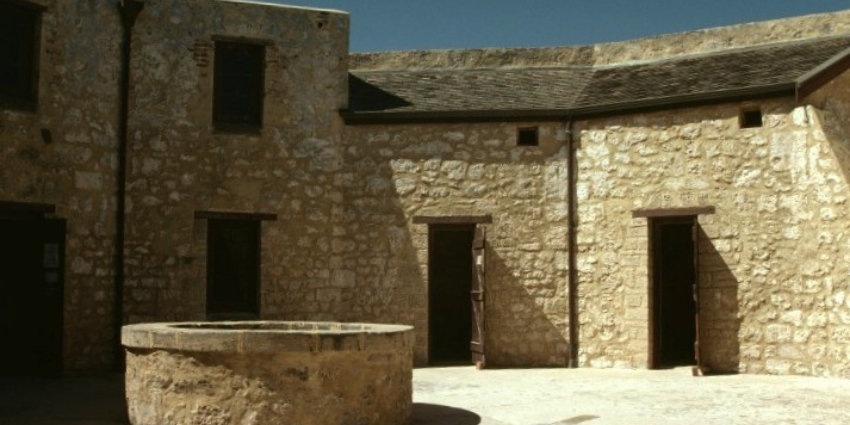
Inside the Round House showing the entrance to several cells, courtyard area and well c1958 - 1975. |
