


The Registration Standards 2025 (2025 Standards) provide a foundation for quality training. They describe key factors that contribute to improving outcomes for students and support training that meets student needs and reflect industry best practice.
Training within the 2025 Standards
The Outcome Standards comprise four Quality Areas. This Fact Sheet is in reference to Quality Area 1: Training and Assessment, and specifically Outcome Standards 1.1 and 1.2 and outlines the key requirements for trainers as well as some considerations to maintain and demonstrate compliance.
Quality Area 1
Outcome: Quality training and assessment engages VET students and enables them to attain nationally recognised, industry relevant competencies.
Quality Area 1 aims to bring together all the elements/systems of quality training and assessment which includes training design, training structure, engagement with industry, effective assessment systems (that meet the Principles of Assessment and Rules of Evidence), Recognition of Prior Learning and Credit Transfer and facilities, resources and equipment
Outcome Standard 1.1
Training is engaging, well-structured and enables VET students to attain skills and knowledge consistent with the training product.
Outcome Standard 1.1 focuses on elements that constitute quality training such as design, structure and pace of delivery. It ensures:
- students are placed at the centre of any training program;
- the training delivered builds practical skills; and
- ensures student characteristics, needs and aspirations are considered. ensuring the RTO accommodates a range of diverse students within different contexts.
It is always important that any training delivered aligns with the training package requirements to enable students to attain the skills and knowledge consistent with the training product and allowing them to work effectively in the workplace.
Performance Indicators
Outcome Standard 1.1 consists of 5 Performance Indicators (PI) which allow trainers to work through a training design process and re-affirm their practices are consistent across the RTO and ultimately meeting the needs of students.
1.1a training is consistent with the requirements of the training product
Performance Indicator 1.1a is the starting point for effective training design. Trainers need to understand the requirements of the training product, and this involves reading and reviewing key source documents such as the:
- Training Package: the knowledge and skills required by individuals to perform effectively in the workplace, expressed in Units of Competency;
- Unit of Competency: defines the specific skills, knowledge and attitudes needed to perform a task or role effectively within a particular industry or workplace and is component of a training package;
- Assessment Requirements: specifies the skills, knowledge and conditions a student must have to perform the work tasks described in the Unit of Competency;
- Qualification: is a formal credential that demonstrates a person's competence in a specific area, whether it be a skill, knowledge, or a combination of both; and
- Licensing Requirements: means qualifications, standards or conditions that are typically mandated by government or regulatory bodies to ensure public safety, consumer protection, and maintain standards within a particular area of study.
When trainers commence delivery of a Unit of Competency they will often ‘unpack’ all the above key documents. This involves a thorough analysis to ensure that the training plans they create directly map to the training package requirements. These training plans could include:
- Learning Objectives: Clearly defined goals that outline what students are expected to learn and achieve by the end of the training. These should align with the outcomes of the training product.
- Content Outline: A detailed breakdown of the topics and subtopics to be covered during the training. This helps ensure that all necessary content is addressed systematically.
- Instructional Strategies: Methods and approaches that trainers will use to deliver the content. This could include lectures, demonstrations, group activities, discussions, and hands-on practice. The choice of strategies should cater to different learning styles and promote active engagement.
- Resources and Materials: A list of all the resources and materials needed for the training, such as textbooks, handouts, multimedia, tools, and equipment. Ensuring these are available and accessible is crucial for effective delivery.
- Schedule and Timeline: A detailed schedule that outlines the timing and sequence of training sessions. This helps in managing time effectively and ensures that all content is covered within the allocated period.
- Learning Environment: Considerations for creating a conducive learning environment, including classroom setup, safety measures, and accessibility. This ensures that students can focus on learning without distractions.
By incorporating these elements into training plans, trainers can ensure that their delivery is well-organised, engaging, and aligned with the training package. This approach not only enhances the effectiveness of the training but also helps students acquire the necessary skills and knowledge in a structured and supportive environment.
It is also important to ensure that all necessary resources, such as equipment, facilities, and instructional materials, are available and accessible to support the training. This includes providing up-to-date technology, industry-standard tools, and a conducive learning environment. By doing so, trainers can deliver practical, hands-on training that not only aligns with the training package but also enhances the learning experience for students.
Over time, qualifications, units of competency, licensing requirements and other key elements may change, and trainers need to remain current by remaining aware of these changes, typically by revisiting the National Register www.training.gov.au. Ensuring training materials are up-to-date, relevant and compliant is important and encouraged through processes of regular revision.
Additional information is available in the Fact Sheet: Developing Training and Assessment Strategies.
What the above documents will not tell trainers is the ‘how’, that is, ‘how do I teach this subject and make it interesting and engaging?’. The answer to this question is covered in the next 4 Performance Indicators.
1.1b the modes of delivery enable VET students to attain skills and knowledge consistent with the training product
Regardless of the chosen mode of delivery, it must facilitate the development of student’s skills and knowledge. While traditional, face-to-face classroom learning was once the standard, today students seek diverse learning experiences such as on-the-job training, online courses, distance education or blended methods.
RTOs must consider several factors when determining the mode of delivery including the:
- requirements of the training product, including both content and assessment needs as mentioned earlier;
- availability and adequacy of training and assessment resources;
- industry support to ensure alignment with current standards and expectations;
- characteristics and preferences of the student cohort;
- specific needs of students, including those with disabilities or special requirements;
- RTO's capability, including staff expertise and technological infrastructure; and
- issues of authenticity, plagiarism, and the use of artificial intelligence, and how these can be managed.
The selected mode of delivery must be suitable for the skills and competencies being taught. For instance, if a course requires students to develop practical skills, the delivery method must allow for hands-on practice.
1.1c training is structured and paced to support VET students to progress, providing sufficient time for instruction, practice, feedback and assessment
For this Performance Indicator, trainers can be creative in their approach to designing training. Detailed below is a model that trainers can use as a starting point for the design of their training program.
ADDIE MODEL
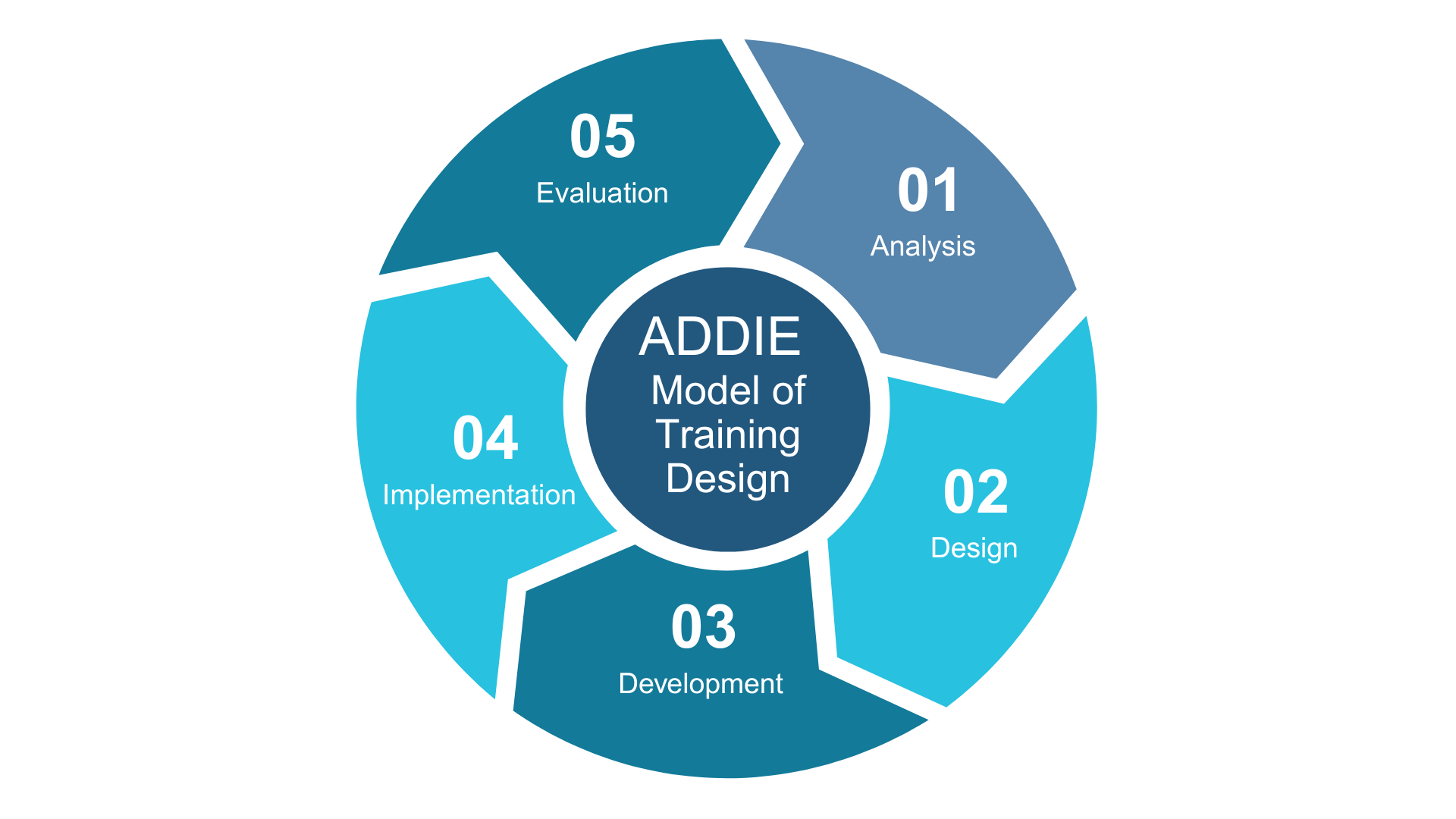
The ADDIE Model of Training Design was created by Greg Kearsley and Richard Culatta (1975). There are 5 phases of design:
- Analysis: This phase involves identifying the needs, goals, and objectives of the students and the learning environment, as well as assessing the current knowledge and skills of the student. Additionally, it includes analysing the assessment requirements to ensure they align with the learning objectives and the students' needs.
- Design: In this phase, instructional strategies, materials, and activities are planned to meet the identified needs and objectives of the training program.
- Development: This phase focuses on creating the actual learning materials, such as presentations, videos, or interactive exercises, based on the design plan
- Implementation: This phase involves delivering the training or learning program to the target audience, ensuring that students have access to the materials and support they need. It also includes ensuring there is sufficient time for instruction, practice, feedback and assessment (now key requirements of this Performance Indicator)
- Evaluation: This final phase assesses the effectiveness of the training or learning program. It involves gathering feedback from students and stakeholders to identify areas for improvement. In line with Outcome Standard 1.5, this phase could also include validation processes to ensure that assessments are fair, reliable, and aligned with industry standards. Validation helps confirm that the training outcomes meet the required competencies and that the assessment methods are appropriate and effective.
It is easy to become distracted when designing training, but this model provides a framework to assist trainers to stay on track and focussed.
1.1d training techniques, activities and resources engage VET students and support their understanding
In order to make the most out of any learning opportunity, there are two key considerations for a trainer, the first, is the potential learning styles of students, and the second, the types of collaborative learning techniques to use that will ensure high levels of student engagement. This Performance Indicator focusses trainers’ attention on ensuring that training is ‘engaging’.
The Certificate IV in Training and Assessment exposes trainers to different learning styles and there are 4 key learning styles that all trainers should be familiar with. The most common are Neil Flemings model and VARK. The VARK acronym stands for:
- V – representing visual students, that is, those who learn by looking at graphs, pictures, and videos.
- A – representing auditory students, that is, those who learn through discussion, conversation and explanation.
- R – representing those who prefer reading and reviewing words, texts and information sources.
- K – representing kinaesthetic students, that is, those who learn through practical activities, projects and learn through real-life experiences.
It is generally recognised that most people nowadays are multi modal and that our learning styles can vary on any given day, however, the VARK model does present a starting point for thinking more deeply about your student cohort.
Once trainers understand learning styles, they can then focus on which collaborative teaching/learning techniques can be used with their student cohort. Detailed below is an overview on some collaborative teaching techniques that trainers can research and consider for implementation within their students.
| Icebreakers and Energisers | |
| Two Truths & A Lie | Helps increase the energy levels at the beginning of a training session. It allows the students to find out more about each other in a safe and supportive way. |
| Speed Dating | This technique allows students to talk to as many of their peers as possible in a short period of time. A sharing tactic that encourages high levels of participation. |
| Pen Pals | A useful technique for building relationships beyond the initial introduction as it allows common bonds to be created. |
| People Bingo | This can be very informal and used to create discussion at the beginning of a training session or used part way through a session as an energiser. |
| Brainstorming | |
| Placemat | This technique is a collaborative learning strategy where students, in groups of 2-4, work around a shared piece of paper (the "placemat") to individually record ideas, then collectively discuss and synthesise their thoughts, ultimately reaching a consensus or shared understanding |
| Think, Pair, Share | Trainers pose a question to a group of students, the students first THINK to themselves prior to being instructed to discuss their response with a person sitting near them (PAIR) and finally SHARE with the rest of the class. |
| Graffiti | Students record their thoughts, questions, and reactions to a topic or text on a shared writing space, fostering a collaborative and informal environment for learning and discussion. It is useful to give all students their own-coloured pen for writing. |
| Rove and Record | Like the Graffiti technique except students wander around a learning space writing their thoughts on posters for everyone to share. |
| Sharing Strategies | |
| Gallery Tour | This active learning technique allows students to circulate the classroom to view and analyse each other's work, providing feedback and fostering a learning community. |
| One Stay Rest Stray | In this technique one student from each group stays to explain their work, while the others ("stray") visit other groups to learn and share information, fostering collaboration and deeper understanding. |
| Walk About | An experiential learning activity where students, often in groups, move around and engage with the environment to learn and apply concepts, fostering a more dynamic and engaging learning experience. |
| Ghost Tour | This technique involves a structured, collaborative walk through a space (like a classroom) to observe and discuss the messages it conveys about culture, learning, and thinking. Students can review each other’s work. |
In researching more about these techniques, a trainer will explore:
- How to facilitate the strategy successfully;
- When to use the strategy;
- Levels of ‘safety’ and ‘accountability’ for the students in each strategy; and
- The outcomes to expect from each teaching technique.
How can trainers demonstrate compliance with this new Performance Indicator?
Demonstrating high levels of engagement with students can be challenging, given that participation and engagement are often spontaneous. However, some ways trainers might consider demonstrating ‘engagement’ are:
- Providing a high-level overview of collaborative teaching techniques used on a training and assessment strategy document;
- Detailing within a session plan how learning styles were identified and the collaborative teaching techniques that were selected as ‘best fit’ for the group;
- In student surveys, ensure there is a question around ‘student engagement’, not just student satisfaction;
- Take photos of students participating in some of the collaborative teaching techniques; and
- Use ongoing reflective questions during a training session, for example, ask students ‘how are you enjoying debriefing this activity?’ then record any relevant comments in a continuous improvement strategy.
The National Centre for Vocational Education Research (NVCER) recently published research into effective teaching and learning. This research, entitled ‘Effective teaching and learning; teacher perspectives on what works best for whom’ was conducted by Tabatha Griffin and Nicki Davidson in March 2025 and provides an excellent resource for trainers on how to identify and implement collaborative teaching opportunities based on different learning styles.
1.1e where the training product requires work placements or other community-based learning, necessary skills and knowledge are able to be attained in that environment
Not all training conducted outside the classroom is a positive experience for students for a range of different reasons. All ‘non classroom’ based learning should therefore be managed from a risk perspective that incorporates contingencies that address an issue when a student may not be able to achieve competency in the workplace/community organisation.
Some factors that may impact on a positive experience for students who undertake work placement or community-based learning may include:
- A lack of student supervision in the workplace;
- Feelings of isolation by the student being away from their peer group;
- Out of date equipment being used that doesn’t match the Unit of Competency and assessment requirements;
- Mismatched expectations or unclear goals around student current skills and knowledge; and
- The work isn’t sufficiently diverse to accommodate the requirements of the Unit of Competency or assessment requirements.
Ultimately, a trainer needs to ensure they undertake high levels of preparation and planning when organising work placements or other community-based learning for students. This will ensure that any risks are mitigated, and that the student’s experience is positive and reflective of RTO practice to ensure the learning outcomes are achieved.
Summary of Outcome Standard 1.1
Outcome Standard 1.1 provides a unique opportunity for trainers to ‘go back to basics’ and revisit what quality teaching and learning looks like within different delivery modes. Trainers should consider their teaching environment and how, after analysing the different learning needs of students, they determine the best possible teaching methods to ensure training is engaging.
Outcome Standard 1.2
Engagement with industry, employer and community representatives effectively informs the industry relevance of training offered by the NVR registered training organisation.
Outcome Standard 1.2 focuses on ensuring training is relevant, fit for purpose, and reflects current industry practice.
Its intent is to ensure that RTOs consider:
- who should be engaged in the training design process (other than RTO staff);
- how do RTOs engage with industry, employers and other stakeholders; and
- how RTOs use the information they gather to inform and improve their services.
Performance Indicators
There are 3 Performance Indicators (PI) linked to Outcome Standard 1.2 which allow trainers to review their current industry/community-based engagement activities and determine if they are making the most of the feedback they receive.
1.2a how it identifies relevant industry, employer and community representatives and seeks meaningful advice and feedback from those representatives
An analysis by trainers should be undertaken to determine if their current process for identifying industry, employer and community representatives is providing them with the information they need. Some key questions trainers might like to consider include:
- What are my current practices for identifying employer/community representatives?
- Are my practices for engagement ad hoc or strategic?
- When I engage with industry/community, am I asking the right questions? What information am I seeking, and how will it inform my training and assessment?
- How do I choose the correct work/community placements for my students? Is the reason for this choice valid?
In determining a suitable employer/community placement, trainers may wish to consider:
- The reputation of the employer/community organisation;
- Previous experience of an employer who has hosted students;
- The values and culture within the organisation;
- Whether the organisation has the equipment, facilities and resources to support students; and
- The competency of the direct supervisor.
Additional information is available in the Fact Sheet: Industry Engagement
1.2b it uses relevant advice and feedback to inform changes to training and assessment strategies and practices
Finding good work placement opportunities for students can sometimes be a long and hard process for trainers, however, once a trainer has established a good working relationship with a stakeholder, that stakeholder is more likely to be willing to take on additional students in the future. It is therefore incumbent on the trainer to ensure that they treat the employer/community representative with respect and take on board relevant advice and feedback when it is presented, be that before, during or after a placement.
Advice and feedback can come in various formats, written or verbal, but will hopefully be constructive around how to improve the outcomes for students and inform training and assessment practices. Any changes proposed by industry/community representatives should be considered carefully by the RTO and if necessary, added to the RTO’s continuous improvement strategy and/or discussed with members of the leadership team.
Some examples of the type of feedback that might be considered relevant includes:
- The extent to which the Unit of Competency reflects actual workplace practice;
- How the feedback can inform and improve training and assessment strategies and practices;
- Whether the student was sufficiently prepared, and were the expectations of the student in the workplace discussed;
- The amount of supervision required, ensuring the employer is informed about the level of supervision needed for the student;
- Whether the employer believed they had sufficient information prior to the placement either about the student or the training required; and
- Time required on-the-job for the student to complete their studies.
Additional information is available in the Fact Sheet: Continuous Improvement and Fact Sheet: Assessing in the Workplace.
1.2c training reflects current industry practice
Trainers should be able to demonstrate that their training reflects current industry practice. If the correct industry/community representatives have been identified (1.2a) and they have provided useful advice and feedback (1.2b) that has been considered, then an RTO’s quality indicator data (both quantitative and qualitative) should support the RTO’s reputation as a provider of high-quality training and assessment services. Quality Indicator information can be formal and informal and may include:
- Focus groups with students;
- Employer surveys;
- Student surveys (anonymous or otherwise);
- Social media posts;
- Realtime feedback apps;
- Networking events;
- Direct marketing with emails; and
- Discussion at the end of a training session or day on work placement.
This quality indicator data can also be linked to Outcome Standard 4.4, which focuses on continuous improvement through systematic monitoring and evaluation. Further information on this Outcome Standard is available in the Fact Sheet: Continuous Improvement.
Additionally, RTOs should ensure that their training reflects current industry practice by considering facilities and resources, understanding the destination of students, and gathering feedback on the structure and pace of learning.
Summary of Outcome Standard 1.2
Outcome Standard 1.2 continues to maintain the intent of Clauses 1.5 and 1.6 of the Standards for Registered Training Organisations 2015. However, there is now greater emphasis placed on ensuring that RTOs identify employers/community representatives that will add value to the learning experience of students. Additionally, when RTOs receive advice and feedback, they don’t ignore the information but rather embrace the opportunity that a review of their practices can bring.
Further References and Resources
- The 2025 Standards
- Online Guidance Hub - Outcome Standards 1.1 & 1.2
- National Training Register (www.training.gov.au)
Fact Sheets:
- Developing Training and Assessment Strategies
- Industry Engagement
- Continuous Improvement
- Assessing in the Workplace
Webinars:
- Designing RTO Training and Assessment Strategies
- Distance and Online Training and Assessment
- Quality Delivery in Training and Assessment
Other:
- Effective teaching and learning: teacher perspectives on what works best for whom – NCVER 25 March 25
- Principles to Guide Foundation Skills Assessment - DEWR 3 September 26
