



The State Development Act 2025 was passed through the WA Parliament in December 2025. The Act sets out a contemporary framework for the coordination, facilitation and promotion of strategic economic development activities across Western Australia.
Fact sheets and guidance documents
Fact sheets and guidance documents are available below. Please download them to view.

Frequently asked questions
Answers to FAQs are below.
What powers does the State Development Act 2025 establish for the Premier and Coordinator General?
Show moreThe Act gives the Premier statutory powers to declare precincts and projects of State significance, based on recommendations from the Coordinator General.
Through delegated statutory powers of the Coordinator General, these declarations enable fast-tracked, coordinated approvals and whole-of-government support for strategically important developments.
What are the notices and powers under the Act?
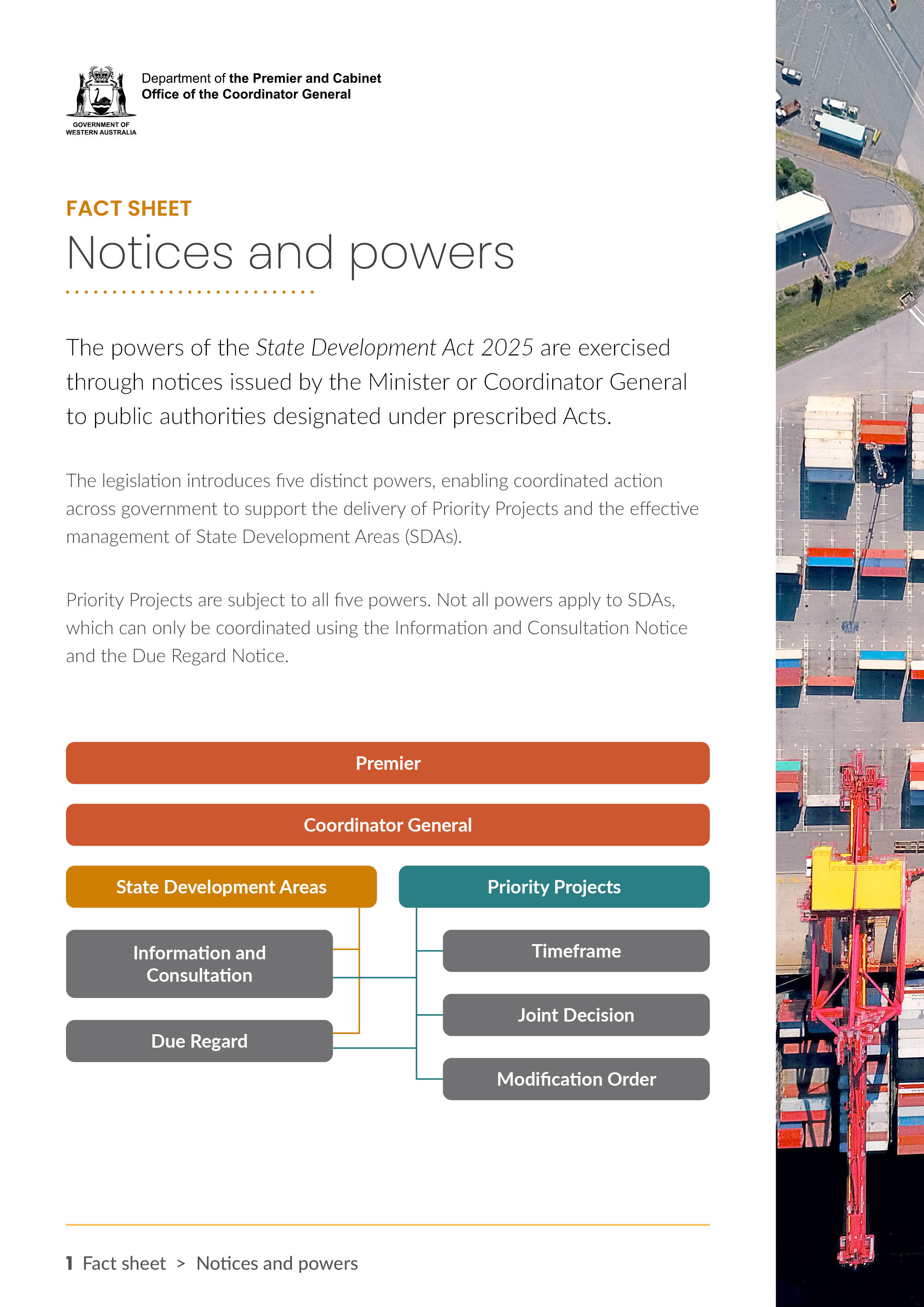
Show moreThere are five distinct notices and orders issued by the Minister or Coordinator General to public authorities designated under prescribed Acts, enabling coordinated action across government. Priority Projects are subject to all five powers. Not all powers apply to SDAs, which can only be coordinated using the Information and Consultation Notice and the Due Regard Notice.
An Information and Consultation Notice enables the Minister or Coordinator General to request information from, or consult with, a public authority in relation to a State development matter. This supports engagement and coordination across government and facilitates the sharing of relevant information, ensuring that Coordinator General can make informed decisions and deliver the objectives of the Act.
A Due Regard Notice sets out specific matters that a decision-maker must consider when making a decision under a designated Act. This enables a more coordinated, consistent approach to development across Government. A Due Regard Notice does not require or permit a decision-maker to consider matters it is not allowed to have regard to under the designated Act. The Environmental Protection Authority and the Heritage Council of Western Australia are also excluded from being issued with a Due Regard Notice as they are independent advisory bodies.
A Timeframe Notice requires a public authority to perform a designated function within a specified period, which cannot be less than 20 business days. This power is intended to provide proponents with certainty around project management milestones and enable strategic approvals to be prioritised across government. Issuing a Timeframe Notice does not guarantee a particular outcome. Instead, it ensures that a decision is made within the issued timeframe. The Coordinator General will engage with public authorities to ensure that any time period set under a Timeframe Notice is reasonable and deliverable. Timeframe Notices are similar to statutory timeframes that already exist in various WA laws and regulations.
A Joint Decision Notice requires a decision to be made jointly by the public authority and the Minister or Coordinator General. It empowers a decision-maker to have regard to the objects of the Act, in addition to any relevant provisions of the designated Act, expanding the scope of matters that a decision-maker can consider. However, this expanded scope of consideration does not mean that decision maker can ignore the requirements of the designated Act. The requirements of the designated Act must still be met, and responsibility for the decision remains with the relevant public authority. As such, review rights are preserved, and decisions must be legally defensible under the provisions of the designated Act.
A Modification Order modifies how certain provisions, or aspects of provisions, of a designated Act apply to a Priority Project. Modification Orders will streamline approvals and reduce duplication while still ensuring that Priority Projects are effectively regulated.
What transparency measures are built into the State Development Act 2025?
Show moreThe Act includes a range of checks and balances to ensure coordination efforts work alongside Western Australia’s existing regulatory system.
It introduces mechanisms to improve coordination and reduce duplication across government processes.
The Coordinator General’s role is to support existing regulators. This ensures decisions remain transparent, accountable, and subject to appropriate oversight, and in alignment with broader government priorities.
For proposed State Development Areas, a legislated consultation process is required. Prior to finalising an SDA Plan, the declaration must be gazetted and the SDA Plan must be made available for public comment before a final decision is made.
When a Priority Project is designated, it must also be gazetted, meaning the declaration is publicly available and formally recorded.
Additionally, the Coordinator General must submit an annual report to the Minister detailing operations under the Act for the previous financial year, including activity on Priority Projects, State Development Area declarations and plans, statutory notices, and modification orders.
This process is more transparent than the existing system and places the obligation on the WA Government to inform the community and consult where required before declarations are made.
How does the Office of the Coordinator General engage in existing planning, environmental and heritage frameworks?
Show moreThe Office works within WA’s existing regulatory system and cannot influence the independence of the recommendations made by the Environmental Protection Authority, the Western Australian Planning Commission or the Aboriginal Cultural Heritage Committee. The Coordinator General facilitates coordination and alignment across agencies while respecting independent decision-making processes.
How does the State Development Act 2025 compare to similar legislation in other jurisdictions like Queensland, South Australia and the Northern Territory?
Show moreThe Act brings WA in line with other jurisdictions, including Queensland, South Australia and the Northern Territory, which have established mechanisms to coordinate and accelerate strategic development.
WA’s approach is tailored to our unique regulatory environment. The powers established under this Act improve coordination of existing approvals processes that are already in place.
This balanced model enables WA to remain competitive nationally and internationally, attract investment, and rapidly pursue opportunities in infrastructure, energy transition, and economic diversification. It also maintains the integrity of our existing robust regulatory system.
Should new project proponents approach the Office of the Coordinator General directly under the State Development Act 2025?
Show moreNo. Proponents should continue to engage with the relevant lead agency under WA’s existing Lead Agency Framework. The Office of the Coordinator General will work with lead agencies to support coordination for designated Priority Projects and declared State Development Areas.
What types of projects or precincts can be captured under the Act?
Show moreProjects may be identified for designation or precincts may be identified for declaration if they are of strategic or economic significance to the State. This includes developments in clean energy, critical minerals, advanced manufacturing, defence, or infrastructure that supports long-term growth. Further information on criteria requirements and assessment pathways will be published soon.
How is the Coordinator General appointed?
Show moreThe Coordinator General is appointed by the Governor of Western Australia on the recommendation of the Minister for State Development. The appointment can be for a term of up to five years, and the Coordinator General may be reappointed multiple times with no limit on the number of terms. The Coordinator General’s remuneration and conditions are set by the Minister, based on advice from the Public Sector Commissioner and subject to the Salaries and Allowances Act 1975. The Coordinator General is bound by the Public Sector Commission Code of Ethics and the standards set by section 9 of the Public Sector Management Act 1994.
 Print this page
