


DWER acknowledges the Traditional Owners of the lands upon which we live and work throughout Western Australia and pay our respects to Elders past and present. We recognise the practice of intergenerational care for Country and its relevance to our work and working with the community, and we continue to move forward with a shared commitment to protect and conserve Country for our future generations.
Background
Western Australia's Climate Adaptation Strategy is ensuring our communities, environment and economy are resilient to future climate change.
The strategy has been developed in consultation with Aboriginal people and recognises the vital role of Aboriginal experiences, knowledge systems, aspirations and leadership.
The WA Government is undertaking further consultation to better integrate Aboriginal knowledge and worldviews into the state’s action on climate resilience and adaptation.
Through this process we seek to build trust, share knowledge and design a dedicated fund to support Aboriginal-led climate adaptation projects and embed Aboriginal empowerment.
The Department of Water and Environmental Regulation (DWER) is leading stakeholder engagement and consultation to design and deliver the Fund.
This project aligns with the principles of the WA Aboriginal Empowerment Strategy 2021-2029 and supports the WA Closing the Gap Implementation Plan 2023-2025.
What is the purpose of the consultation?
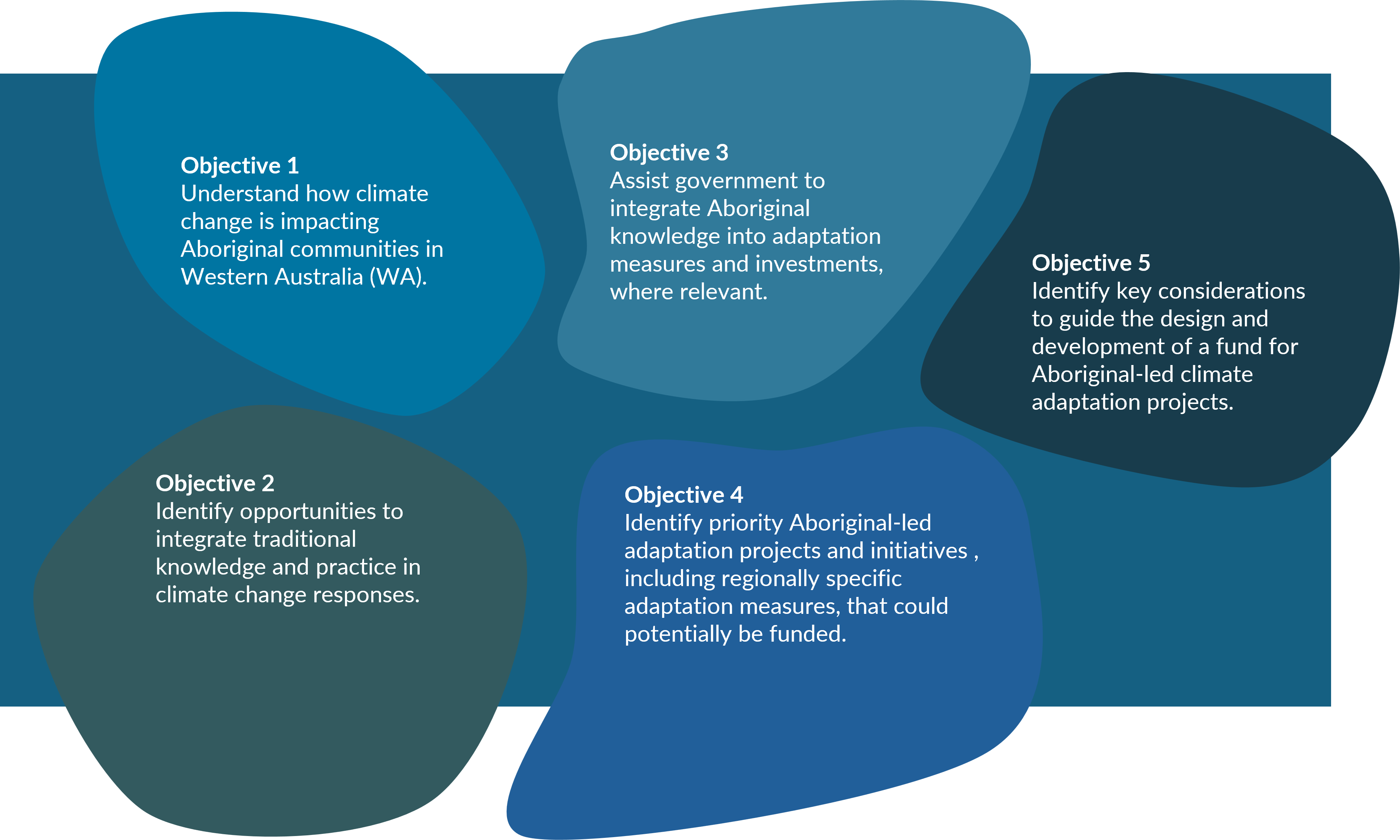
The engagement process commenced in mid-2025 and seeks to build relationships with Aboriginal communities across metropolitan, regional and remote areas. Key objectives are outlined below.
How do I participate?
There are several different ways to participate in the consultation. These include:
- Metropolitan and regional workshops: In-person workshops held across WA metropolitan area and regions to engage with stakeholders in each region in a way which is convenient and culturally safe. If you are interested in attending workshops please register here.
- Online workshops: Interactive virtual sessions to provide an accessible option for stakeholders who cannot attend in person or prefer virtual engagement. If you are interested in attending workshops please register here.
- Online workshops for young people: Interactive virtual sessions provide a culturally safe and accessible platform for young Aboriginal people to share their views and contribute to the Project. If you are interested in attending workshops please register here.
- Survey: A structured survey to gather input from stakeholders who prefer to provide feedback at their own pace and in their own time. If you are interested in completing the survey, please click here.
- Email submissions: To offer a flexible and direct channel for stakeholders to submit feedback or supporting documents. If you are interested in completing the survey, please send an email to WAACA@KaalaBarna.com.au.
- Honorarium payments: More information about honorarium payments can be found at this link.
When are the workshops?
Broome - 30 September to 1 October
Online - 1 October
Kununurra - 2 October
Perth - 14 October
Mandurah - 16 October
Bunbury - 20 October
Albany - 21 October
Online - 24 October
Karratha - 27 October
Geraldton - 29 October
Fitzroy Crossing - 28 October to 30 October
Esperance - 11 November
Register for workshops here.
Contact us
If you have any questions about the consultation, don’t hesitate to email us on WAACA@KaalaBarna.com.au
Frequently asked questions
Show moreWhat is the WA Aboriginal Climate Adaptation Project?
The WA Aboriginal Climate Adaptation Project is a State Government initiative under the WA Climate Adaptation Strategy that aims to engage with Aboriginal leaders and regional communities to build trust, share knowledge and design a dedicated fund for Aboriginal-led climate adaptation projects.
Who is leading the project?
The Department of Water and Environmental Regulation (DWER) is leading the project, and is partnering with Aboriginal consultancy, Kaala Barna & Nous Group.
The intention is for DWER to work in partnership with Aboriginal people based on the needs and aspirations of community.
Why is the State Government consulting on a Fund for Aboriginal-led Climate adaptation projects?
In consultation with Traditional Owner groups on the Climate Adaptation Strategy, a significant proportion of Aboriginal representatives outlined a desire for greater involvement in building Western Australia’s climate resilience and additional support and funding for Aboriginal-led climate change adaptation projects.
How does this project relate to Closing the Gap?
The WA Aboriginal Climate Adaptation Project represents a dual opportunity for the State to progress the self-determination of Aboriginal people and strengthen their capacity for climate change adaptation and resilience. The project will apply the principles of empowerment and self-determination set out in the WA Aboriginal Empowerment Strategy 2021-2029 and contribute towards the priority reforms and socio-economic outcomes of the WA Implementation Plan for Closing the Gap.
The project presents an opportunity to progress the priority reforms related to strengthening formal partnerships and shared decision-making with Aboriginal people, building the Aboriginal community-controlled organisation (ACCO) sector and transforming government processes and systems.
How long is the consultation period?
The WA Aboriginal Climate Adaptation Project will incorporate a 12-week consultation period which includes:
- early engagement activities
- two rounds of on Country (in person) workshops tailored for specific stakeholder groups
- additional online workshops
- an online survey
- written submissions via email.
Who is the State Government consulting as part of this project?
A diverse group of stakeholders will be consulted on the WA Aboriginal Climate Adaptation Project including:
- Elders and Traditional Owners
- Registered Native Title Bodies Corporate (more commonly known as Prescribed Bodies Corporate - PBCs)
- Aboriginal peak bodies
- Aboriginal community-controlled organisations
- Aboriginal community-controlled health organisations
- Aboriginal businesses
- Aboriginal land and sea councils/ Native Title representative bodies
- Aboriginal academics and representatives from University’s
- Aboriginal young people representatives
- Aboriginal advisory groups and councils.
What is the purpose of the workshops?
Workshops will help empower Aboriginal leadership and create spaces for deep listening to Aboriginal knowledge.
The workshops aim to build trust, understand the impacts of climate change on Aboriginal communities, and collaborate on the development of a Fund for Aboriginal-led climate adaptation projects, including identifying priority Aboriginal-led adaptation projects and initiatives, including regionally specific measures, that could potentially be funded. Insights from the workshops also aims to identify key considerations to guide the design and development of a Fund.
What regions will be covered during consultation?
The consultation process will include on Country regional workshops and two rounds of consultation. Additional online workshop options will be available if there is interest from specific groups of stakeholders.
The regional workshops will cover each WA region, locations including:
- Esperance
- Albany
- Kalgoorlie
- Katanning
- Bunbury
- Mandurah
- Northam
- Geraldton
- Karratha
- Broome
- Fitzroy Crossing
- Kununurra
How will feedback be used?
Feedback from workshops and other engagement methods will be a key input to the design of the proposed Fund. Where appropriate, feedback will also inform development of future adaptation and resilience activities.
Will workshop participants receive updates?
Yes. Consultation outcomes will be shared with workshop participants aligned with principles of Free Prior and Informed Consent and Indigenous Data Sovereignty. This is essential for the respectful sharing of knowledge and is recognised as best practice when engaging with Indigenous knowledge systems.
All workshop participants will receive updates through close-out sessions, written summaries and visual materials.
How can I participate if I can’t attend an in-person workshop?
You can participate via online workshops, surveys, or by submitting written feedback via WAACA@KaalaBarna.com.au
What happens after the consultation?
Key findings from the consultation will be presented to stakeholders in close-out sessions. These findings will inform the final design of the proposed Fund, which will be subject to further Government consideration.
Who is eligible for paid participation?
Individuals with lived experience relevant to the engagement activity, including Aboriginal Elders, community leaders and community members, are eligible for paid participation. Eligibility for paid participation is defined in Appendix 1 of the Community Paid Participation Policy and excludes those participating in a professional or representative capacity. (A link to the Community Paid Participation Policy will be included when published)
What are the payment rates?
Payment is based on role and duration of participation: active participants receive $100 (half day) or $200 (full day); advisors receive $200 (half day) or $400 (full day); Aboriginal Elders or community leaders receive $250 (half day) or $500 (full day). (A link to the Community Paid Participation Policy will be included when published)
How are payments processed?
Payments are made after the activity, following approval by DWER. Participants must complete a statement by a supplier form and provide bank details or request a cheque. (A link to the Community Paid Participation Policy will be included when published)
What do I need to do to receive payment?
If you are eligible, under Australian Taxation Office (ATO) requirements, you must complete an ATO Statement by a Supplier form declaring you are not operating as a business.
Will the fund also support decarbonisation and energy transition projects led by Aboriginal people?
The fund could potentially support a range of projects that respond to climate change, including climate Aboriginal-led adaptation, resilience, decarbonisation and energy projects. The scope of the proposed fund will be informed by priority projects identified by Aboriginal people across the regions.
Subject to establishment of the proposed fund, the Fund could potentially support projects identified as part of this consultation process, or other projects not specifically identified but important to delivering climate resilience outcomes for Aboriginal people. This may include new or existing projects.
How does this project relate to the First Nations National Climate Risk Assessment?
The First Nations National Climate Risk Assessment identifies climate change is impacting Aboriginal people’s self-determination. Climate change has been identified as a risk to self-determination and these risks will change over time.
Identified risks to Aboriginal people’s self-determination include risks to:
- health, wellbeing and identity
- cultural knowledge, practices, values and sites
- economic participation, including social and economic development
- Country, including land and sea through the changing climate
- water and food security
- communities and settlements.
WA Aboriginal Climate Adaptation Project recognises these risks and is intended to facilitate projects led by Aboriginal people to help mitigate the risks climate change poses to Aboriginal people’s self-determination.
How does this project relate to the First Nations Clean Energy Strategy?
The First Nations Clean Energy Strategy is a national framework to guide investment, influence policy, and support First Nations people to self-determine how they participate in, and benefit from, Australia’s clean energy transition.
The clean energy transition is a critical moment for Australia’s relationship with First Nations peoples. The Strategy is a 5-year national framework for action that will help all governments, industry and community members to work together to create opportunities for First Nations people to make their own choices and gain social and economic benefits through the energy transition.
There are potential synergies and alignment with the WA Aboriginal Climate Adaptation Project and the Strategy. Strategy objectives align with fund objectives. The fund could potentially support decarbonisation and energy transition projects led by Aboriginal people.
Can Aboriginal groups be assured that funding will be made available for Aboriginal-led adaptation projects through the proposed fund?
This consultation process is an opportunity to inform future funding arrangements for WA Aboriginal Climate Adaptation.
Consultation undertaken as part of WA Aboriginal Climate Adaptation will provide a better understanding of the issues of importance for Aboriginal and Torres Strait Islander people and communities to address matters related to climate change, ensuring future funding for climate adaptation and resilience is based on community priorities (making space for Aboriginal ways of knowing, doing, and leading).
The establishment of the fund will ultimately require consideration and approval by the Minister for Climate Resilience and Cabinet.
When will funding be available for Aboriginal-led projects?
Subject of further Government consideration and approval, funding for Aboriginal-led projects may be available from the 2026-27 financial year.
 Print this page
