


Welcome to the October Update
October marks the beginning of the transition arrangements for the Registration Standards 2025 (2025 Standards) in Western Australia for TAC regulated RTOs.
As RTOs prepare for the implementation of the 2025 Standards from 1 January 2026, the Training Accreditation Council (the Council) remains committed to supporting providers to meet their compliance obligations by delivering clear guidance and education resources such as the TAC Registration Standard 2025 Hub, Fact Sheets, and webinars.
The Council is also pleased to announce that following its tabling in the Parliament, the TAC Annual Report 2024–2025 has been published on the website.
Over the past year, key highlights include:
- The launch of the revised TAC Strategic Plan 2025–2028, setting a clear direction for the Council over the next three years.
- The introduction of a new TAC Risk Framework, designed to enhance the Council’s ability to identify and respond to emerging risks.
- Regulatory activities aligned to the 2023–2025 TAC Regulatory Strategy to monitor systemic risks to quality across the WA VET sector.
- TAC Education Program webinars and workshops, including the flagship TAC Event delivered to approximately 1,400 participants.
- Feedback on TAC audit activity with RTOs remained positive, with 93% of respondents indicating that the audit experience added value to their business.
Transition Arrangements for the 2025 Standards
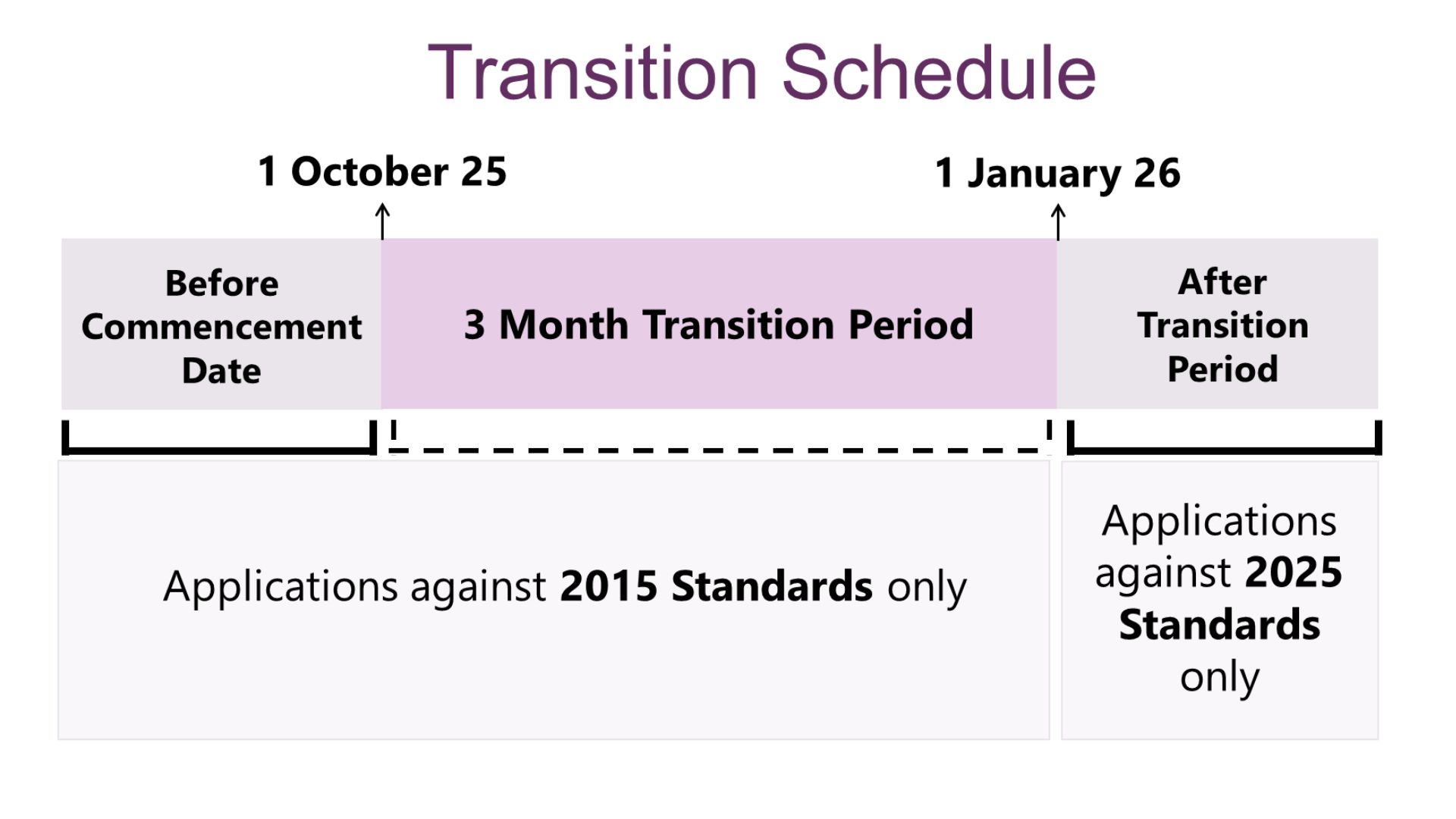
To support RTOs in their transition to the 2025 Standards, a three-month transition period from 1 October to 31 December 2025 is provided in the amendments to the WA Vocational Education and Training (General) Regulations 2009.
During this transition period:
- RTOs must continue to comply with the Standards for RTOs 2015.
- All applications submitted during this time will be assessed against the Standards for RTOs 2015.
From 1 January 2026, all RTOs must operate under the 2025 Standards. All applications from 1 January 2026 will be against the 2025 Standards.
Applications submitted during the transition period under the Standards for RTOs 2015 will be audited and presented to Council for a decision against the Standards for RTOs 2015, even if the audit or decision occurs after 1 January 2026.
TAC Education Program
Upcoming Events:
Register now for our upcoming event. You can also be alerted to new events by following Event Page on Humanitix.
VET Student Support - Outcome Standards 2.1 and 2.2
Mon, 27 Oct, 9:30am - 10:30am AWST
TAC Registered RTOs are invited to the VET Student Support webinar which will guide RTOs through the requirements of Outcome Standards 2.1 and 2.2 under the 2025 Standards, focusing on the critical steps that must occur before enrolment.
Learn how to provide clear, accurate, and accessible course information, assess student suitability, and tailor enrolment procedures to different training products and cohorts. Case studies will illustrate practical approaches to ensuring students are well-informed and set up for success
Webinar Recordings:
View the TAC Education Program to access professional development opportunities, support and guidance materials and access previous webinar recordings and resources.
Updated Fact Sheets
A comprehensive suite of Assessment Fact Sheets is now available to support high-quality, compliant assessment practices across the sector. These resources align with the 2025 Standards and provide practical guidance for RTOs on delivering fair, valid, and industry-relevant assessments.
The updated suite includes Fact Sheets on:
Each Fact Sheet offers targeted advice to help RTOs strengthen their assessment system, from designing fit-for-purpose tools, conducting workplace assessments and validating assessment decisions. These resources outline expectations for industry engagement, and provide strategies for supporting diverse student cohorts.
In addition to the updated materials, RTOs are encouraged to refer to the previously published Training Product Equivalence Fact Sheet, which remains a key resource for understanding how equivalence is determined and applied in credit decisions and assessment planning.
Whether refining assessment tools or reviewing validation schedules this suite of Fact Sheets offers valuable insights to enhance quality and compliance.
Managing Training Package Changes
RTOs must stay alert to changes in training packages, particularly where updates affect core or named elective units within a qualification. For example, a common risk arises when a qualification is updated and core or named elective units are removed.
The removal or replacement of core or named elective units in qualifications can directly impact an RTO’s scope of registration. If a core or named elective unit is removed or replaced, the unit will no longer be on the RTO’s scope of registration and the RTO is not authorised to deliver or issue certification for it, including in relation to a skill set.
RTOs should regularly review their scope of registration and ensure it aligns with current training product requirements. Delivering units not on scope can lead to non-compliance and serious consequences, including invalid certification of students.
To help stay informed, RTOs can subscribe to alerts from training.gov.au (TGA). These notifications provide timely updates whenever changes occur to training products, making it easier to manage scope and avoid surprises. Instructions for subscribing to these alerts are available on the TGA website.
Focus on Quality Article: Strengthening Assessment Practice
Quality assessment practices are central to Vocational Education and Training (VET) as they determine whether students are competent to perform the tasks required in the workplace. More than meeting a compliance requirement, high-quality assessment underpins student success, industry trust, and the credibility and integrity of qualifications issued across the sector.
With the introduction of the Registration Standards 2025 (2025 Standards), assessment practices are under renewed focus. The 2025 Standards require RTOs to demonstrate that assessment systems are fit-for-purpose, aligned with the training product, and responsive to individual student needs. These changes aim to strengthen the quality and consistency of assessment outcomes and ensure students are genuinely job-ready.
Unlike general education, where assessment often reflects what a student has learned, assessment in the VET system certifies what a student can do, a distinction which carries significant weight. A poor assessment decision can affect not only a student’s career but also workplace safety, service quality, and the reputation of the VET sector.
The 2025 Standards reinforce the importance of:
- Pre-validation of assessment tools before use;
- Ensuring all training package requirements are addressed;
- Authenticity of evidence, especially in online and remote settings;
- Fair, valid, reliable, and flexible assessment practices; and
- Regular validation of assessment decisions and tools.
Assessors must be confident that the evidence presented is the student’s own work and reflects their current capability. This is particularly important in an era of AI-generated content and increased online delivery. Strategies such as direct observation, targeted questioning, and supervised assessments help maintain integrity.
The suite of Assessment Fact Sheets and the recent Assessment Webinar provide practical guidance on implementing these requirements, including examples, checklists, and tools to support quality assessment.
TAC RTO and Stakeholder Perception of Performance Report
The Council has published the RTO and Stakeholder Perception of Performance Report 2024. The surveys, conducted by an independent research company, Research Solutions Pty Ltd, indicate that overall perceptions of TAC’s performance are very positive, with 93.5% of RTOs and 88% of stakeholders rating TAC’s performance as good or excellent.
The infographic provides report highlights, and a copy of the full report can be downloaded via the TAC website.
Other important updates
VET Data Streamlining Developer Portal
The VET Data Streamlining (VDS) Developer Portal is now live. The Portal is a technical resource designed to assist Student Management System vendors and other relevant stakeholders with their own systems to connect to VDS APIs.
For more information and to register for the VDS Developer Portal, visit the NCVER website.
Jobs and Skills Australia
Jobs and Skills Australia (JSA) has released the following:
Consultation
Reports:
- Our Gen AI Transition - Final release - 30 Sep
- Our Gen AI Transition Case Studies - 30 Sep
- International Students Pathways and Outcomes Study Report - 25 Sep
Latest NCVER Reports
NCVER has released the following new reports:
- VET in Schools 2024 - 10 Oct
- Apprentices and trainees 2025: March quarter - 25 Sep
- Total VET students and courses 2024 - 22 Sep
 Print this page
