


Legislation, wiring rules and requirements
Building and Energy legislative framework
Wiring Rules
AS/NZS 3000, Electrical Installations (known as the Australian/New Zealand Wiring Rules) are the technical rules that set out the requirements for the design, construction, and verification of electrical installations.
Compliance with the Wiring Rules is mandatory under regulation 49 of the Western Australian Electricity (Licensing) Regulations 1991.
Electrical legislation
For a list of the energy legislation administered by Building and Energy visit:
Building and Energy legislative framework
Some provisions of the electrical legislation and the WA Electrical Requirements reference Australian Standards, including the Wiring Rules, and require compliance with those standards. These standards are developed by Standards Australia in collaboration with industry and government.
Copies of standards can be accessed via the following:
- Purchased via paid subscription or individual standard purchase from Standards Australia.
- The reserve section of the State Library of Western Australia which provides limited, no-fee access to Australian Standards.
- Reader Room which is an initiative by Standards Australia that provides limited, no-fee access to many Australian Standards for non-commercial purposes.
WA Electrical Requirements
View the current WAER – August 2023
The WA Electrical Requirements (WAER) sets out the minimum requirements for all electrical installations in WA.
Compliance with the WAER is mandatory under Regulation 49 of the Western Australian Electricity (Licensing) Regulations 1991. The WAER should be read with the Electricity Regulations 1947, Part VIII, and the Electricity (Licensing) Regulations 1991. Both sets of regulations take precedence.
The document makes frequent references to relevant Australian Standards. As a general rule, nothing in those standards is replicated in the WAER. The reader needs to refer to the quoted Australian Standards.
Failure to comply with a requirement may result in prosecution under the Electricity (Licensing) Regulations 1991. It may also cause electricity connection delays.
Electrical licensing
Western Australia’s system for regulating electrical work ensures that only suitably qualified people who hold electrical licenses are legally entitled to carry out electrical work.
More information on licensing and renewals please see the link below.
Visit the electrical licensing page
Electrical eNotice
Preliminary Notices and Notices of Completion must be completed and provided to the relevant network operator or to Building and Energy (where there is no network operator).
Safe working guidelines for electrical workers and apprentices
View the Safe working guidelines
The safe working guidelines explain responsibilities for employers, supervising electrical workers, electrical workers and apprentices involved with electrical work and covers electrical safety risks and management practices to ensure the safety of workers.
These guidelines are designed to complement the Electricity (Licensing) Regulations 1991 in matters specifically related to the licensing, supervision and safety of electrical workers and apprentices.
A person carrying out electrical work is safe when the appropriate practices and procedures are followed. They are an integral part of the electrical trade and must be the first skills learned. The safe working guidelines provide information on the dangers and risks when undertaking electrical work and cover basic trade safety knowledge and practices to be followed by every electrical worker and apprentice.
Supervision of electrical workers
Apprentices and some new employees require effective supervision for their safety and training and the safety of others. The responsibility for determining the appropriate level of supervision rests with the employer and the supervising electrical worker, which is covered in the safe working guidelines.
This publication replaces the 2018 publications Safe working guidelines for electrical workers and Safe working guidelines and assessment for electrical apprentices.
Responsibility for general safety
Employer and employee responsibilities for maintaining workplace safety are set out in the Work Health and Safety Act 2020.
Employers have a duty of care to maintain a safe working environment for employees by providing information and training, safe work procedures, safety equipment and effective supervision.
Employees have a duty of care to ensure their own safety and to avoid any act or omission which adversely affects the safety of others during the performance of their work. Employees must cooperate with employers, follow safe work procedures and use protective equipment.
Apprentice safety assessment test and report
The safe working guidelines form part of the apprentices' reference material during the apprenticeship.
To apply for an electrician’s training licence, an apprentice needs to read and understand the safe working guidelines and then complete a written test with a minimum pass mark of 80%.
The apprentice’s employer must conduct the test and submit a brief report to Building and Energy with the apprentice’s training licence application form.
View the apprentice safety assessment test and report:
Supervision requirements after completion of apprenticeship
Apprentices who have completed their apprenticeship (former apprentices) must apply for an electrician’s licence as soon as possible to ensure they are properly licensed to carry out electrical work. The fact sheet, Obtaining an Electrician's Licence on completion of an apprenticeship provides further information about this process.
Regulation 50AB of the Electricity (Licensing) Regulations 1991 (ELR) confirms that former apprentices may continue to be employed to carry out electrical work, provided their employer has taken all reasonable steps to be satisfied that they:
- hold an electrician’s training licence (which remains valid until it expires, which is three months after completing an apprenticeship); and
- have applied for an electrician’s licence.
While waiting for an electrician’s licence application to be processed, former apprentices remain subject to the same supervision requirements that apply to holders of an electrician’s training licence. These requirements are outlined in regulations 50 and 50AA of the ELR and the Safe working guidelines for electrical workers and apprentices.
It is important to remember that if an electrician’s training licence expires and a former apprentice has not yet obtained an electrician’s licence, they will become unlicensed and can no longer carry out electrical work.
Electrical work in medical centres
Electrical installations in medical centres present a higher level of risk than standard commercial premises due to the vulnerability of patients and the use of medical electrical equipment. In Western Australia, licensed electrical contractors and electricians must ensure that electrical work carried out in patient treatment areas complies with AS/NZS 3003:2018 – Electrical installations – Patient areas, in addition to AS/NZS 3000 (Wiring Rules).
AS/NZS 3003 applies to areas where low voltage medical electrical equipment is intended to be used on patients, including GP clinics, dental practices, day surgeries and allied health facilities. The standard introduces additional protective measures designed to minimise the risk of electric shock to patients during medical procedures.
Identifying patient electrical areas
Correct identification of patient electrical areas is a critical first step. AS/NZS 3003 requires all patient areas to be classified as either:
- body protected electrical areas, or
- cardiac protected electrical areas.
This classification is based on the medical procedures performed and the clinical use of electrical equipment within each room. Importantly, electricians and electrical contractors do not determine the classification of medical rooms. Responsibility for classification rests with the owner or operator of the medical facility, often in consultation with clinicians or biomedical specialists, and with reference to AS/NZS 2500 – Guide to the safe use of electricity in patient care.
However, electricians have a clear duty to seek, confirm and document this information from the client before commencing work. Assuming an area is non-patient or incorrectly treating a room as a standard commercial space, may result in a non-compliant and potentially unsafe installation.
Body protected electrical areas in medical centres
Many rooms within medical centres are commonly classified as body protected electrical areas, such as consultation rooms, treatment rooms and dental surgeries. These areas have specific electrical requirements under AS/NZS 3003, which are additional to the Wiring Rules and may include:
- Medical grade 10 mA Type 1 RCD protection for socket outlets supplying medical equipment.
- Dedicated patient sub circuits that do not supply other rooms.
- Equipotential earthing and bonding of exposed conductive parts.
- Restrictions on socket outlet colours, labelling and signage.
- Display of the green body protected area sign.
- Mandatory inspection, testing and regular recertification.
These requirements apply not only to new installations, but also to alterations, additions and repairs within identified patient areas.
AS/NZS3003 also contains several appendixes that provide examples of commissioning checklist and routine inspection checklists.
Defects associated with medical centres
- Incorrect identification of patient electrical areas.
- No evidence of commissioning or certification documentation.
- Protection of socket-outlets identified as ‘Cleaning Purpose Only’ not in accordance with the standard or not provided.
- Incorrect or missing circuit identification.
- Mechanical protection not in accordance with the applicable requirements.
- Non-compliant protective devices - 30 mA RCD used where 10 mA required.
- Non-compliant or missing Body Protected Area signage.
- Socket outlets without indicator lights (neon/LED).
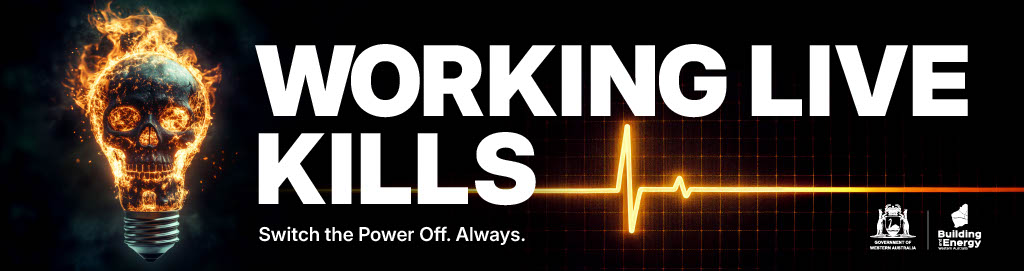
Working Live Kills
Electrical workers are at a greater risk of electric shocks and electrocution than members of the general public or workers in other occupations.
Building and Energy's education campaign, Working Live Kills, aims to change the behaviours and habits of those who have been in the industry for a long time, and to educate and to empower younger workers to enforce the rules and turn the power off before any work is performed.
Working live is the leading cause of burns, shocks, serious accidents and fatalities for electricians. To help keep workers safe, the law was changed in 2017 to ban live work on or near an exposed, energised part of an installation that can be de-energised.
Remember, make the safe call – turn off the power off while you work – because Working Live Kills.
To promote the safety message ‘Working Live Kills’ tool box and car bumper stickers were designed. Multiple options were circulated to students to obtain feedback on the most impactful design. The stickers were extremely successful with industry stakeholders and registered training organisations who assisted with the wide distribution.
To request ‘Working Live Kills’ stickers, please contact: EGPgeneraladmin@demirs.wa.gov.au
Letter to electricity customers regarding ban on live work
View the letter to electrical installation owners
Building and Energy prepared a letter signed by the Director of Energy Safety to inform electricity customers about the new laws, which strictly limit work on or near energised electrical equipment to exceptional circumstances. Electrical contractors and electricians are encouraged to provide a copy of this letter to their customers when quoting and performing electrical work.
Compliance obligations for other workers
Persons performing any work in premises with an electricity supply must be aware of the potential significant hazards associated with live electrical equipment.
In particular, there are a number of possible electrical hazards in roof spaces that are a danger to any person, workers or occupier, when entering a roof space. These hazards may include:
- exposed live electrical conductors or terminals;
- unenclosed joints in conductors (i.e. no connection boxes);
- substandard or deteriorated wiring (often associated with older buildings);
- unused wiring left in the roof space that has not been disconnected from the switchboard;
- past electrical work not performed by a competent person which could be substandard and unsafe;
- live consumers mains even when the main switch is off and the SPD is removed;
- solar array DC and service AC cabling carrying significant DC voltage;
- damaged cables (e.g. chewed by rodents); and
- metallised thermal insulation which may be energised due to poor installation practices.
Building and Energy has developed stickers to be affixed to the roof space manhole and at the main switchboard/meter box to serve as a reminder to switch the power off before anyone enters the roof space.

To request stickers, please contact: EGPGeneralAdmin@demirs.wa.gov.au
More information can be found in the Work Health and Safety (General) Regulations 2022 – Regulation 153, Work in roof spaces.
