


State EV Strategy for WA
Show moreThe State EV Strategy emphasises the multiple benefits of EVs, including improving air quality in urban centres, reducing greenhouse gas emissions, supporting local industry and delivering a range of benefits for consumers. The Strategy’s actions are preparing WA for the transition to low and zero‐emission EVs.
In releasing the State EV Strategy, the government undertook to continue to monitor trends in EV technology and markets and implement the necessary measures to ensure Western Australia continues to take advantage of the associated economic, social and environmental benefits. The EV Strategy Progress Report responds to current EV trends and technologies and includes additional government commitments made since the State EV Strategy was released.
The Strategy supports investing over $525 million through the following actions to support the electrification of cars and buses in WA, and additional measures to build on the actions in the State EV Strategy and further accelerate the uptake of EVs. These have also been added to the State EV Strategy actions captured in EV Strategy Progress Report.
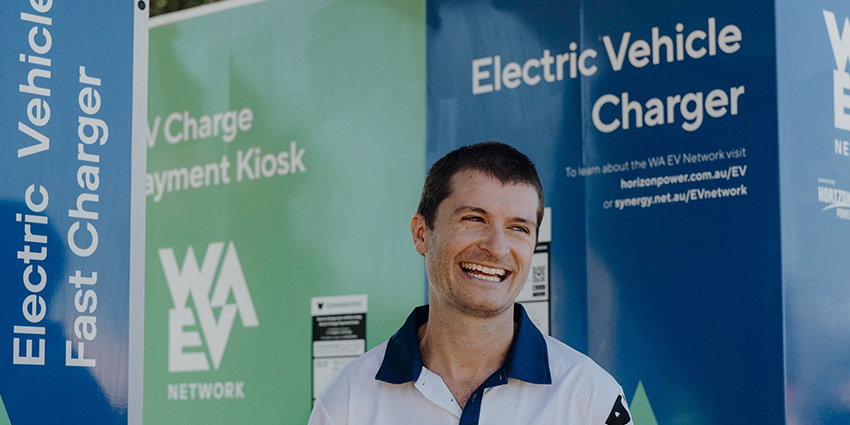
- Completing the $23 million WA EV Network, one of the world’s longest connected EV charging networks. The 110 chargers across 49 sites connect Perth and regional Western Australia – stretching north from Perth to Kununurra, along the south-west coast to Mundrabilla on the Nullarbor and east to Kalgoorlie.
- Providing $50.5 million in rebates to 14,424 Western Australian drivers who purchased a new EV or hydrogen fuel cell vehicle up to a value of $70,000 before 10 May 2025.
- $15 million to support small businesses, not-for-profits and local governments to install charging infrastructure by providing grants of up to 50 per cent of the installation costs through the Charge Up grant scheme.
- $ 6.2 million to trial the installation of EV charging infrastructure at Transperth train stations, providing car parking bays with commuter charging access.
- $435 million in funding to electrify the Transperth bus fleet and install associated charging infrastructure.
- Developing a statewide strategy for future electric road transport charging infrastructure to support the transition to net zero.
- Developing a road freight decarbonisation strategy for south west Western Australia in consultation with the road freight sector.
WA EV Data
Show moreThe Department of Transport publishes quarterly updates on EV licensing data on their website: WA Electric Vehicle Licensing Data.
Government rebates and incentives
Show moreIncentives
Charge Up EV Charging Grants
The Charge Up EV Charging Grants provide funding for Electric Vehicle (EV) charger hardware, software and installation costs for not-for-profit organisations, small to medium businesses and local government authorities. Up to 50% co-funding is available for AC chargers (7 to 22kW) and DC chargers (24 to 350kW). Applications for Round 3 have now closed. For more information visit www.wa.gov.au/chargeup.
Zero Emission Vehicle (ZEV) Rebate
In May 2022, the State Government introduced the Zero Emissions Vehicle Rebate Scheme to encourage the purchase of zero emissions vehicles as part of the Government’s Clean Energy Car Fund. Rebates of $3,500 are available to Western Australians that buy a new electric or hydrogen fuel cell vehicle by 10 May 2025 up to a value of $70,000. A total rebate of $50.5 million have been paid to 14,424 Western Australian drivers. If you would like to know more about the rebate, visit the Department of Transport website Zero Emissions Vehicle (ZEV) Rebate.
WA EV Network charger map
Show moreSynergy and Horizon Power have delivered and are now operating Australia’s longest EV-charging network (the WA EV Network). This $23 million investment includes 110 charging stations across 49 different locations connecting Perth and regional WA. You can find the EV-charger map and more information on Synergy’s WA EV Network.
Vehicle Emissions Star Rating (VESR)
Show moreThe Vehicle Emissions Star Rating (VESR) allows you to compare vehicle emissions and running costs for over 16,000 vehicles.
How VESR works
VESR is a six-star rating system which allows you to compare the carbon dioxide emissions of different cars, utes and vans. It’s simple – the more stars a vehicle has, the lower the vehicle’s tailpipe CO2 emissions.
Consider your annual cost with a fully customisable calculator. For a personalised result, input the price you pay for fuel or electricity and the distances you drive. Alternatively, learn more about topics ranging from battery recycling to emissions offsets through the resources tab.
Your choice can drive big changes
Choose VESR to:
- make sustainable choices when deciding on your next vehicle purchase
- calculate the environmental and running costs of your current vehicle
- compare the emissions and cost savings of up to four different vehicles in a single moment.
Compare your vehicle now.
Planning approvals
Show moreA Position Statement - Electric Vehicle Charging Infrastructure has been prepared by the Department of Planning Lands and Heritage to outline how EV-charging infrastructure should be assessed in the WA planning system. The Position Statement aims to assist proponents and decision makers by advocating for a streamlined approvals process, and provide guidance on development applications, public works, appropriate locations, and recommended numbers of EV chargers in different land use types.
Sectoral Emissions Reduction Strategy for WA – pathway for transport
Show moreThe State Government introduced new transport initiatives under the Sectoral Emissions Reduction Strategy, released in December 2023. These initiatives will further support the state’s transition to low- and zero-tailpipe emissions vehicles, including commitments to:
- increase the State Government fleet EV target to at least 50 per cent of all new purchases in eligible categories from 1 July 2025 to demonstrate government leadership and support the supply of EVs to the second-hand vehicle market
- develop a statewide strategy for future electric road transport charging infrastructure required to support the transition to net zero
- fund installation of additional EV chargers at new METRONET train stations to boost the rollout of EV-charging stations underway at existing train station parking bays.
Electric Vehicle Action Plan
Show moreTransitioning to electric transport will play a key role in shaping WA’s future electricity systems. The State Government’s Electric Vehicle (EV) Action Plan: preparing Western Australia’s electricity systems for EVs, outlines 26 priority actions to integrate EVs within WA’s power systems. The Action Plan is administered by Energy Policy WA in the Department of Energy, Mines, Industry Regulation and Safety.
Are Automated Vehicles (AVs) allowed in Western Australia?
Show moreAutomated vehicles (AVs) have many potential benefits including improved road safety, mobility and accessibility, as well as reduced carbon emissions and improved productivity, traffic flow and fuel efficiency. However, current laws do not allow for the general on-road use of AVs, including automated cars, trucks and buses except under AV trial frameworks. The WA AV trial framework can be found on the DTMI website.
The National Transport Commission (NTC) and the Commonwealth Department of Infrastructure, Transport, Regional Development, Communications, Sports and the Arts (DITRDCSA) have been working alongside state and territory governments to create a regulatory framework for AV. Further information on this (including public consultation) can be found on the NTC website.
