


The VET quality framework
In line with the Vocational Education and Training (General) Regulation 2009 (VET Regulations), Registered Training Organisations (RTOs) or those applying to be RTOs with the Training Accreditation Council (TAC/Council) are required to demonstrate their ability to comply with the VET quality framework as part of their application for registration and in maintaining registration as an RTO.
The VET quality framework (the framework) comprises the:
- registration standards 2025 (which incorporates the Outcome Standards; and the Compliance Standards and Fit and Proper Person Requirements);
- Australian Qualifications Framework (AQF);
- data provision requirements; and
- financial viability guidelines.
Each of the components of the framework are described in more detail in the table below.
Registration Standards 2025
| Outcome Standards - Registration Standards 2025 (Version 1 dated 20/08/2025) | The Outcome Standards are a foundation for quality training – describing the key factors that contribute to quality VET. They set out the key elements of quality training and assessment which organisations must demonstrate to be registered, and maintain registration, as a training provider. |
The Credential Policy (dated 14/3/2025) outlines the credentials required for trainers and assessors undertaking particular training and assessment activities or roles. RTOs must comply with the Credential Policy (as referenced within the 2025 Standards) to ensure training is delivered by properly qualified and credentialled people. The Policy also mandates that validation is performed by individuals with the necessary credentials. | |
| Compliance Standards & Fit and Proper Person Requirements – Registration Standards 2025 (Version 1 dated 20/08/2025) | The Compliance Standards set out requirements relating to accountability, integrity of nationally recognised training products, and information and transparency that RTOs must meet at all times to protect VET students and support the integrity of Australia’s VET sector. |
| Fit and Proper Person Requirements | |
The Fit and Proper Person Requirements are set out in Schedule 1 of the Compliance Standards The Fit and Proper Person Requirements set out the requirements that governing persons must meet. This seeks to ensure that these people are suitable to direct or manage the RTO. | |
| Nationally Recognised Training Logo Conditions of Use Policy | |
The Nationally Recognised Training (NRT) Logo Conditions of Use Policy is set out in Schedule 2 of the Compliance Standards. The NRT Logo is a distinguishable mark of quality for promoting and certifying national VET leading to Australian Qualifications Framework (AQF) certification documentation. The Policy seeks to protect the integrity of VET qualifications by ensuring appropriate use of the NRT Logo. |
Other regulatory requirements
| Australian Qualifications Framework, (Second Edition, January 2013) | The Australian Qualifications Framework (AQF) sets out requirements for regulated qualifications in the Australian education and training system, setting out course levels, qualifications and associated learning outcomes to support flexible, nationally consistent and high-quality qualifications. |
| The Data Provision Requirements(Version 1 dated 20/08/2025) | The data provision requirements set out the information RTOs must collect and provide against the Australian Vocational Education and Training Management Information Statistical Standard (AVETMISS VET Provider Collection specifications: release 8.0", revised 31 October 2022) and as required under the VET Data Policy (Version 1 dated 20/08/2025), and as requested by the Council. |
| Financial Viability Assessment Guidelines for the Registration of Training Providers 2017 (Issued under Section 13 of the VET Act, dated 06/09/2017) | The financial viability guidelines are set out in Financial Viability Assessment Guidelines for the Registration of Training Providers 2017 Ministerial Guideline. This sets out how financial viability risk assessments of RTOs (and those seeking to become an RTO) are undertaken by the Council to monitor the financial position of RTOs, including the mitigation of risks to VET students. |
All of these elements contribute to high-quality VET by maintaining the reputation and integrity of the VET sector and mitigating risks to students. Compliance may be tested by TAC through audits and may be examined as part of assessment of applications and risk-based monitoring activities.
The role of the VET quality framework
Show moreHigh-quality VET is vital to Australia’s future: the knowledge and skills it produces positions Australia as an economically prosperous, socially equitable and environmentally sustainable nation. Further, the VET sector plays a critical role in helping Australians get gain well paid and secure jobs, boosting living standards and creating opportunities for Australians to prosper.
While the quality of training is affected by many variables, RTOs have a critical role in ensuring training is high-quality and meets the diverse range of VET students and employer needs.
The VET quality framework (the framework) is a foundation for quality training – describing the key factors that contribute to quality VET. The framework fosters a VET sector that is trusted, capable and equipped to deliver quality training and provide the skills Australia needs for the future.
The purpose of the framework is to:
- support RTOs to deliver nationally consistent, high-quality training that leads to quality outcomes for students, industry, employers and the Australian community
- ensure training and assessment delivered by RTOs meets industry requirements (as set out in training packages and accredited courses) and ensures students are well equipped for employment and further study, and
- ensure RTOs operate with integrity and consider the needs of both students and industry.
By meeting the outcomes set out in the framework, RTOs can contribute to building increasing confidence in the sector, address risks to students and sector integrity, and design and deliver fit for purpose training that meets the needs of industry. In addition, the framework helps to cultivate a shared understanding of what constitutes quality training delivery for all users of the VET system and embeds a culture of quality within the sector.
RTO Responsibilities
Show moreRTOs regulated by TAC are responsible for ensuring they meet the VET quality framework at all times.
While performance against the VET quality framework (the framework) is tested at market entry and regular intervals following this, an RTO needs to be able to demonstrate that is meets the framework at all times.
This includes where some, or all, of the services are subcontracted to other RTOs, organisations or individuals (third parties). RTOs need to have effective mechanisms in place for overseeing and monitoring any subcontracted services to ensure compliance with the VET quality framework across its operations.
Roles in quality training and assessment
Show moreAustralia’s VET sector has a strong reputation for quality, both within Australia and internationally. However, poor performing, unethical or non-genuine RTOs damage the reputation of the sector, reduce student and employer confidence in VET, discourage government investment (or otherwise drive governments to attach more conditions to their investment to mitigate risk) and pose risks to the community (particularly where training is safety critical or for a licensed profession).
Ensuring the delivery of high-quality training and assessment:
- equips students with invaluable skills for work and life;
- supports a diverse array of students to gain skills and participate in employment;
- builds a strong and capable workforce to meet emerging and growing demand across industries;
- grows the economy; and
- supports RTOs to thrive because their service is respected and valued in the marketplace.
Different stakeholders play different roles in supporting a sustainable and thriving VET sector.
RTOs
RTOs play a critical role, including:
- governing persons – set the direction and culture of RTOs and are responsible for overseeing and monitoring performance and guiding continuous improvement
- trainers and assessors – deliver training (imparting knowledge and skills) to students and assess whether students have demonstrated their competency
- other staff – it takes many different people to support quality training and assessment; this includes admin staff, support staff, wellbeing staff and others, and
- third parties – RTOs rely on a wide range of third parties, including to market and advertise courses, attract students, and provide facilities and resources.
VET Students
VET students often rely on VET outcomes to gain employment, career advancement or life skills. VET students need to be able to make informed choices about training that best meets their needs and have confidence that, no matter which RTO they choose, they will receive quality training and assessment that is both responsive to industry or community needs and meets their needs. Students can contribute to the quality of VET by acting with integrity, and by providing feedback and making complaints to RTOs where issues arise, to help them improve.
Industry and Employers
Employers rely on RTOs to provide essential skills and knowledge to both potential new employees and existing workers. By actively engaging with RTOs, industry groups and employers can help ensure that the training and assessment delivered by RTOs is relevant to their needs and that graduates are competent. VET professional associations also play a role supporting quality training delivery and support of RTO governance and trainers and assessors.
Governments
Governments are significant purchasers of VET through public funding of some RTOs (such as TAFEs) and also by subsidising ‘in demand’ courses. Governments also invest in the infrastructure that supports the VET sector including Jobs and Skills Councils, the National Careers Institute, and training.gov.au.
Ongoing investment depends on government having confidence in the sector’s ability to deliver quality training and assessment to students. Governments contribute to the overall quality of VET by maintaining oversight of the sector, directing finite resources to areas of greatest need, and driving robust policy including developing Standards for the sector which are effective in delivering quality.
VET Regulators
The Training Accreditation Council (TAC/Council), the Australian Skills Quality Authority (ASQA), and the Victorian Registration and Qualifications Authority (VRQA) contribute to the overall quality of VET by controlling market entry, monitoring the performance of providers in the market and taking action where providers are not meeting the community’s expectations and are non-compliant with the legislation.
Registration Standards 2025
Show moreThe Registration Standards 2025 (2025 Standards) comprise of three documents:
- Outcome Standards - Registration Standards 2025;
- Compliance Standards & Fit and Proper Person Requirements – Registration Standards 2025; and
- the Credential Policy.
These documents collectively set the expectations for RTOs regulated by TAC to deliver high-quality training and assessment that engages students and enables them to achieve nationally recognised, industry-relevant competencies.
The Outcome Standards
Show moreDownload: Outcome Standards - Registration Standards 2025;
| 1. Training and assessment | Quality training and assessment engages VET students and enables them to attain nationally recognised, industry relevant competencies. |
| Training | 1.1 Training is engaging, well-structured and enables VET students to attain skills and knowledge consistent with the training product. |
| 1.2 Engagement with industry, employer and community representatives effectively informs the industry relevance of training offered by the WA registered provider. | |
| Assessment | 1.3 The assessment system is fit-for-purpose and consistent with the training product. |
| 1.4 The assessment system ensures assessment is conducted in a way that is fair and appropriate and enables accurate assessment judgement of VET student competency. | |
| 1.5 Assessment system is quality assured by appropriately skilled and credentialled persons through a regular process of validating assessment practices and judgements. | |
| Recognition of prior learning and credit transfer | 1.6 VET students with prior skills, knowledge and competencies are supported to seek recognition of prior learning to progress through the relevant training product. |
| 1.7 VET students who have previously completed an equivalent training product are supported to have their training recognised. | |
| Facilities, equipment, and resources | 1.8 Facilities, resources and equipment for each training product are fit-for-purpose, safe, accessible and sufficient. |
| 2. VET student support | VET students are treated fairly and properly informed, supported and protected. |
| Information | 2.1 VET students have access to clear and accurate information concerning the provider, the relevant training product, and students are made aware of any changes that may affect them. |
| 2.2 VET students are advised, prior to enrolment, about the suitability of the training product for them, taking into account the student’s skills and competencies. | |
| Training support | 2.3 VET students have access to support services, trainers and assessors and other staff to support their progress throughout the training product. |
| 2.4 Reasonable adjustments are made to support VET students with disability to access and participate in training and assessment on an equal basis. | |
| Diversity and inclusion | 2.5 The learning environment promotes and supports the diversity of VET students. |
| Wellbeing | 2.6 The wellbeing needs of the VET student cohort are identified and strategies are put in place to support these needs. |
| Feedback, complaints and appeals | 2.7 Feedback and complaints management addresses concerns and informs continuous improvement of the WA registered provider. |
| 2.8 Effective appeal processes are available to VET students where decisions of the WA registered provider or a third party adversely affect the student. | |
| 3. VET Workforce | VET students are trained, assessed and supported by people who are qualified, skilled and committed to professional development. |
| VET workforce management | 3.1 The workforce is effectively managed to ensure appropriate staffing to deliver services. |
| Trainer and assessor competencies | 3.2 Training and assessment is delivered to VET students by credentialled people with current skills and knowledge in training and assessment. |
| 3.3 Training and assessment is delivered by people with current industry skills and knowledge relevant to the training product. | |
| 4. Governance | Effective governance and a commitment to continuous improvement supports the quality and integrity of VET delivery. |
| Leadership and accountability | 4.1 A WA registered provider operates with integrity and maintains accountability for the delivery of quality services. |
| 4.2 Roles and responsibilities of WA registered provider staff and third parties are clearly defined and understood. | |
| Risk management | 4.3 Any risks to VET students, staff and the provider itself are identified and managed. |
| Continuous improvement | 4.4 A WA registered provider undertakes systematic monitoring and evaluation of the provider to support quality delivery and continuous improvement of services. |
Structure of the Outcome Standards
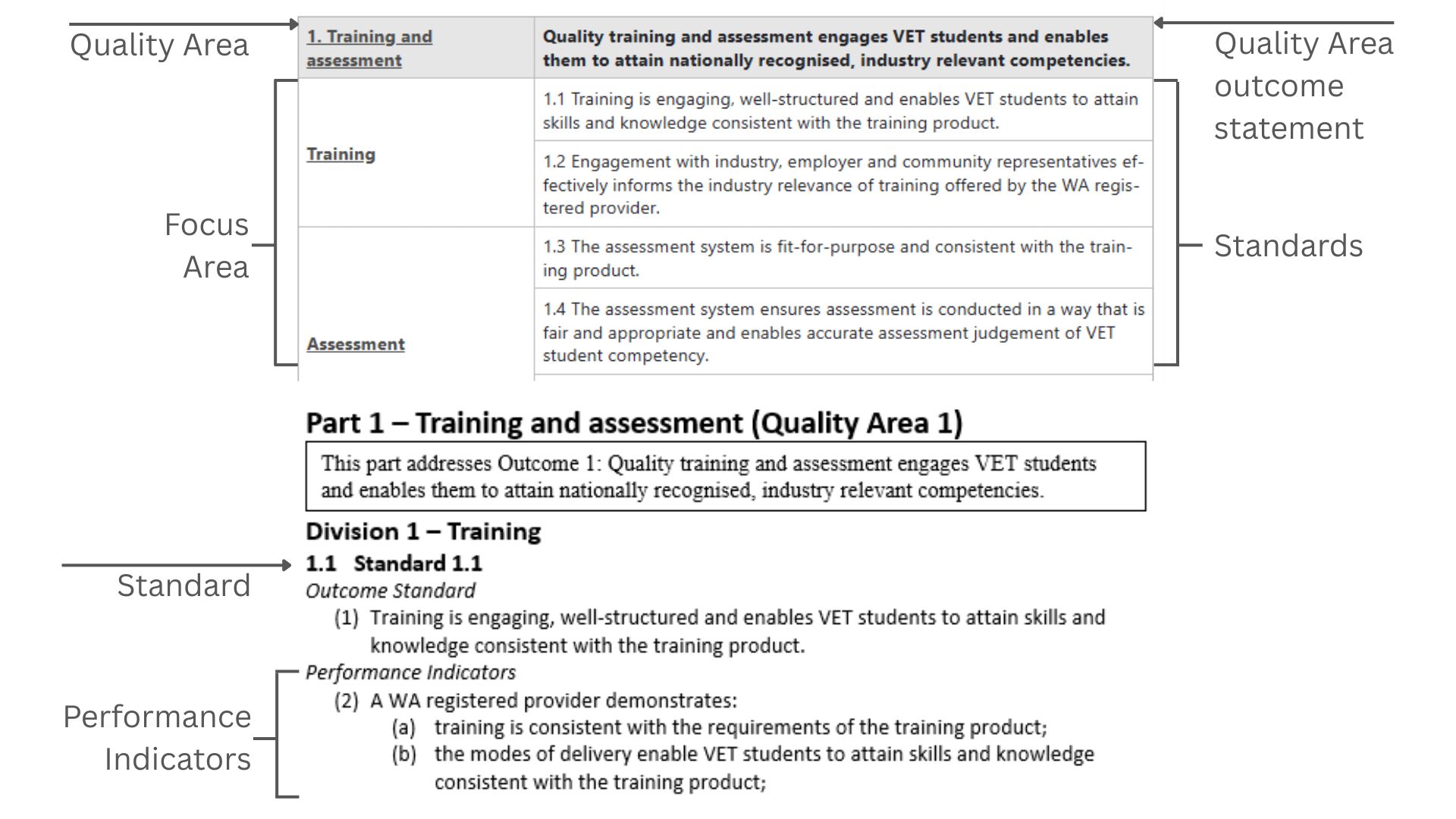
The Outcome Standards are structured against 4 overarching Quality Areas, each with an Outcome Statement which describes the overarching outcome.
| Quality Areas | Quality Area Outcome Statements |
| Quality training and assessment engages VET students and enables them to attain nationally recognised, industry relevant competencies. | |
| VET students are treated fairly and properly informed, supported and protected. | |
| VET students are trained, assessed and supported by people who are qualified, skilled and committed to professional development. | |
| Effective governance and a commitment to continuous improvement supports the quality and integrity of VET delivery. |
For each Quality Area, there are a number of focus areas, comprising one or more outcomes-focused standards. Each standard comprises a set of performance indicators, which set out the things an RTO must demonstrate to meet the standard.
Regulators will consider RTO compliance at the standard level.
Self-assurance statements and reflective questions
The self-assurance statements and reflective questions can be found against each of the 2025 Standards in the Registration Standards 2025 Hub for easy reference.
The self-assurance statements and reflective questions have been designed to assist RTOs when considering their processes and procedures, whether these are right for the RTO and meet the 2025 Standards.
The 2025 Standards have been designed to allow for more flexibility and innovation and recognise that RTOs are diverse and operate within different settings and delivery contexts. When reviewing the self-assurance statements and reflective questions, RTOs are encouraged to review their processes to ensure these align with, and support achievement of, the outcomes described in the Standard.
The self-assurance statements and reflective questions may be used by RTOs as a professional development opportunity with their staff, as well as to inform how they are tracking towards compliance.
They should NOT be used solely to determine compliance, and RTOs should refer to the specific Quality Areas and associated Standards.
Compliance Standards
Show moreDownload: Compliance Standards & Fit and Proper Person Requirements – Registration Standards 2025;
The Compliance Standards are made up of 21 requirements split into three areas and two Schedules:
| Information and transparency | 7 - Marketing and advertising 8 - Guarantees and inducements |
| Integrity of nationally recognised training products | 9 - Issuance of AQF certification documentation 10 - Records of AQF certification documentation and assessments 11 - Issue of VET qualifications and VET statements of attainment 12 - Student identifier requirements 13 - Nationally Recognised Training logo 14 - Transition of training products |
| Accountability | 15 - Annual declaration on compliance 16 - Notification of material changes 17 - Third party arrangements 18 - Prepaid fee protection measures 19 - Public liability insurance 20 - Compliance with laws |
| Schedule 1 – Fit and Proper Person Requirements | |
| Schedule 2 – Nationally Recognised Training Logo Conditions of Use Policy | |
Credential Policy
Show moreDownload: Credential Policy (dated 14/3/2025)
The Credential Policy (the Policy) outlines relevant credentials for trainers and assessors undertaking particular training and assessment activities or roles. The Policy forms part of the Registration Standards 2025 (2025 Standards) and must be read in conjunction with the Outcome Standards and the Compliance Standards.
All RTOs must comply with the Policy, in addition to the Outcome Standards and the Compliance Standards.
The Outcome Standards are referenced throughout the Policy for ease of reference. Further to the credentialling requirements set out in the Policy, the Outcome Standards set out additional requirements relating to individuals undertaking certain training and assessment activities. As the Outcome Standards also contain credentialling requirements, the Policy must not be read as a standalone list of credentialling requirements.
Other Requirements
Show moreRTOs also have a range of broader regulatory requirements to comply with.
Some of these are specifically referenced in the 2025 Standards such as the Disability Standards for Education 2005, the Student Identifiers Act 2014 and the National Principles for Child Safe Organisations), however, most are not.
The legislative requirements applicable to RTOs differ based on organisational type, structure and size, location, student cohort and the scope of services provided.
RTOs are responsible for ensuring they understand and comply with all applicable legislative requirements.
