


Background
Murujuga (which means ‘hip bone sticking out’ in the Ngarluma-Yaburara language) encompasses the Burrup Peninsula and the Dampier Archipelago, approximately 1,300 kilometres north of Perth in Western Australia. The Government of Western Australia recognises Murujuga as a place of exceptional ecological, cultural and archaeological significance containing one of the largest and most diverse collections of Aboriginal engraved rock art in the world.
In recognition of its Outstanding Universal Value, the Murujuga Cultural Landscape was inscribed on the United Nations Educational, Scientific and Cultural Organisation (UNESCO) World Heritage List in 2025. This international recognition acknowledges the area’s deep cultural importance to Traditional Owners and the global significance of its rock art, which spans tens of thousands of years of continuous cultural expression.
Murujuga is also an important location for industry activity that contributes to local, state and national economies and employment. Concerns about the potential effects of industrial air emissions on rock art have led to a series of independent scientific studies and the establishment of rock art monitoring programs to improve understanding of environmental conditions and support informed management.
Partnership with Murujuga Aboriginal Corporation
The Department of Water and Environmental Regulation (the Department) works in close partnership with the Murujuga Aboriginal Corporation (MAC), which represents the Traditional Custodians of Murujuga. This partnership supports the ongoing monitoring and protection of Murujuga’s internationally significant rock art and ensures that Traditional Owner knowledge and perspectives are integral to the Rock Art Monitoring Program.
Murujuga Rock Art Strategy
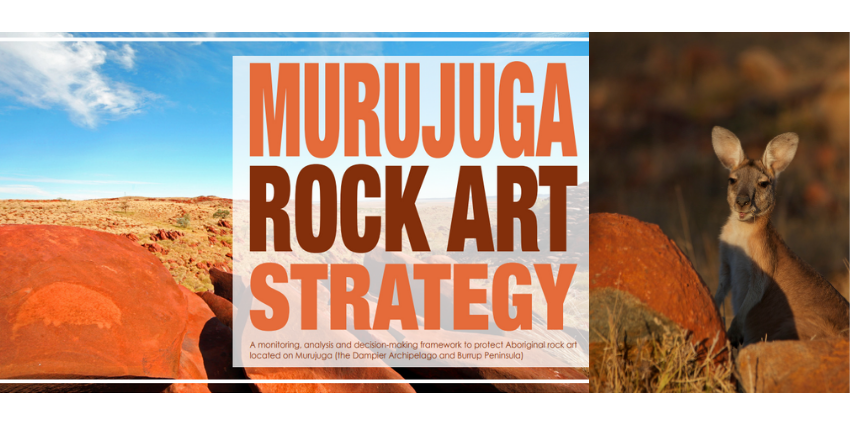
The Murujuga Rock Art Strategy provides a long-term framework to support the protection of Aboriginal rock art at Murujuga. The Strategy builds on previous work to guide monitoring, scientific analysis and management activities, with the aim of strengthening the understanding and protection of this landscape.
The Murujuga Rock Art Strategy is regularly reviewed to ensure it remains fit for purpose, reflects contemporary scientific knowledge and management practices and supports clear and effective governance arrangements for the ongoing protection of rock art.
Scope
Show moreThe Department has primary responsibility for the day-to-day implementation of the Strategy working in partnership with MAC. This includes collaboration with MAC to oversee the development and implementation of a world-leading monitoring and analysis program to assess whether the rock art on Murujuga is subject to accelerated change.
The scope of the Strategy is to:
- establish an environmental quality management framework, including the derivation, implementation and review of environmental quality criteria.
- develop and implement a robust monitoring and analysis program to assess whether physical or chemical change is occurring to the rock art at Murujuga over time.
- Identify, commission and coordinate scientific studies that support the monitoring and analysis program and inform effective management and protection of the rock art.
- establish and maintain governance arrangements that ensure:
- monitoring, analysis and reporting are undertaken in a transparent, scientifically rigorous and repeatable manner that provides confidence to Traditional Owners, the community, industry, scientists and other stakeholders in the integrity and reliability of the data and results; and
- government is provided with accurate, timely and appropriate advice and recommendations to support the protection of the rock art, consistent with legislative responsibilities
- develop and implement a communication strategy, in consultation with stakeholders to support the effective sharing of information about the monitoring program, findings and outcomes.
Monitoring program
Show moreMonitoring activities include air quality monitoring across Murujuga, repeated assessment of selected rock art panels and laboratory-based investigations to support interpretation of monitoring data. The program is overseen by the Department in partnership with MAC with input from independent scientific experts and peer review processes.
Key milestones and status
Show more| Year | Program key milestones and status |
|---|---|
| 2020–2021 |
|
| 2022 |
|
| 2023 |
|
| 2024–2025 |
|
| 2025–2026 |
|
| 2026–2030 |
|
| 2030 |
|
Stakeholder reference group
Show moreThe Murujuga Rock Art Stakeholder Reference Group is an advisory group that was established in September 2018. The group facilitates engagement between the Murujuga Aboriginal Corporation (MAC) and key government, industry and community representatives on the development and implementation of the strategy.
Professor Stephen van Leeuwen is the independent chair of the stakeholder reference group. Visit the document collection to read summaries of meetings and community forums.
The Terms of Reference are reviewed regularly in consultation with MAC and the Independent Chair to ensure the group remains effective in achieving its purpose.
To contact the stakeholder reference group, email murujugarockartsrg@dwer.wa.gov.au.
Previous monitoring
Show moreOver the past two decades, a range of scientific studies have investigated whether industrial emissions could affect Murujuga’s rock art. Early monitoring programs, including work undertaken by the Commonwealth Scientific and Industrial Research Organisation between 2004 and 2016, primarily focused on colour change and mineral characteristics of the rock surfaces.
Building on this earlier work, the Murujuga Rock Art Monitoring Program (MRAMP) was developed in response to independent reviews that identified the need for more comprehensive, scientifically robust and integrated monitoring to better inform long-term management. MRAMP is a partnership led by the Murujuga Aboriginal Corporation and the Department with scientific research undertaken by Curtin University.
Independent laboratory testing and expanded field datasets have informed the development and refinement of Murujuga-specific Interim Environmental Quality Criteria, which acts as early warning triggers to protect the rock art should potential risks be detected.
You can view previous monitoring reports in the document collection. Chapter 2 of the monitoring studies data collection and analysis plan includes an evaluation of previous studies and data.
