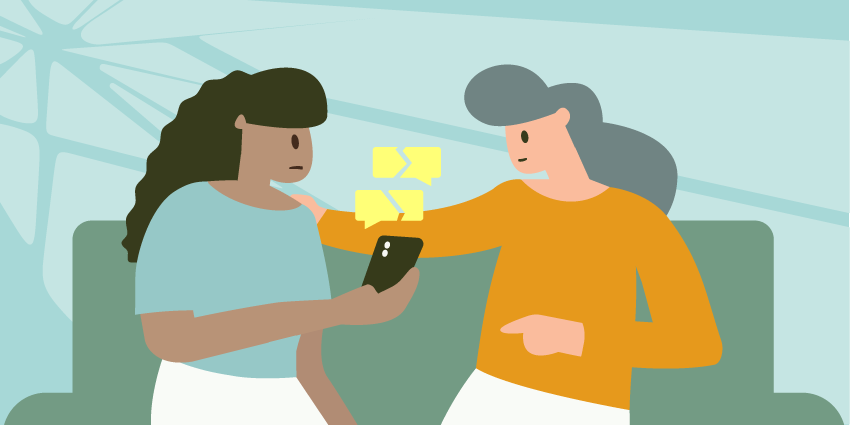
To find services or supports you are comfortable with, please visit the helplines and support services page – use a friend’s phone if you think yours is being monitored.
When someone at home makes you feel scared or hurts you, you might be going through family and domestic violence. It doesn’t have to be hitting and pushing. It can include making you or someone else in your family feel bad by:
- Yelling or swearing at them.
- Saying mean things to someone to hurt them.
- Threatening or bullying them.
- Controlling what they can and can’t do.
Seeing family and domestic violence can make you feel unsafe and helpless.
But remember that you’re not alone, and the violence is never your fault. Keep reading to find out what family and domestic violence can look like and what support services are here to help you.
What does family and domestic violence look like at home?
As a child or young person, you might experience family and domestic violence when:
- The violence or abuse is happening to you.
- You see it happening to someone else at home.
- You know it’s happening in your home, or to someone you care about, even if it only happens when you’re not there, or you don’t see it or hear it.
Family and domestic violence can happen in many different ways, and it doesn’t have to be physical. It can include:
- Seeing or hearing a parent or carer experience violence.
- Having to take extra care of your siblings or your parents or carers after violence has happened.
- Feeling scared of violence in your home.
- Not being looked after properly by your parents or carers.
- Experiencing violent behaviour and abuse yourself.
- Being asked to spy and report on other family member’s actions or movements.
- Threatening to take you away or harm you.
- Trying to make you choose sides and turn against one parent.
- Using visits or custody to keep control, even after separating.
Is it abuse if no one physically hurts me?
Yes - abuse is more than hitting and pushing. If you're feeling scared, uncomfortable or controlled at home, that can be abuse, even if no one physically hurts you. This is sometimes called coercive control, or emotional abuse.
Some examples can include:
- Seeing or hearing your parent or carer being hurt.
- Having to take extra care of your siblings or your parents or carers after violence has happened.
- Feeling scared of someone in your family, or someone who lives in your home.
- Not being looked after properly by your parents or carers.
- Being hurt, threatened or controlled.
- Being asked to spy and report on other family member's actions or movements.
- Being threatened with being taken away or hurt.
- Being made to take sides against one parent.
What does being unsafe at home feel like?
Family and domestic violence can make you feel overwhelmed, confused and scared at home. Everyone reacts in their own way, but here are some feelings or thoughts you might have if there’s violence at home:
- Feeling like it’s your fault that violence is happening.
- Feeling bad for not being able to stop the violence.
- Feeling scared of what might happen if you try to get help.
- Worrying that it could break up your family if you tell anyone.
- Feeling physically sick, tired or having stomach aches from the stress.
- Having a hard time focusing and learning in school.
- Noticing a lot of negative thoughts in your head.
- Feeling scared to talk to anyone outside of your family.
- Wanting to help and change things but not knowing how to help.
If you're feeling uncomfortable around family, that feeling matters - you deserve to feel safe at home.
Why is this happening - is it my fault?
No - feeling unsafe at home is never your fault. The person hurting you, or someone else in your family, is responsible for their own actions. If you're feeling scared at home, there are ways to get help.
What can I do if I don't feel safe at home?
If you, or someone you know, is in immediate danger, call the police now on 000.
If you are experiencing family and domestic violence here’s what you can do:
Tell someone you trust what's happening at home
Talking about what you’re experiencing can be difficult. When you’re ready to talk to someone, choose a person you trust. This can be:
- A relative.
- A friend.
- A friend's parent.
- A teacher at school.
- A school counsellor.
- A doctor or nurse.
Try not to worry about having the right words to explain everything. Talking to a trusted adult can be as simple as saying "I don't feel safe at home."
Get help from a support service
There are many free support services available to help you.
If you're not comfortable talking on the phone to someone, there are online chat services and mobile phone apps where you can message trained counsellors.
- Kids Helpline: provides free support and counselling (talking through problems) to people aged 5-25. Phone: 1800 551 800.
- Lifeline: provides support for those experiencing emotional distress with access to 24-hour crisis support and suicide prevention services. Phone: 13 11 14.
- headspace: provides mental health and wellbeing support for young adults aged between 12-25. Phone: 1800 650 890.
- 1800RESPECT: a national telephone and online counselling and referral service. Phone: 1800 737 732.
- 13 YARN: provides 24/7 support for Aboriginal and Torres Strait Islander people. Phone: 13 92 76.
- ReachOut: a 100% online, anonymous and confidential support service for young adults.
- Suicide Call Back: provides immediate telephone counselling and support in a crisis for people over 15 years old. Phone: 1300 659 467. Online chat is available 24/7.
Take some safety steps
If you are feeling unsafe at home, it isn't your job to fix it. It's important that you tell someone what is happening, whether that's a trusted adult or a support service. Here are some other safety steps you can try to take when dealing with family violence at home:
- Know your safe spaces and places you can go if you need to be away from the conflict, like a friend’s house or a trusted neighbour’s house.
- Have important emergency contacts ready, including phone numbers from trusted adults, emergency services and support hotlines.
- Plan an exit strategy and prepare a bag with essentials ready to go such as clothes and any medications you need. Keep it somewhere it won’t be found like somebody else’s house.
- Keep a phone handy and make sure it’s charged. You can use it to call for help if you feel unsafe.
- Don’t try to stop the violence if it’s between adults. You should focus on staying safe and getting support.
- Seek support services and reach out to organisations that offer help for young people. They can provide guidance to keep you safe. See below for a list of services available.
Find more information and resources
- BeyondNow: an app designed to help people feeling suicidal to create a safety plan they can access at any time.
- eSafety - young people: find useful information to help you stay safe online.
- eSafetykids: find useful information help you be an eSafe kid.