


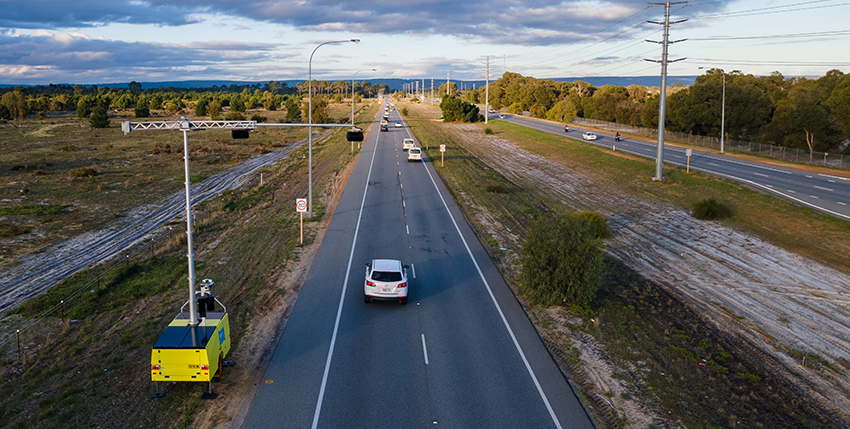
Too many Western Australians lose their lives or are seriously injured in crashes on our roads. The State Government is committed to reducing road trauma in WA. Safety cameras are a key part of helping us achieve that goal.
Safety cameras are an effective way to change behaviour. They can be placed anywhere, at any time. The risk of being caught is an effective way to motivate people to drive safer. It’s not about catching people out. It’s about preventing the behaviour in the first place.
Types of safety cameras
Safety camera trailers
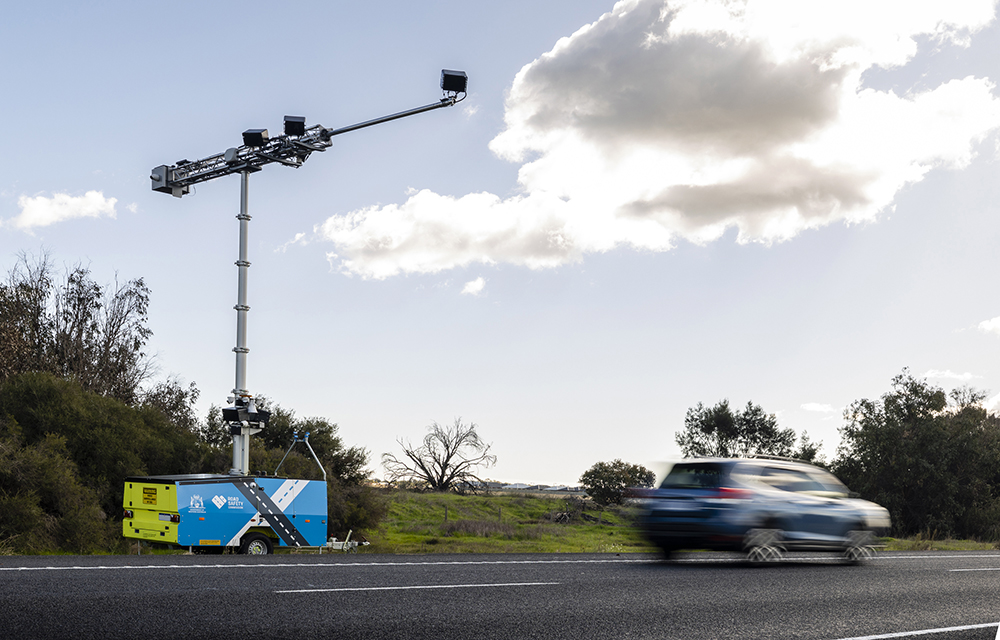
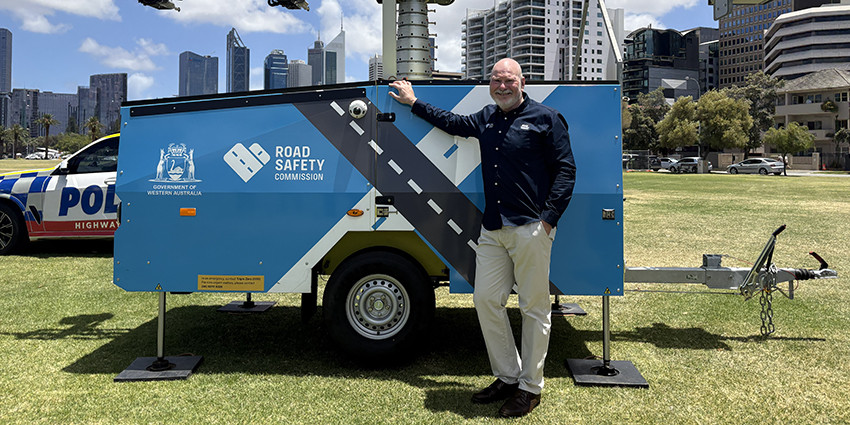
Safety cameras are mounted on large, bright yellow trailers with Road Safety Commission branding and can be moved to various locations across WA.
A fleet of eight safety camera trailers is currently in operation.
Fixed safety cameras
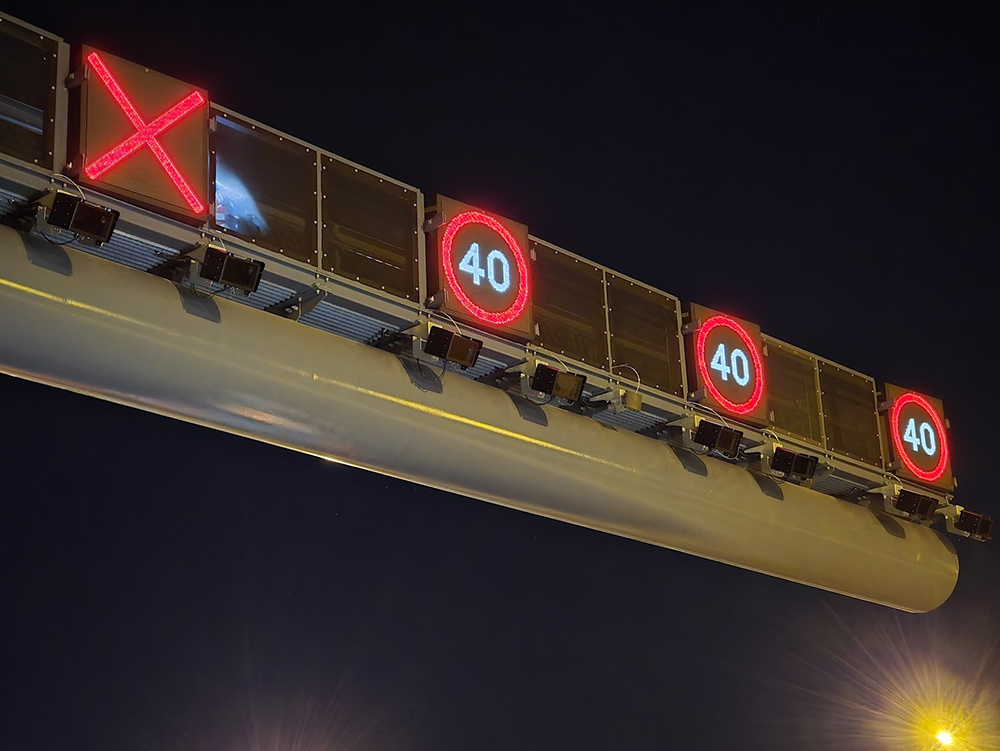
There are currently fixed safety cameras operating at two locations on the Kwinana Freeway at Gentilli Way (Salter Point) and Mill Point Road (South Perth) in the Perth metropolitan area.
From 1 June 2026, new fixed safety cameras will be in operation on the Mitchell Freeway at Vincent Street (Leederville).
The fixed safety cameras have the same capabilities as the safety camera trailers and operate in the same way. The only difference is they are stationary and cannot move to other locations.
Mitchell Freeway caution notice period
From 1 June 2026, there will be a six‑month caution notice period to educate drivers about the dangers of mobile phone use and incorrect seatbelt use. During this time, drivers detected by the new Mitchell Freeway safety cameras will receive a caution notice instead of a traffic infringement, giving them a chance to change their dangerous driving behaviour before penalties apply.
This caution notice period only applies to mobile phone and seatbelt offences detected by the Mitchell Freeway safety cameras. Speeding offences detected by these safety cameras will be issued with a traffic infringement from 1 June 2026 with no caution notice period.
All other safety cameras will continue to issue infringements for all offences as normal.
What the safety cameras detect
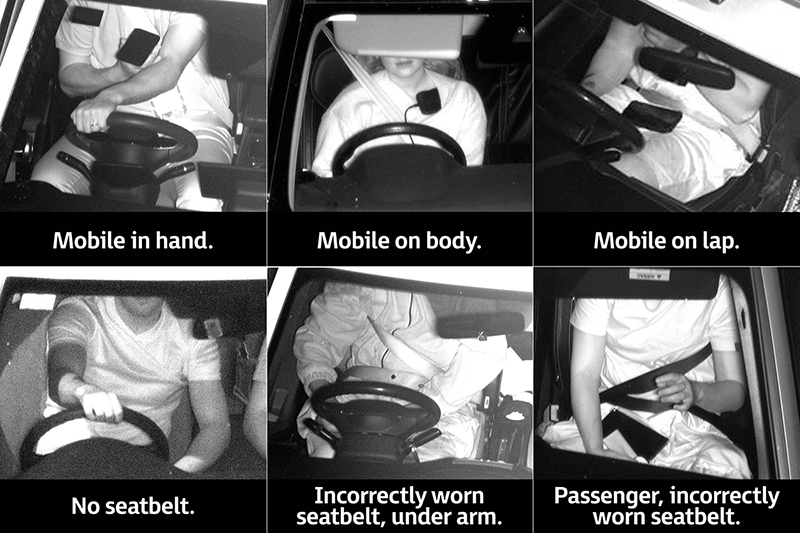
Safety cameras can detect multiple offences simultaneously. This includes:
- drivers and front seat passengers not wearing or incorrectly wearing a seatbelt;
- drivers using, holding or resting a mobile phone on their body while driving; and
- speeding.
Below are some examples of the types of offences the safety cameras detect.
For more information about offence penalties (including fines and demerits), please visit the following pages.
Safety camera FAQs
Show moreWhat are safety cameras?
A safety camera is a type of camera that is used to monitor and enforce traffic laws. Safety cameras can be fixed (stationary, unable to be moved) or mobile (able to be transported).
Why use safety cameras?
Some offences, like drink-and-drug driving or hoon behaviour, require active policing efforts.
Others, like speeding, mobile phone, and seatbelt violations, can be addressed through a combined effort of safety cameras and police enforcement to reduce high-risk behaviours on our roads.
How do safety cameras work?
Artificial Intelligence (AI) software reviews all safety camera images. If no suspected offence is detected, the image is automatically and permanently deleted.
When a potential offence is detected, the image is reviewed by at least two independent human adjudicators, before a decision is made to issue an infringement.
Strict data security measures apply, as with all WA traffic cameras.
Where are they located?
The safety camera trailers are deployed statewide to ensure a geographical spread of deterrence. The Road Safety Commission selects sites based on multiple criteria, including crash and speed data and information from the WA Police Force and Main Roads Western Australia.
Four safety camera trailers are based in Perth (metropolitan), two are based in Albany (Great Southern) and two are based in Geraldton (Mid West). They are rotated around these regions regularly.
Fixed safety cameras on the Kwinana Freeway are installed at Gentilli Way (Salter Point) and Mill Point Road (South Perth).
There are also fixed safety cameras on the Mitchell Freeway at Vincent Street (Leederville).
Why have safety cameras been introduced to regional areas?
Regional road fatalities remain high, with most serious crashes involving local drivers. In 2024, over 60% of road deaths occurred in regional areas, and we want this to change.
How do safety cameras improve safety?
We must continue working together to make every journey safe as a community. To save lives, we’re focusing on three key areas:
• Engineering • Education • Enforcement
When combined, these areas play an essential role in making our roads safer for everyone.
Safety cameras are an effective way to change behaviour. They can be placed anywhere, at any time. The risk of being caught is a strong motivator for people to drive safer. It’s not about catching people out. It’s about preventing the behaviour in the first place.
I wasn’t holding my phone; it was on my lap. Why did I receive an infringement?
It is illegal to hold your phone in your hand or have it resting on any part of your body, including your lap, while driving. This applies even when you are stopped in traffic or at traffic lights.
As a driver, to keep yourself and other road users safe your full attention is needed when driving. There is no reason for your phone to be in your hand or on your body while driving.
You can find out more about mobile phone offences here.
My seatbelt was buckled just tucked under my arm. Why did I receive an infringement?
It is an offence to not wear or incorrectly wear a seatbelt in Western Australia.
Further, drivers must ensure that passengers travelling in their vehicle are appropriately restrained.
Front seatbelts have been mandatory in WA for over 50 years, yet we sadly continue to see lives lost and impacted by their incorrect use.
You can find information about how to correctly wear a seatbelt here.
How long after an offence will an infringement be issued?
The Department of Transport and Major Infrastructure is responsible for traffic infringement notices and related customer service functions.
Every effort is made to ensure a traffic infringement notice is issued and delivered promptly to the recipient.
Information about managing, reviewing and paying a traffic infringement notice is available on the Department of Transport and Major Infrastructure’s website.
Why didn’t I receive a caution notice?
The current caution notice period only relates to seatbelt and mobile phone offences detected by new safety cameras on the Mitchell Freeway.
The previous caution notice period ended on 7 October 2025. From 8 October 2025, fines and demerit points have applied for mobile phone, seatbelt, and speeding offences detected by safety cameras.
Where does the money from fines go? What’s the money used for?
As with the speed and red-light safety camera programs, 100 per cent of funds from new safety camera infringements will go directly into the Road Trauma Trust Account.
Funds in the Road Trauma Trust Account are managed by the Road Safety Commission and are legislatively required to be spent on projects and programs which reduce injuries and deaths on Western Australian roads.
The Road Trauma Trust Account funds important road safety initiatives such as road safety education in schools, flashing lights in school zones, alcohol interlock assessment and treatment services and road safety infrastructure and improvements.
Visit the Road Trauma Trust Account page for more information.
How is my privacy protected?
The Road Safety Commission, the Department of Transport and Major Infrastructure and WA Police Force - the agencies responsible for the management and administration of safety camera programs and infringements - have strict obligations to ensure the personal information of WA road users is protected in accordance with statutory requirements.
Safety camera operating requirements ensure only the minimum amount of data required to detect and enforce offences is retained.
Where can I learn about the associated offences and penalties?
Mobile phone use: Any off-road glance lasting two seconds or longer is risky, irrespective of the nature of the task. The safest option is not to use your mobile phone at all while you're driving. Learn more about driver distraction and penalties associated with mobile phone offences on the mobile phones and distractions page.
Seatbelts: Over the past five years, 20% of people who died in a crash on WA roads were not wearing a seatbelt. Wearing a seatbelt is one of the easiest ways to protect drivers and passengers in a vehicle. Learn how to secure your seatbelt and the penalties associated with improper use on the seatbelts page.
Speeding: The faster you travel, the longer it takes to stop and the larger the risk of serious injury. Find out more about the impacts of speeding and the associated penalties on the speeding page.
Where can I find more information about the safety camera program?
The aim of the safety camera program is to increase road safety by utilising the latest technology to deter and detect unsafe driving.
The roll out of new safety camera technology is a key part of the State’s 10-year Road Safety Strategy, Driving Change.
More information about the program is available on the safety cameras page.
Safety camera resources
Show moreInformation and downloadable resources on safety cameras and related offences - mobile phones, seatbelts and speeding can be found here -> Safety camera resources
Traffic infringement notices
Show moreThe Department of Transport and Major Infrastructure is responsible for traffic infringement notices and related customer service functions.
Information about managing, reviewing and paying a traffic infringement notice is available on the Department of Transport and Major Infrastructure’s website.
Road Trauma Trust Account
Show moreAll funds from new safety camera infringements go directly into the Road Trauma Trust Account. These funds must be used for road safety initiatives.
Announcements
More safety cameras to come as part of $80 million investment targeting dangerous driving
Live now. Fines and demerit points apply for offences detected by new safety cameras

 Print this page
